Context
Recently, the world's second National Environmental Standards Laboratory (NESL) and the world's fifth National Primary Standards Facility for solar cell calibration was inaugurated at CSIR-National Physical Laboratory (CSIR-NPL).
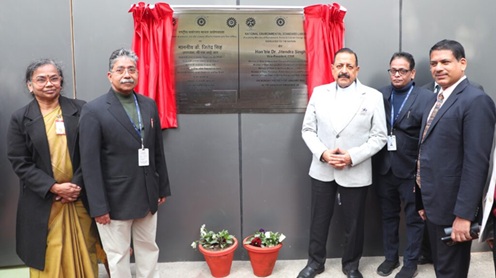
About the National Environmental Standards Laboratory
- The National Environmental Standards Laboratory is India's premier national facility, specializing in testing, calibration, and certification of air pollution monitoring instruments for Indian climatic and environmental conditions.
- Location: New Delhi, CSIR-NPL
- Affiliated Organization: Council of Scientific and Industrial Research (CSIR)
Objectives
- Ensuring the accuracy of air pollution monitoring instruments through specific standards
- Supporting the effective implementation of pollution control policies such as the National Clean Air Programme (NCAP)
Key Features
- Calibration and testing of instruments under Indian climatic conditions—temperature, humidity, and dust loads
- Ensuring the accuracy and standardization of environmental data
- Supporting domestic manufacturing, startups, small and medium enterprises (SMEs), and regulators
- Currently, only the UK and India have such a national-level facility.
About the National Primary Standards Facility for Solar Cell Calibration
- The National Primary Standards Facility is a state-of-the-art metrology facility for solar cell calibration.
- Its objective is to ensure accurate measurements in accordance with global photovoltaic (PV) standards to ensure reliable quality and performance of solar energy equipment in India and the world.
- Location: New Delhi, CSIR-NPL
Key Features
- Use of laser-based differential spectral response (L-DSR) system, which ensures highly accurate measurements.
- Developed in collaboration with the Physikalisch-Technische Bundesanstalt (PTB) of Germany
- Only the fifth such facility has been established in the world.
About CSIR
- The Council of Scientific and Industrial Research (CSIR) is a contemporary research and development organization known for its cutting-edge research and development knowledge base in diverse science and technology fields.
- CSIR It covers a wide range of science and technology fields – from oceanography, geophysics, chemistry, medicine, genomics, biotechnology and nanotechnology to mining, aeronautics, instrumentation, environmental engineering and information technology.
- It provides significant technological interventions in a range of areas related to societal endeavors, including environment, health, drinking water, food, housing, energy, agriculture and non-agriculture.






 Contact Us
  New Batch : 9555124124/ 7428085757
  Tech Support : 9555124124/ 7428085757