Why in news?
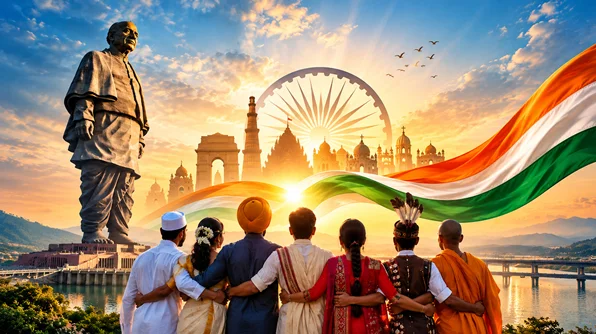
India will observe National Unity Day (Rashtriya Ekta Diwas) on 31 October 2026, marking the 151st birth anniversary of Sardar Vallabhbhai Patel, popularly known as the Iron Man of India.
Key Facts
|
Particular
|
Information
|
|
National Unity Day
|
31 October
|
|
Also known as
|
Rashtriya Ekta Diwas
|
|
First observed
|
2014
|
|
Commemorates
|
Birth anniversary of Sardar Vallabhbhai Patel
|
|
Birth year
|
1875
|
|
Birthplace
|
Nadiad, Gujarat
|
|
Popular title
|
Iron Man of India
|
|
First Deputy Prime Minister
|
Sardar Vallabhbhai Patel
|
|
First Home Minister
|
Sardar Vallabhbhai Patel
|
|
States integrated
|
More than 560 princely states
|
|
Statue of Unity height
|
182 metres
|
|
Statue inaugurated
|
31 October 2018
|
|
Statue location
|
Ekta Nagar, Gujarat
|
|
Associated initiative
|
Run for Unity
|
|
Ek Bharat Shreshtha Bharat
|
Announced in 2015
|
What is National Unity Day?
- The Government of India officially introduced this observance in 2014 to recognise Patel's historic contribution to bringing together hundreds of princely states and strengthening India's national unity.
- The day reminds citizens that India's strength lies in its diversity, democratic values, social harmony and collective commitment to national integrity.
Historical Background
- 2014: The Government of India announced 31 October as Rashtriya Ekta Diwas.
- 31 October 2014: The first National Unity Day was observed across the country.
- 2015: The initiative Ek Bharat Shreshtha Bharat was announced on the occasion of Rashtriya Ekta Diwas.
- 2018: The Statue of Unity was inaugurated on 31 October in Gujarat to commemorate Sardar Patel's contribution.
- 2025-2026: A two-year national commemoration of Patel's 150th birth anniversary, launched in October 2024, continues through 2026.
Sardar Vallabhbhai Patel: The Iron Man of India (1875-1950)
- Sardar Vallabhbhai Patel was one of the most influential leaders of India's freedom movement and a key architect of modern India's political integration.
- A lawyer by profession, Patel joined the national movement under the influence of Mahatma Gandhi.
- His leadership in peasant movements and his administrative abilities made him one of the most prominent leaders of the Indian National Congress.
- One of Sardar Patel's greatest achievements was the political integration of more than 560 princely states into the Indian Union after independence in 1947.
|
Movement/Event
|
Contribution
|
|
Kheda Satyagraha (1918)
|
Led the peasants' struggle against revenue collection during crop failure.
|
|
Bardoli Satyagraha (1928)
|
Led the farmers' movement against increased land revenue; earned the title 'Sardar'.
|
|
Civil Disobedience Movement (1930)
|
Participated in the national struggle against British rule.
|
|
Quit India Movement (1942)
|
Played an important role in mobilising support for the movement.
|
Why was integration necessary?
At the time of independence, British India consisted of two broad categories:
- British-administered provinces.
- Princely states ruled by Indian princes under British paramountcy.
- With the end of British paramountcy, princely states faced the question of accession to India or Pakistan, while the future political arrangement of some states remained uncertain.
- This created the possibility of political fragmentation and threatened the unity of the newly independent country.
How did Sardar Patel achieve integration?
Patel, as India's first Deputy Prime Minister and Home Minister, worked with V.P. Menon, Secretary of the States Department, to bring the princely states into the Indian Union.
|
Strategy
|
Explanation
|
|
Instrument of Accession
|
Provided the legal mechanism for princely states to accede to India.
|
|
Diplomatic negotiations
|
Persuaded rulers to join the Indian Union through dialogue and negotiations.
|
|
Standstill Agreements
|
Helped maintain existing administrative arrangements during the transition.
|
|
Administrative measures
|
Facilitated the merger and reorganisation of princely states.
|
|
Firm action where necessary
|
Used appropriate measures in complex cases such as Hyderabad.
|
Important cases of princely state integration
|
Princely State
|
Nature of integration
|
|
Junagadh
|
Integrated following a popular referendum in February 1948.
|
|
Hyderabad
|
Integrated through Operation Polo in September 1948.
|
|
Jammu and Kashmir
|
Acceded to India through the Instrument of Accession signed by Maharaja Hari Singh in October 1947.
|
|
Travancore
|
Joined the Indian Union through negotiations.
|
Major Initiatives and Symbols Associated with National Unity Day
- Statue of Unity
- Located at Ekta Nagar, Gujarat.
- Height: 182 metres.
- Inaugurated on 31 October 2018.
- Dedicated to Sardar Vallabhbhai Patel.
- It is the world's tallest statue.
- Run for Unity
- Organised across different parts of India.
- Encourages public participation, especially among youth.
- Promotes national integration and social harmony.
- Ek Bharat Shreshtha Bharat
- Announced on 31 October 2015.
- Promotes cultural exchange between states and Union Territories.
- Strengthens mutual understanding and national integration.
National Unity Day 2026: Major Celebrations
- Unity Parade: Participation of Central Armed Police Forces and state police contingents.
- Cultural performances: More than 900 artists showcasing India's cultural diversity.
- Run for Unity: Public participation to promote national solidarity.
- Unity Pledge: Citizens reaffirm their commitment to national unity, integrity and security.
- Youth participation: Activities and programmes through schools, colleges and youth organisations.
Significance
- National integration: Promotes unity among different regions, communities and cultures.
- Territorial integrity: Reminds citizens of the importance of protecting India's sovereignty.
- Social harmony: Encourages mutual respect and peaceful coexistence.
- Cooperative federalism: Strengthens cooperation between the Centre and states.
- Youth participation: Encourages young citizens to contribute towards nation-building.
Challenges to National Unity in India
- Communalism: Religious polarisation can weaken social harmony.
- Regionalism: Regional divisions and competing interests may create tensions.
- Caste-based discrimination: Social inequalities undermine fraternity and equality.
- Linguistic differences: Language-related disputes can sometimes create inter-state tensions.
- Extremism and insurgency: Violent movements threaten internal security and territorial integrity.
Prelims MCQ
Q. National Unity Day is observed every year on which date?
A. 2 October
B. 31 October
C. 14 November
D. 26 November
Mains Practice Questions
Q. Discuss Sardar Vallabhbhai Patel's contribution to the political integration of India after independence.
|
FAQs
When is National Unity Day celebrated?
Every year on 31 October.
Why is Rashtriya Ekta Diwas celebrated?
To commemorate Sardar Vallabhbhai Patel's birth anniversary and his contribution to national integration.
When National Unity Day was first observed?
2014.
Where is the Statue of Unity located?
Ekta Nagar, Gujarat.
What is the height of the Statue of Unity?
182 metres.
|