
- UPSC Exam
- State PCS
- One Day Exam
- Current Affairs
- PT Quiz
- Downlaods
- About Coaching
- Blog
- Videos

| Prelims: (Defence & Security + CA) Mains: (GS 3 – Defence, Security, Strategic Technologies, Indigenous R&D) |
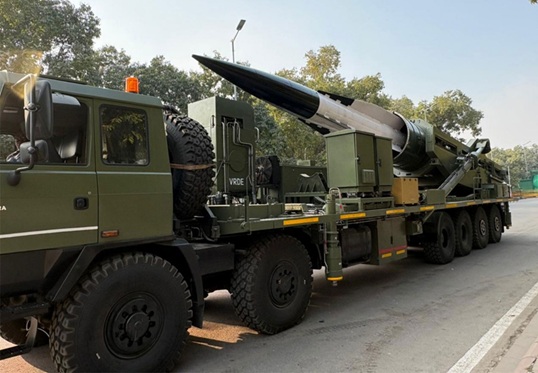
At the 77th Republic Day Parade on Kartavya Path, the Defence Research and Development Organisation (DRDO) unveiled the Long Range Anti-Ship Hypersonic Missile (LR-AShM) for the first time.
This has drawn attention to India’s expanding portfolio of hypersonic missile programmes, signalling a growing emphasis on next-generation strategic and tactical weaponry, particularly for maritime dominance and deterrence.
Hypersonic weapons—defined as systems travelling at speeds exceeding Mach 5—represent a transformative shift in modern warfare due to their:
Globally, only a few countries, including the United States, Russia, and China, have operational or near-operational hypersonic systems. India’s entry into this domain reflects its ambition to enhance credible deterrence, protect maritime interests, and strengthen indigenous defence capabilities.
The DRDO showcased the Long Range Anti-Ship Hypersonic Missile (LR-AShM) along with its launcher. The system is tailored to meet the Indian Navy’s coastal battery requirements and can engage both static and moving targets at ranges of up to 1,500 km, carrying multiple payload options.
The LR-AShM follows a quasi-ballistic trajectory, beginning like a ballistic missile but flying at lower altitudes and manoeuvring mid-course.
The missile uses a two-stage solid rocket motor:
At hypersonic speeds, the missile can cover a 1,500 km range in about 15 minutes, leaving minimal time for detection, tracking, and interception.
Extended-range variants of up to 3,500 km are already under development, which could significantly enhance India’s strategic reach and deterrence posture.
The missile can neutralise all classes of warships, including aircraft carriers, destroyers, and submarines operating near the surface. Current and future variants are expected to become a critical asset for sea denial operations, particularly in the strategically vital Indian Ocean Region (IOR), limiting adversaries’ military and commercial use of maritime spaces.
Beyond the Navy’s coastal batteries:
This multi-platform adaptability could firmly place India among a small group of nations with comprehensive hypersonic weapons capability.
The LR-AShM draws on key technologies from India’s existing missile programmes, including:
This reflects a convergence of proven propulsion, guidance, and control systems into a next-generation hypersonic platform.
Amid intense global competition, the DRDO is pursuing two parallel hypersonic paths:
The LR-AShM represents the glide vehicle track, showcasing major indigenous advances in materials science, thermal protection, and control systems for sustained hypersonic flight.
Earlier this month, DRDO achieved a major milestone by conducting ground tests of an Actively Cooled Scramjet Full-Scale Combustor, recording a run time of over 12 minutes.
This built on a successful subscale test conducted on April 25 last year, which ran for more than 1,000 seconds. DRDO had earlier demonstrated hypersonic air-breathing scramjet technology with the Hypersonic Technology Demonstration Vehicle (HSTDV) flight test in September 2020 from Dr APJ Abdul Kalam Launch Complex, marking a foundational step toward operational hypersonic cruise missiles.
FAQs1. What makes LR-AShM different from conventional missiles ? It combines hypersonic speed, high manoeuvrability, and low-altitude flight, making it extremely difficult to detect and intercept compared to conventional ballistic or cruise missiles. 2. What is a hypersonic glide vehicle (HGV) ? An HGV is launched by a rocket to high altitude and then glides unpowered through the atmosphere at speeds exceeding Mach 5, manoeuvring toward its target. 3. How does LR-AShM enhance India’s naval power ? It significantly boosts sea denial capabilities by enabling India to strike high-value naval targets at long ranges with minimal warning. 4. What is the difference between ramjets and scramjets ? Ramjets operate best at supersonic speeds but not hypersonic, while scramjets allow sustained powered flight at hypersonic speeds by maintaining supersonic airflow in the combustion chamber. 5. Why are hypersonic weapons strategically important ? They compress decision-making time, evade missile defences, and enhance deterrence by increasing the credibility of rapid and precise strike capabilities. |



Our support team will be happy to assist you!

 Contact Us
  New Batch : 9555124124/ 7428085757
  Tech Support : 9555124124/ 7428085757