Why in the News ?
Indian scientists have achieved a significant milestone in the field of biodiversity by discovering a new species of wasp. This new species, named Spilomena malabarica, was found in the Kozhikode district of Kerala. This discovery not only highlights India's rich biodiversity but also strengthens the potential for biological pest control in agriculture.
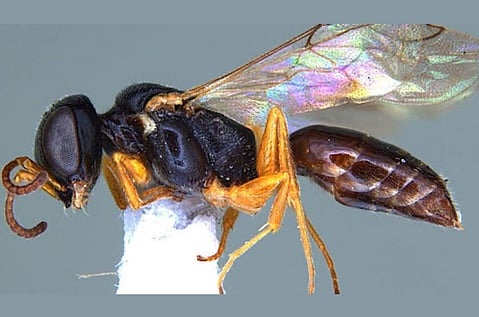
Significant achievement by Indian scientists
- This new species has been identified by scientists from the Zoological Survey of India (ZSI).
- During their research, scientists obtained a specimen of this rare insect in a special yellow pan trap.
- Later, its structure was studied in detail using modern microscopes and 3-D imaging technology.
Extremely Small but Special Wasp
- Spilomena malabarica is extremely small in size. Its length is approximately 3.5 millimeters and its body is black and brown.
- It is difficult to identify it with the naked eye, so scientists conducted a thorough study of its microscopic anatomy.
- Scientists found that its forewings have only one submarginal cell, which distinguishes it from other related species. This unique wing structure is a key basis for its identification.
Why is it important for agriculture ?
- This wasp preys on small plant-damaging insects such as aphids.
- Aphids are known to cause significant damage to agricultural crops, horticultural plants, and other vegetation.
- In such a situation, this new species can help in naturally controlling the number of these pests.
- Experts believe that in the future, it can be used in the field of biological pest control, which can reduce dependence on chemical pesticides.
How is it different from other species ?
- Researchers have found that this species shares some similarities with its closest relative, Spilomena unus, but significant differences have been found in its head and facial structure.
- Its head is relatively shorter.
- The ratio between the eyes and the crown is different.
- The clypeus is relatively flatter.
- These features distinguish it from other known species.
Named in honor of the Malabar region
-
The new species is named 'malabarica' in honor of the historic Malabar region of Kerala, where the specimen was discovered. According to scientists, naming new species is an important way to honor local geographical and natural heritage.
New Scientific Questions Raised in Taxonomy
- This discovery has also presented a new challenge for scientists.
- Spilomena malabarica has been found to possess characteristics that blur the boundaries between two distinct groups of wasps.
- This suggests that the current classification system may require revision in the future.
- Researchers believe that DNA analysis and detailed life cycle studies will better understand the evolution and classification of this species.
Important Step Toward Biodiversity Conservation
According to experts, this discovery is proof that many species still exist in India's forests and natural ecosystems that remain to be identified. This discovery of a tiny insect not only enriches the country's biodiversity but also advances scientific understanding related to ecological balance, biological evolution and conservation of natural resources.






 Contact Us
  New Batch : 9555124124/ 7428085757
  Tech Support : 9555124124/ 7428085757