|
Prelims: India-New Zealand FTA, Free Trade Agreement, Tariff Reduction, Duty-Free Trade, Bilateral Trade, Market Access, Investment, MFN, Non-Tariff Barriers, Ratification, Trade Liberalisation.
Mains: GS Paper II - International Relations, GS Paper III - Indian Economy
Keywords: India-New Zealand FTA, Free Trade Agreement, India-New Zealand Trade, Tariff Reduction, Bilateral Trade, International Trade, Foreign Investment, Most-Favoured-Nation, Trade Liberalisation
|
Why in News?
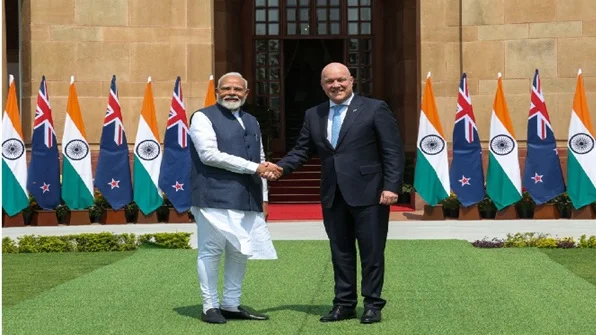
- New Zealand’s Parliament on 16 September 2026 passed legislation to implement the Free Trade Agreement (FTA) with India. The legislation was approved by 93 votes to 29, with support from the opposition Labour Party.
- Under the agreement, tariffs on around 95% of New Zealand’s exports to India will be eliminated or significantly reduced.
Important points
- Around 57% of New Zealand’s exports to India will become duty-free from the day the agreement comes into effect.
- After full implementation, tariffs on nearly 95% of New Zealand exports to India will be eliminated or significantly reduced.
- The agreement will provide duty-free access to New Zealand for all Indian goods.
- New Zealand has agreed to invest $20 billion in India over the next 15 years.
- The agreement is expected to improve market access for products such as food, fibre, technology, education, tourism and professional services.
- New Zealand’s kiwifruit industry expects to save around $125 million in tariffs over five years.
India-New Zealand Trade Relations
- India and New Zealand originally signed the trade agreement in April 2026. Negotiations for the FTA were announced in March 2025.
- The agreement aims to increase trade and investment between the two countries and provide businesses with better access to each other’s markets.
- In the year ending June 2026, two-way trade between India and New Zealand stood at around NZ$3.99 billion. India was New Zealand’s ninth-largest goods and services export market.
What Will the Agreement Provide?
- The FTA will reduce or remove tariffs on a large number of products traded between the two countries. This can lower the cost of exports and make it easier for businesses to enter each other’s markets.
- The agreement also includes provisions related to faster border clearance and preferential access in selected sectors.
- It includes Most-Favoured-Nation (MFN) commitments for wine and some key services sectors.
Significance
India
- The agreement can provide Indian exporters with greater access to the New Zealand market. It may create opportunities in areas such as:
- Agriculture and food products
- Textiles and other manufactured goods
- Technology and professional services
- Education
- Tourism
- The investment commitment by New Zealand could also support greater economic cooperation between the two countries.
New Zealand
- New Zealand exporters are expected to benefit from lower tariffs and improved access to India’s large and growing consumer market.
- The kiwifruit sector is one of the major expected beneficiaries, with the industry estimating significant savings in tariff payments.
Target for Bilateral Trade
- India and New Zealand have set a goal of doubling two-way trade by 2030.
- The FTA is intended to support this objective by reducing trade barriers, improving market access and encouraging investment.
When Will the FTA Come into Effect?
- The agreement will become effective after India and New Zealand complete their respective ratification procedures.
- Following the completion of these procedures, the tariff reductions and other provisions of the agreement will be implemented according to the agreed schedule.
Strengthening Bilateral Relations
- The agreement can strengthen economic ties between India and New Zealand by promoting trade, investment and services. It can also support greater private-sector cooperation between the two countries.
Background: India-New Zealand Relations
- India and New Zealand share historical, cultural, educational and economic ties. Diplomatic relations were established in 1952.
- Both countries cooperate in areas such as trade, education, agriculture, technology, tourism and people-to-people relations. New Zealand is also home to a significant Indian-origin community.
- In recent years, bilateral relations have expanded through high-level visits, trade negotiations and cooperation in the Indo-Pacific region. The India-New Zealand Free Trade Agreement (FTA) is aimed at further strengthening economic and trade relations between the two countries.
Challenges
- Differences in the size and structure of the two economies may affect the distribution of benefits.
- Domestic producers may face greater competition due to increased market access.
- Non-tariff barriers, including standards and regulatory requirements, may continue to affect trade.
- Small and medium enterprises may face difficulties in meeting foreign market standards.
- Ensuring that the benefits of the agreement reach a wider range of exporters could be challenging.
- The FTA will become operational only after both countries complete their respective ratification procedures.
Way Forward
- Ensure effective and timely implementation of the FTA.
- Provide exporters, particularly MSMEs, with information about market opportunities and regulatory requirements.
- Strengthen regulatory cooperation to reduce non-tariff barriers.
- Promote sector-specific cooperation in agriculture, food processing, technology, education and tourism.
- Facilitate the implementation of New Zealand’s investment commitments in India.
- Regularly review progress towards the target of doubling bilateral trade by 2030.
Conclusion
The India-New Zealand Free Trade Agreement is aimed at reducing trade barriers and expanding economic cooperation between the two countries. With most New Zealand exports expected to receive lower or zero tariffs in India and all Indian goods receiving duty-free access to New Zealand, the agreement could provide new opportunities for exporters, investors and service providers in both countries.
Prelims Practice Question
Q. Consider the following statements regarding the India-New Zealand Free Trade Agreement:
- Tariffs on around 95% of New Zealand exports to India will be eliminated or significantly reduced.
- All Indian goods will receive duty-free access to New Zealand.
- New Zealand has committed to investing $20 billion in India over the next 15 years.
Which of the statements given above are correct?
(a) 1 and 2 only
(b) 2 and 3 only
(c) 1 and 3 only
(d) 1, 2 and 3
Mains Practice Question
Q. The India-New Zealand Free Trade Agreement can deepen economic cooperation between the two countries. Discuss its potential benefits for India and examine the challenges associated with its implementation.
|
FAQs
1. What is the India-New Zealand Free Trade Agreement?
The India-New Zealand FTA is a trade agreement aimed at reducing tariffs and other trade barriers and improving market access between the two countries.
2. What is the major feature of the FTA?
Around 95% of New Zealand’s exports to India will receive tariff elimination or significant tariff reductions, while all Indian goods will receive duty-free access to New Zealand.
3. How much will New Zealand invest in India?
New Zealand has committed to investing $20 billion in India over the next 15 years.
4. When will the FTA come into effect?
The FTA will come into effect after both India and New Zealand complete their respective ratification procedures.
5. What was the bilateral trade between India and New Zealand?
Two-way trade stood at approximately NZ$3.99 billion in the year ending June 2026.
|






 Contact Us
  New Batch : 9555124124/ 7428085757
  Tech Support : 9555124124/ 7428085757