Why in news?
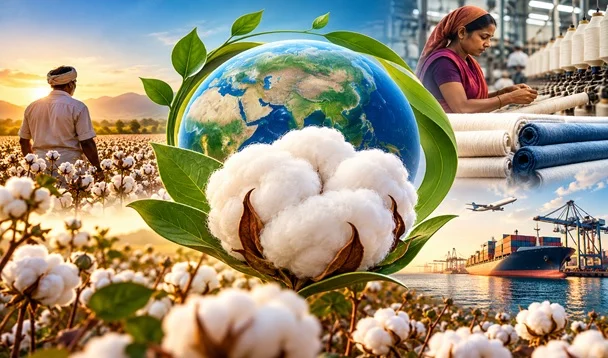
World Cotton Day is observed every year on 7 October to highlight cotton’s importance for farmers, workers, the textile industry, international trade and sustainable development.
Key Facts
|
Particular
|
Details
|
|
Observed on
|
7 October
|
|
First World Cotton Day
|
7 October 2019
|
|
First celebration venue
|
WTO Headquarters, Geneva
|
|
UN recognition
|
2021
|
|
UN Resolution
|
A/RES/75/318
|
|
2026 International Event
|
Tashkent, Uzbekistan
|
|
2026 Theme
|
Cotton for Good: Building Prosperity Through Trade, Transformation and Partnership
|
World’s Cotton Production
- Cotton is cultivated across more than 75 countries. The leading cotton-producing countries include China, India, Brazil, United States and Pakistan. These five countries account for more than three-fourths of global cotton production.
- In 2024, global cotton production was estimated at approximately 26 million tonnes, while more than 9 million tonnes entered international trade.
- For the 2026–27 season, the International Cotton Advisory Committee (ICAC) projected:
|
World production
|
25.9 million tonnes
|
|
World consumption
|
25.2 million tonnes
|
|
Global trade
|
around 9.6 million tonnes
|
|
Ending stocks
|
nearly 18 million tonnes
|
India and Cotton: The “White Gold”
- Cotton is popularly known as “White Gold” because of its high economic importance. India is the only country cultivating all four recognised cultivated cotton species.
- India occupies a distinctive position in the global cotton economy. It has the world’s largest area under cotton cultivation and ranks among the world's leading cotton producers and consumers.
Four Cultivated Cotton Species
|
Species
|
Common classification
|
|
Gossypium arboreum
|
Asian/Desi cotton
|
|
Gossypium herbaceum
|
Asian/Desi cotton
|
|
Gossypium hirsutum
|
American/Upland cotton
|
|
Gossypium barbadense
|
Egyptian/Extra-long staple cotton
|
India’s Cotton Production
- According to the Ministry of Textiles, India's cotton production in 2025–26 was provisionally estimated at 290.91 lakh bales, with each bale weighing 170 kg.
- The area under cotton cultivation stood at approximately 114.82 lakh hectares, while productivity was around 431 kg per hectare.
|
Indicator
|
2025–26
|
|
Area
|
114.82 lakh hectares
|
|
Production
|
290.91 lakh bales
|
|
Productivity
|
431 kg/hectare
|
|
Standard Indian cotton bale
|
170 kg
|
Major Cotton-Producing States in India
- Cotton is predominantly grown in the Deccan Plateau, central India and north-western plains.
- Important cotton-producing states include Gujarat, Maharashtra, Telangana, Rajasthan, Karnataka, Madhya Pradesh, Andhra Pradesh, Haryana and Punjab.
- Cotton requires a warm climate, adequate sunshine and a relatively long frost-free period. Black soil or Regur soil is particularly suitable for cotton because of its high moisture-retaining capacity.
Why is Cotton important?
- Cotton is one of the world’s most important natural fibres and supports a vast global value chain extending from farms to ginning to spinning to weaving to garments to international trade.
- According to FAO, cotton sustains about 24 million growers and benefits more than 100 million families worldwide. Women constitute an estimated 43% of the labour force in cotton production, particularly playing important roles in planting and harvesting.
- Cotton therefore contributes to rural livelihoods, employment, textile manufacturing, international trade, export earnings and poverty reduction.
Economic Importance for India
- Cotton connects two major sectors of the Indian economy Agriculture and Textile Industry.
- Millions of farmers depend directly or indirectly on cotton cultivation, while the cotton textile value chain supports employment in ginning, spinning, weaving, processing, garment manufacturing and exports.
- India also has a significant international trade footprint. According to the Ministry of Textiles, India exported an estimated 18 lakh bales of cotton in 2024–25.
Mission for Cotton Productivity (Kapas Kanti)
- A major recent development is the government's five-year Mission for Cotton Productivity (Kapas Kanti) covering 2026-27 to 2030-31.
- The mission has an approved outlay of approximately ₹5,659.22 crore.
- Its broad focus includes higher productivity, better cotton quality, climate resilience, pest resistance, high-yielding varieties and extra-long staple cotton.
- The initiative seeks to address one of India's major cotton-sector challenge relatively low productivity despite having a very large area under cultivation.
Minimum Support Price and Cotton Farmers
- The Government announces a Minimum Support Price (MSP) for cotton to protect farmers against sharp falls in market prices.
- The Cotton Corporation of India (CCI) undertakes MSP procurement when market prices fall below the prescribed support price.
- CCI therefore acts as an important institutional mechanism for Price support, Prevention of distress sale, Farmer protection and Cotton market stability.
Challenges Facing the Cotton Sector
- Climate Change: Irregular rainfall, droughts, extreme temperatures and changing weather patterns can reduce cotton productivity.
- Pest Attacks: Cotton cultivation remains vulnerable to pests such as the pink bollworm, increasing production risks and pesticide dependence.
- Low Productivity: India has a very large cotton cultivation area, but increasing yield per hectare remains a major policy priority.
- Water Stress: Cotton cultivation can create water-management concerns, particularly where irrigation practices are inefficient.
- Price Volatility: Cotton prices are influenced by domestic production, international prices, global demand and competition from synthetic fibres.
- Competition from Synthetic Fibres: Cotton's share of global fibre consumption has declined significantly over the decades as synthetic fibres expanded rapidly. FAO notes that cotton's share fell from around 60% in the 1960s to about 22% in 2024.
Significance of World Cotton Day
- Promote sustainable cotton production
- Recognise the contribution of cotton farmers and workers
- Encourage value addition in developing countries
- Strengthen international cooperation and improve opportunities for small farmers
- Promote innovation across the cotton value chain.
- It also draws attention to the importance of an open, fair, predictable and transparent international trading system for cotton-producing developing countries.
Prelims MCQ
Q. With reference to cotton cultivation in India, consider the following statements:
- India cultivates all four recognised cultivated species of cotton.
- Black soil is particularly suitable for cotton cultivation because of its moisture-retention capacity.
- Cotton Corporation of India undertakes MSP operations for cotton.
Which of the statements given above are correct?
(a) 1 and 2 only
(b) 2 and 3 only
(c) 1 and 3 only
(d) 1, 2 and 3
Mains Practice Question
Q. Discuss the major challenges facing India’s cotton sector.
|
FAQs
When is World Cotton Day observed?
7 October every year.
When World Cotton Day was first celebrated?
7 October 2019.
When did the UN recognise World Cotton Day?
2021.
Where will the 2026 international event be held?
Tashkent, Uzbekistan.
What is cotton popularly called?
White Gold.
|






 Contact Us
  New Batch : 9555124124/ 7428085757
  Tech Support : 9555124124/ 7428085757