New
GS Foundation (P+M) - Delhi : 19th Jan. 2026, 11:30 AM Republic Day offer UPTO 75% + 10% Off, Valid Till : 28th Jan., 2026 GS Foundation (P+M) - Prayagraj : 09th Jan. 2026, 11:00 AM Republic Day offer UPTO 75% + 10% Off, Valid Till : 28th Jan., 2026 GS Foundation (P+M) - Delhi : 19th Jan. 2026, 11:30 AM GS Foundation (P+M) - Prayagraj : 09th Jan. 2026, 11:00 AM

onomic Survey 2025–26: Sustaining High Growth Amid Global Fragmentation

Prelims: (Economy + CA)
Mains: (GS 3 – Indian Economy, Fiscal Policy, Infrastructure, Inclusive Growth)

Why in News ?

The Union Minister for Finance and Corporate Affairs, Smt. Nirmala Sitharaman, tabled the Economic Survey 2025–26 in Parliament on 29 January 2026. The Survey presents a comprehensive assessment of India’s macroeconomic performance, sectoral trends, structural reforms, and future outlook.
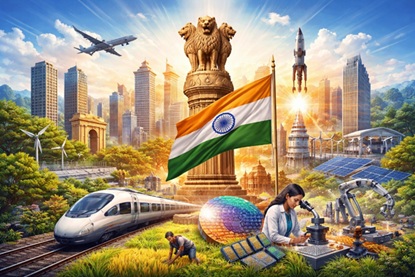
State of the Economy: Growth with Resilience

  • Growth Projections:
    • First Advance Estimates project real GDP growth at 7.4% and GVA growth at 7.3% in FY26.
    • Potential growth for India is estimated at around 7%, while FY27 growth is projected at 6.8–7.2%.
  • Demand-Side Trends:
    • Private Final Consumption Expenditure (PFCE) grew by 7.0% in FY26, reaching 61.5% of GDP, the highest since 2012.
    • Growth supported by low inflation, stable employment, and rising real purchasing power.
    • Strong agricultural performance boosted rural demand, while urban consumption improved due to tax rationalisation.
  • Investment Activity:
    • Gross Fixed Capital Formation (GFCF) grew by 7.8% and remained at 30% of GDP, driven by public capex and revival in private investment.
  • Supply-Side Performance:
    • Services sector remains the main growth driver, with GVA growth of 9.3% in H1 FY26 and 9.1% estimated for the full year.

Fiscal Developments: Anchoring Stability Through Credible Consolidation

  • Revenue Performance:
    • Centre’s revenue receipts rose to 9.2% of GDP in FY25 (PA), up from 8.5% in FY16–FY20.
    • Non-corporate tax collections increased from 2.4% of GDP pre-pandemic to 3.3% post-pandemic.
  • Tax Base Expansion:
    • Income tax return filings increased from 6.9 crore in FY22 to 9.2 crore in FY25, reflecting improved compliance and digital administration.
  • GST Collections:
    • Gross GST collections during April–December 2025 stood at ₹17.4 lakh crore, growing 6.7% YoY.
    • E-way bill volumes rose 21% YoY, indicating robust transaction activity.
  • Capital Expenditure:
    • Effective central government capex rose to 4% of GDP in FY25, from 2.7% pre-pandemic.
    • Under Special Assistance to States for Capital Expenditure (SASCI), states maintained capex at around 2.4% of GDP.
  • Debt and Deficit:
    • Combined state fiscal deficit edged up to 3.2% of GDP in FY25.
    • India reduced its general government debt-to-GDP ratio by 7.1 percentage points since 2020, while sustaining high public investment.

Monetary Management and Financial Intermediation

Banking Sector Performance

  • Asset Quality:
    • Gross Non-Performing Assets (GNPAs) reached a multi-decadal low of 2.2% in September 2025.
    • Net NPA ratio stood at 0.5%, a record low.
  • Credit Growth:
    • Outstanding credit grew 14.5% YoY as of December 2025, compared to 11.2% in December 2024.

Financial Inclusion

  • PM Jan Dhan Yojana (PMJDY):
    • 55.02 crore bank accounts opened as of March 2025, with 36.63 crore in rural and semi-urban areas.
  • Key Schemes:
    • Stand-Up India: Loans of ₹10 lakh–₹1 crore for SC, ST, and women entrepreneurs.
    • PM SVANidhi: Collateral-free loans to street vendors.
    • PM Mudra Yojana: Over ₹36.18 lakh crore disbursed across 55.45 crore loan accounts by October 2025.

Capital Markets and Financial Ecosystem

  • Investor Base:
    • Demat accounts crossed 21.6 crore, with 12 crore unique investors by September 2025—nearly 25% women.
    • Mutual fund industry reached 5.9 crore unique investors, with strong participation from non-tier-I and tier-II cities.
  • International Validation:
    • IMF–World Bank FSAP 2025 highlighted India’s resilient and diversified financial system, with total financial sector assets at 187% of GDP (CY 2024).

External Sector: Playing the Long Game

  • Trade Performance:
    • India’s share of global merchandise exports nearly doubled from 1% (2005) to 1.8% (2024).
    • Share of global services exports rose from 2% to 4.3% over the same period.
  • Exports and Remittances:
    • Total exports reached USD 825.3 billion in FY25, growing 6.1% YoY.
    • Services exports hit an all-time high of USD 387.6 billion, growing 13.6%.
    • India remained the world’s largest recipient of remittances, with inflows of USD 135.4 billion in FY25.
  • Current Account and Reserves:
    • Current Account Deficit (CAD) remained moderate at around 1.3% of GDP in Q2 FY26.
    • Foreign exchange reserves rose to USD 701.4 billion (16 January 2026), covering 11 months of imports and 94% of external debt.
  • FDI Inflows:
    • Gross FDI inflows reached USD 64.7 billion during April–November 2025.
    • India ranked fourth globally in Greenfield investment announcements in 2024 and emerged as the largest destination for Greenfield digital investments (2020–24).

Inflation: Tamed and Anchored

  • Headline Inflation:
    • Average CPI inflation during April–December 2025 stood at 1.7%, the lowest since the CPI series began.
    • Decline driven by moderation in food and fuel prices, which together account for 52.7% of the CPI basket.
  • Global Comparison:
    • India recorded one of the sharpest declines in inflation among EMDEs, with a reduction of 1.8 percentage points in 2025 over 2024.

Agriculture and Food Management

  • Production Trends:
    • Foodgrain production reached 3,577.3 lakh metric tonnes (LMT) in AY 2024–25, an increase of 254.3 LMT over the previous year.
    • Growth driven by rice, wheat, maize, and coarse cereals (Shree Anna).
  • Diversification:
    • Horticulture, accounting for 33% of agricultural GVA, reached 362.08 million tonnes, surpassing foodgrain output.
  • Marketing and Infrastructure:
    • e-NAM onboarded 1.79 crore farmers, 2.72 crore traders, and 4,698 FPOs, covering 1,522 mandis across 23 states and 4 UTs.
    • Agriculture Infrastructure Fund (AIF) and ISAM strengthened farm-gate facilities.
  • Income Support:
    • Over ₹4.09 lakh crore released under PM-KISAN since inception.
    • PM Kisan Maandhan Yojana (PMKMY) enrolled 24.92 lakh farmers as of December 2025.

Services: From Stability to New Frontiers

  • Contribution to GDP:
    • Services’ share in GDP rose to 53.6% in H1 FY26; GVA share reached 56.4%, the highest ever.
  • Global Position:
    • India is the world’s seventh-largest exporter of services, with its global share rising to 4.3%.
  • FDI Magnet:
    • Services accounted for 80.2% of total FDI during FY23–FY25.

Industry’s Next Leap: Structural Transformation and Global Integration

  • Industrial Growth:
    • Industry GVA grew 7.0% in H1 FY26.
  • Manufacturing Revival:
    • Manufacturing GVA grew 7.72% in Q1 and 9.13% in Q2 FY26, reflecting structural recovery.
  • PLI Schemes:
    • Across 14 sectors, PLI attracted over ₹2.0 lakh crore of actual investment, generating incremental production/sales of ₹18.7 lakh crore and over 12.6 lakh jobs.
  • Innovation and Semiconductors:
    • India’s Global Innovation Index rank improved to 38th (2025) from 66th (2019).
    • India Semiconductor Mission approved 10 projects with investments of ₹1.60 lakh crore.

Investment and Infrastructure: Strengthening Connectivity and Competitiveness

  • Capital Expenditure:
    • Government capex increased nearly 4.2 times, from ₹2.63 lakh crore (FY18) to ₹11.21 lakh crore (FY26 BE).
    • Effective capex in FY26 (BE) stands at ₹15.48 lakh crore.
  • Transport Infrastructure:
    • National Highway network expanded by 60%, reaching 1,46,572 km (FY26 up to December).
    • High-speed corridors increased nearly ten-fold from 550 km (FY14) to 5,364 km.
    • Rail network reached 69,439 route km, with 99.1% electrification by October 2025.
  • Aviation and Power:
    • India is the world’s third-largest domestic aviation market, with airports increasing from 74 (2014) to 164 (2025).
    • Installed power capacity reached 509.74 GW, with renewable energy forming 49.83% of total capacity.
  • Power Sector Reforms:
    • DISCOMs recorded a positive PAT of ₹2,701 crore in FY25, a historic first.
    • AT&C losses reduced from 22.62% (FY14) to 15.04% (FY25).
  • Digital and Water Infrastructure:
    • Tele-density reached 86.76%, and 5G services cover 99.9% of districts.
    • Over 81% of rural households have access to clean tap water under the Jal Jeevan Mission.
  • Space Sector:
    • India became the fourth nation to achieve autonomous satellite docking (SpaDeX).

Environment and Climate Change

  • During FY26 (up to 31 December 2025), 38.61 GW of renewable energy capacity was added, including:
    • 30.16 GW solar,
    • 4.47 GW wind,
    • 3.24 GW hydro, and
    • 0.03 GW bio-power.

Education and Health: What Works and What’s Next

Education

  • School Education:
    • India serves 24.69 crore students across 14.71 lakh schools, supported by 1.01 crore teachers.
    • Gross Enrolment Ratios (GER):
      • Primary: 90.9%
      • Upper Primary: 90.3%
      • Secondary: 78.7%
      • Higher Secondary: 58.4%
  • Higher Education:
    • Higher education institutions increased from 51,534 (2014–15) to 70,018 (June 2025).
    • India now has 23 IITs, 21 IIMs, and 20 AIIMS, plus international IIT campuses in Zanzibar and Abu Dhabi.
    • National Credit Framework (NCrF) adopted by 170 universities.
    • Academic Bank of Credit covers 2,660 institutions, with over 4.6 crore IDs issued.

Health

  • Mortality Reduction:
    • Since 1990, India reduced:
      • Maternal Mortality Rate (MMR) by 86%,
      • Under-Five Mortality Rate (U5MR) by 78%,
      • Neonatal Mortality Rate (NMR) by 70%.
    • Infant Mortality Rate declined from 40 (2013) to 25 (2023).

Employment and Skill Development: Getting Skilling Right

  • Employment Trends:
    • 56.2 crore people (aged 15+) were employed in Q2 FY26, with 8.7 lakh new jobs added over Q1 FY26.
    • Organised manufacturing employment grew 6% YoY in FY24, adding over 10 lakh jobs.
  • Labour Reforms:
    • Labour Codes formally recognised gig and platform workers, expanding social security and benefit portability.
  • Unorganised Workers:
    • e-Shram portal registered over 31 crore workers, with 54% women.
  • National Career Service (NCS):
    • Over 5.9 crore registered job seekers, 5.3 million job providers, and mobilisation of 80 million vacancies.
  • Skill Ecosystem:
    • National Scheme for Upgradation of ITIs aims to upgrade 1,000 government ITIs through modern infrastructure and industry-aligned courses.

Rural Development and Social Progress

  • Poverty Reduction:
    • As per NITI Aayog’s Multidimensional Poverty Index (MPI), poverty declined from 55.3% (2005–06) to 11.28% (2022–23).
    • World Bank revised poverty line to USD 3/day (2021 PPP); India’s poverty rates in 2022–23 stood at 5.3% (extreme) and 23.9% (lower-middle-income).
  • Social Services Expenditure:
    • Social services expenditure rose to 7.9% of GDP in FY26 (BE).
  • SVAMITVA and Rural Technology:
    • Drone surveys completed in 3.28 lakh villages.
    • 2.76 crore property cards issued.
    • Over 1,094 drones distributed to SHG Drone Didis, including 500 under Namo Drone Didi Scheme.

Evolution of the AI Ecosystem in India

  • The Survey emphasises smaller, task-specific AI models tailored to India’s low-resource and diverse settings.
  • AI demand is driven by real-world needs across healthcare, agriculture, urban management, education, disaster preparedness, and governance, promoting inclusive and decentralised innovation.

Urbanisation: Making India’s Cities Work

  • Initiatives like the Namo Bharat Regional Rapid Transit System (RRTS) are reshaping urban and peri-urban labour markets by reducing travel times, supporting polycentric growth, and easing pressure on metropolitan cores.

From Import Substitution to Strategic Resilience and Strategic Indispensability

The Survey proposes a disciplined Swadeshi approach through a three-tiered framework:

  1. Critical vulnerabilities with high strategic urgency.
  2. Economically feasible capabilities with strategic payoffs.
  3. Low-urgency or high-cost substitutions to be deprioritised.

It advocates:

  • A National Input Cost Reduction Strategy treating competitiveness as infrastructure.
  • A progression from Swadeshi → Strategic Resilience → Strategic Indispensability, aiming to embed India deeply in global value chains so that “buying Indian” becomes the natural choice.

FAQs

1. What growth rate does the Economic Survey 2025–26 project for FY26 ?

It projects real GDP growth at 7.4% and GVA growth at 7.3%, making India the fastest-growing major economy for the fourth consecutive year.

2. How has inflation performed according to the Survey ?

Average headline inflation during April–December 2025 stood at 1.7%, the lowest since the CPI series began, driven mainly by moderation in food and fuel prices.

3. What are the key achievements in financial inclusion ?

Under PMJDY, 55.02 crore bank accounts have been opened, and the investor base has expanded to 12 crore unique investors, with nearly 25% women.

4. What does the Survey say about India’s external sector ?

India’s exports reached USD 825.3 billion, services exports hit USD 387.6 billion, remittances touched USD 135.4 billion, and forex reserves rose to USD 701.4 billion.

5. What is meant by ‘Strategic Indispensability’ in the Survey ?

It refers to embedding India so deeply into global value chains that its products and services become essential to the world economy, moving beyond self-reliance to global indispensability.

Have any Query?

Our support team will be happy to assist you!

OR