Prelims: (Environment + CA)
Mains: (GS 2 – Governance, Environmental Regulation; GS 3 – Environment, Biodiversity, Conservation) |
Why in News ?
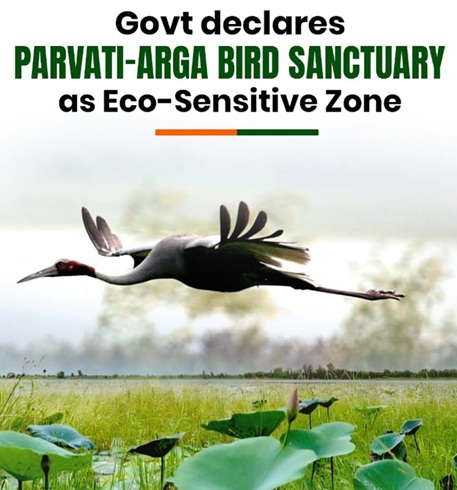
The Parvati–Arga Bird Sanctuary in Uttar Pradesh has been declared an Eco-Sensitive Zone (ESZ) by the Government. The move aims to strengthen ecological protection around the sanctuary by regulating developmental and human activities in its surrounding areas.
Background & Context
India’s protected areas face growing pressure from urbanisation, infrastructure expansion, pollution, and land-use change. To address these challenges, the government has increasingly relied on Eco-Sensitive Zones (ESZs) as a regulatory buffer around ecologically important regions.
Wetlands such as Parvati–Arga play a crucial role in biodiversity conservation, climate resilience, groundwater recharge, and migratory bird habitats. Declaring an ESZ around such areas aligns with India’s commitments under global biodiversity and wetland conservation frameworks, including the Ramsar Convention.
About Parvati–Arga Bird Sanctuary
Location
- Situated in Gonda district, Uttar Pradesh
Ecological Features
- A permanent freshwater wetland system
- Comprises two oxbow lakes:
- Represents a typical Indo-Gangetic floodplain ecosystem
Ramsar Status
- Designated as a Ramsar Site, recognising its international importance as a wetland ecosystem
Flora of the Sanctuary
- Vegetation is representative of the Indo-Gangetic ecosystem
- Supports aquatic plants, wetland grasses, and surrounding riparian vegetation
- Presence of invasive species, notably:
- Water hyacinth (Eichhornia crassipes), which threatens native biodiversity and water quality
Faunal Significance
Avifauna
The sanctuary is particularly important for threatened vulture species, including:
- Critically Endangered
- White-rumped vulture (Gyps bengalensis)
- Indian vulture (Gyps indicus)
- Endangered
- Egyptian vulture (Neophron percnopterus)
Ecological Importance
- Provides nesting and foraging grounds for resident and migratory birds
- Acts as a key habitat for scavenger species crucial for ecosystem health
What is an Eco-Sensitive Zone (ESZ)?
Definition
- Also known as Ecologically Fragile Areas (EFAs)
- Areas notified by the Ministry of Environment, Forest and Climate Change (MoEFCC) around:
- National Parks
- Wildlife Sanctuaries
- Protected Areas
Purpose of Declaring ESZs
- To act as shock absorbers for protected areas by regulating human activities
- To minimise habitat degradation due to industrialisation, mining, and urban expansion
- To serve as a transition zone between:
- Areas of high ecological protection
- Areas with controlled and sustainable human use
Extent of Eco-Sensitive Zones
- ESZs can extend up to 10 km around a protected area
- The actual extent depends on:
- Ecological sensitivity
- Local geography
- Anthropogenic pressures
Significance of ESZ Status for Parvati–Arga Sanctuary
Environmental Protection
- Regulates construction, polluting industries, and land-use change
- Protects wetland ecology and bird habitats
Biodiversity Conservation
- Enhances protection for critically endangered vulture species
- Helps control invasive species and habitat degradation
Sustainable Development
- Balances conservation with livelihoods of local communities
- Encourages eco-friendly activities and sustainable tourism
Challenges and Way Ahead
Challenges
- Encroachment and pollution from nearby settlements
- Spread of invasive species like water hyacinth
- Enforcement gaps in ESZ regulations
Way Forward
- Strengthen monitoring and local governance mechanisms
- Community participation in wetland conservation
- Scientific management of invasive species
- Integration of wetland conservation with district-level planning
FAQs
Q1. Where is the Parvati–Arga Bird Sanctuary located ?
It is located in the Gonda district of Uttar Pradesh.
Q2. Why is Parvati–Arga important ecologically ?
It is a Ramsar-designated wetland supporting endangered vulture species and Indo-Gangetic wetland biodiversity.
Q3. What is an Eco-Sensitive Zone ?
It is a regulated buffer area around protected regions to reduce ecological damage from human activities.
Q4. Which ministry notifies ESZs in India ?
The Ministry of Environment, Forest and Climate Change (MoEFCC).
Q5. What is the maximum extent of an ESZ ?
An ESZ can extend up to 10 km around a protected area, depending on local conditions.
|






 Contact Us
  New Batch : 9555124124/ 7428085757
  Tech Support : 9555124124/ 7428085757