New
Hindi Medium: (Delhi) - GS Foundation (P+M) : 6th July 2026, 6:00 PM Hindi Medium: (Prayagraj) - GS Foundation (P+M) : 5th July 2026, 8:00 AM English Medium: (Delhi) - GS Foundation (P+M) : 20th July 2026 English Medium: (Prayagraj) - GS Foundation (P+M) : 15th July 2026, 8:00 AM Hindi Medium: (Delhi) - GS Foundation (P+M) : 6th July 2026, 6:00 PM Hindi Medium: (Prayagraj) - GS Foundation (P+M) : 5th July 2026, 8:00 AM English Medium: (Delhi) - GS Foundation (P+M) : 20th July 2026 English Medium: (Prayagraj) - GS Foundation (P+M) : 15th July 2026, 8:00 AM

RBI Issues New Data Governance Framework for Banks and NBFCs: Key Features, Objectives and Significance

Prelims

Banking

Mains

GS Paper II : Governance, Regulatory Bodies

GS Paper III : Indian Economy, Banking, Science & Technology

Why in News

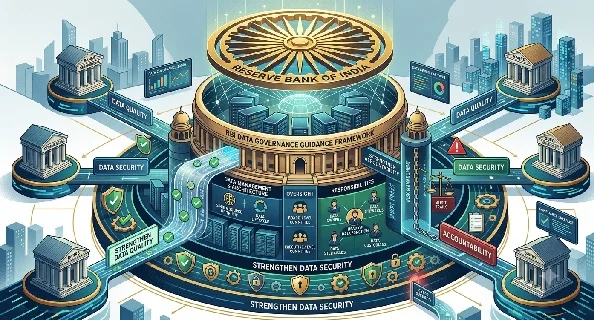
  • On 15 July 2026, the Reserve Bank of India released draft norms proposing a comprehensive Data Governance Framework (DGF) for banks and Non-Banking Financial Companies (NBFCs). The framework seeks to institutionalise accuracy, consistency, confidentiality, integrity, and traceability of data across the systems and business functions of regulated entities (REs). 

What is Data Governance ?

  • It refers to the system of policies, processes, standards and responsibilities through which an organization manages its data throughout its lifecycle.
  • It ensures that data is accurate, complete, consistent, secure, available to authorized users, and used ethically and legally.

Why has RBI issued the framework ?

  • The banking sector has undergone rapid digital transformation due to internet banking, mobile banking, UPIAI-based financial services, digital lending, cloud computing, and open banking initiatives. 
  • Banks now generate enormous volumes of data every day. Poor data governance can lead to incorrect regulatory reporting, cyber security vulnerabilities, fraud, weak risk management, poor customer service, and compliance failures. The RBI framework aims to address these concerns through standardized governance practices.

Objectives of the RBI Data Governance Framework

  • Improve data quality across banks.
  • Establish accountability for data ownership.
  • Strengthen data security and privacy.
  • Promote consistency in data management.
  • Enhance regulatory reporting.
  • Support better decision-making using reliable data.
  • Improve operational resilience.
  • Build trust in India's digital financial ecosystem.

Key Features of the Framework

  • Data Quality Management : Banks must establish systems for accuracy, completeness, timeliness, consistency, and validity. Regular quality assessments and audits are encouraged.
  • Data Security : The framework stresses encryption, access controls, identity management, monitoring unauthorized access, and incident response mechanisms.
  • Data Lifecycle Management : Banks should manage data through all stages (Collection, Storage, Processing, Sharing, Archiving, and Disposal). Appropriate retention policies should be maintained.
  • Metadata Management : Banks should maintain proper metadata describing data source, definitions, ownership, usage, and classification. This improves consistency across departments.
  • Regulatory Reporting : The framework seeks to improve accuracy of reports submitted to RBI, timely submission, and consistency across reporting systems. Reliable reporting strengthens financial supervision.
  • Technology and Automation : Banks are encouraged to use automation, Artificial Intelligence, analytics, data lineage tools, and data catalogues to improve governance efficiency.
  • Risk Management : Banks should identify risks relating to data leakage, poor data quality, unauthorized access, data manipulation, and operational failures. Risk mitigation plans should be periodically reviewed.
  • Periodic Review : The framework recommends continuous monitoring, internal audit, compliance review, and policy updates to keep pace with technological developments.

Importance of the Framework

  • Strengthens Financial Stability : Reliable banking data improves supervision and enables the RBI to detect emerging risks.
  • Better Regulatory Compliance : High-quality data leads to more accurate reporting and reduced compliance risks.
  • Supports Digital Banking : The framework enhances trust in digital financial services.
  • Improves Decision-Making : Management can make informed business decisions using reliable data.
  • Reduces Fraud : Better governance helps identify anomalies and suspicious activities at an early stage.
  • Enhances Customer Trust : Customers benefit from improved data accuracy, security and privacy.

Significance for the Indian Economy

  • Strengthening banking resilience.
  • Improving financial sector governance.
  • Supporting fintech innovation.
  • Enhancing credit risk assessment.
  • Promoting secure digital payments.
  • Facilitating responsible use of AI in banking.
  • Challenges in Implementation
  • Legacy IT systems in many banks.
  • Shortage of skilled data professionals.
  • Integration of multiple databases.
  • Ensuring consistent implementation across public and private sector banks.

Way Forward

  • Build a strong data governance culture.
  • Train bank employees regularly.
  • Upgrade legacy technology infrastructure.
  • Strengthen cybersecurity capabilities.
  • Adopt international best practices.
  • Improve coordination between business and technology teams.
  • Conduct regular audits and compliance assessments.

Prelims Pointers

Aspect

Key Fact

Issuing authority

Reserve Bank of India (RBI)

Date of draft release

15 July 2026

Applicable entities

Commercial banks and NBFCs (Regulated Entities)

Related upcoming reform

Expected Credit Loss (ECL) framework, effective 1 April 2027

Key legal alignment

Digital Personal Data Protection (DPDP) Act, 2023 and DPDP Rules, 2025

Minimum rank for data function head

Chief General Manager (CGM) or equivalent

Board-level body mandated

Data Governance Committee (or existing board committee assigned the role)

Review frequency of the DGF

At least annually, or more frequently if required

Core data-quality principles cited

Accuracy, consistency, confidentiality, integrity, traceability

PRELIMS MCQ

Q. With reference to the RBI's Data Governance Guidance Framework for Banks, consider the following statements:

  1. It seeks to improve data quality, security and accountability within banks.
  2. The framework places responsibility for data governance solely on the Information Technology (IT) department.
  3. It recommends clear roles such as data owners and data stewards for effective governance.

Which of the statements given above is/are correct?

A. 1 and 3 only

B. 2 only

C. 1, 2 and 3

D. 3 only

MAINS PRACTICE QUESTION 

Q. "In the era of digital banking, data governance has become as important as financial governance." Discuss in the context of the RBI's Data Governance Guidance Framework for Banks.

FAQs

1. What is the RBI's Data Governance Guidance Framework ?

It is an RBI framework to improve data quality, security, accountability, and governance in banks.

2. Why has RBI introduced this framework ?

To strengthen data management, improve regulatory reporting, and enhance financial system resilience.

3. Who oversees data governance in banks ?

The Board of Directors has the overall responsibility for overseeing data governance.

4. What are the main objectives of the framework ?

To improve data quality, security, accountability, and decision-making while ensuring regulatory compliance.

5. How does the framework benefit customers ?

It improves data accuracy, strengthens privacy, and enhances trust in digital banking services.

Have any Query?

Our support team will be happy to assist you!

OR