Prelims: (Infrastructure + Disaster Management + CA)
Mains: (GS Paper 3 – Infrastructure, Disaster Management, Security, Ecology) |
Why in News ?
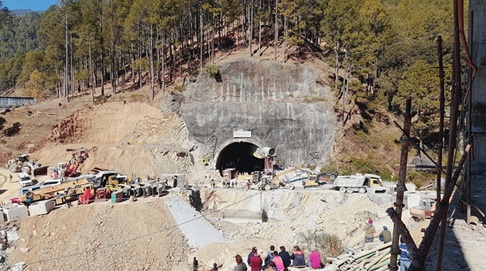
Following the Silkyara Bend–Barkot Tunnel collapse on NH-134 (Char Dham Mahamarg Pariyojana) in Uttarakhand on 12 November 2023, the Ministry of Road Transport and Highways (MoRTH) has issued comprehensive tunnel safety guidelines.
The collapse trapped 41 workers for 17 days, exposing serious gaps in geological assessment, tunnel design, and emergency preparedness, especially in the fragile Himalayan region.
Background & Context
India’s recent infrastructure push—particularly under Char Dham Connectivity, strategic border roads, and mountain highways—has significantly increased tunnelling activity in geologically young and unstable terrains.
The Himalayas, being a fold mountain system, are prone to:
- Faults and fractures
- High seismicity
- Weak rock mass
- Water ingress and landslides
The Silkyara incident became a watershed moment, highlighting how procedural compliance-driven project execution failed to address ground realities, necessitating a risk-based engineering approach.
Why Tunnel Safety Matters
- Tunnels are critical for all-weather connectivity in:
- Mountainous regions
- Snow-bound areas
- Congested urban zones
- Strategic and border areas
- India’s expanding highway and strategic road network has amplified geological, human, and disaster risks.
- Tunnel failures can lead to:
- Loss of life
- Strategic disruptions
- Cost overruns and public distrust
MoRTH Tunnel Safety Guidelines: Key Provisions
1. Strengthening Planning & Risk Assessment (DPR, GBR, Risk Register)
Issues Identified
- Detailed Project Reports (DPRs) treated as procedural formalities
- Inadequate geological and geotechnical investigations
Guidelines
- Project authority to verify accuracy and adequacy of geological investigations
- Mandatory preparation of:
- Geotechnical Baseline Report (GBR)
- Risk Register (hazards, risks, mitigation measures)
- Adoption of risk allocation principle: “Risk shall be borne by the party best equipped to manage it.”
- GBR and risk register to be shared with bidders to ensure transparency and realistic costing
2. Geological Realities & Design Challenges
Core Concerns
- Tunnel design depends heavily on the ground acting as a support system
- Predicting ground behaviour from limited tests is unreliable, especially in the Himalayas
- Poor geological investigation leads to:
- Time overruns
- Cost escalation
- Structural failures
Special Conditions to be Assessed
- Squeezing and swelling ground
- Rock bursts
- Shallow overburden zones
- Tunnels below perennial streams/nalas
- Hot water ingress
- Toxic or flammable gases (especially in long tunnels)
3. Tunnelling Technologies: NATM vs TBM
New Austrian Tunnelling Method (NATM)
- “Design-as-you-go” approach
- Suitable for non-uniform rock conditions
- Controlled blasting
- Mandatory excavation and support sheet after each round
Tunnel Boring Machine (TBM)
- Suitable for uniform geological stretches
- Requires high vigilance against:
- Roof collapse
- Sudden water ingress
4. Collapse Risk Zoning & Safety Infrastructure
- Mandatory classification of tunnels into collapse-risk zones
- High-risk zones must include:
- Np-4 escape pipe (minimum 0.9 m diameter)
- Mobile rescue containers
- Fixed rescue containers
- Minimum 24-hour survival capacity for trapped workers
5. Emergency Response & Human Capacity
- Shift managers to be trained as first responders
- Mandatory Emergency Response Plan (ERP):
- Prepared in advance
- Updated weekly based on evolving site conditions
- Emphasis on human preparedness alongside engineering solutions
India’s Tunnel Infrastructure Snapshot
As per MoRTH’s reply in Parliament (December 12, 2024):
- 42 tunnels (60.37 km) completed under 27 NH projects
- 57 tunnels (93.96 km) under implementation in 37 NH projects
- 3 tunnels (9.68 km) approved at a cost of ₹1,962 crore
- One 6-lane PPP project in Maharashtra costing ₹4,501 crore, including 2 tunnels (3.47 km), cleared by the PPP Appraisal Committee
Challenges & Way Forward
Key Challenges
- Weak and non-scientific DPR preparation
- Complex Himalayan geology
- Inadequate on-site emergency preparedness
- Coordination gaps during rescue operations
Way Forward
- Institutionalise scientific, data-driven DPRs
- Integrate real-time geological monitoring
- Conduct periodic independent safety audits
- Clear role definition among:
- Incident Commander (District Magistrate)
- Construction agencies
- Local administration
- NDRF / SDRF commanders
- Armed Forces to ensure:
- Technical support
- Inter-agency coordination
- Responder safety
- Use these guidelines as a template for other sectors:
- Metro rail
- Hydropower projects
FAQs
Q1. What was the Silkyara tunnel incident ?
A tunnel collapse in Uttarakhand in November 2023 that trapped 41 workers for 17 days.
Q2. Why are tunnels risky in the Himalayas ?
Due to young fold mountains, seismicity, weak rock mass, and high water ingress.
Q3. What is a Geotechnical Baseline Report (GBR) ?
A document defining baseline geological conditions for risk allocation and contract transparency.
Q4. What is the NATM method of tunnelling?
A flexible “design-as-you-go” tunnelling method suitable for variable geology.
Q5. How do the new guidelines improve safety ?
By mandating risk zoning, emergency preparedness, scientific planning, and human capacity-building.
|






 Contact Us
  New Batch : 9555124124/ 7428085757
  Tech Support : 9555124124/ 7428085757