
- UPSC Exam
- State PCS
- One Day Exam
- Current Affairs
- PT Quiz
- Downlaods
- About Coaching
- Blog
- Videos

| Prelims: (International Relations + CA) Mains: (GS 2 – India and Bilateral Relations; GS 3 – Energy Security, Nuclear Power) |
India and Canada have signed a long-term uranium supply agreement under which the Canadian company Cameco will supply about 22 million pounds (around 10,000 tonnes) of uranium to India between 2027 and 2035.
The deal, valued at about 2.6 billion Canadian dollars, aims to ensure fuel supply for India’s nuclear reactors and support the country’s ambitious plan to expand nuclear energy capacity.
This is India’s second major uranium supply agreement within a month, following a similar arrangement with Kazatomprom of Kazakhstan.
These agreements are crucial for India’s goal of expanding nuclear power capacity significantly by 2047 as part of its clean energy transition.

India’s nuclear energy programme has long faced constraints due to limited domestic uranium availability. While the country possesses uranium deposits, their low ore quality and limited extraction capacity make imports necessary.
Historically, India faced restrictions in nuclear trade due to international sanctions after its nuclear tests in 1974 and 1998. However, global cooperation improved significantly after the Nuclear Suppliers Group granted India a waiver in 2008, enabling civilian nuclear commerce with other countries.
Since then, India has expanded uranium supply partnerships with several countries to ensure stable fuel availability for nuclear power generation.
Although India has domestic uranium deposits, their uranium concentration ranges between only 0.02% and 0.45%, which is significantly lower than the global average of 1–2%.
In contrast, some mines in Canada contain uranium concentrations as high as 15%, making extraction far more efficient.
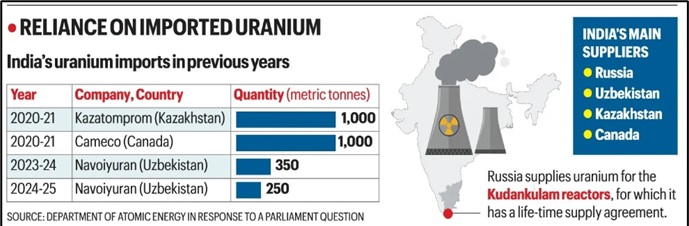
India currently consumes about 1,500–2,000 tonnes of uranium annually, with demand estimated at 1,884 tonnes in 2025.
With nuclear expansion plans, annual uranium demand may increase to about 5,400 tonnes in the coming decades.
Even with increased mining, domestic production may meet only about 30% of total demand, making imports essential.
India’s uranium mining operations are primarily located in :
Currently, seven uranium mines are operational in the country.
Additional uranium deposits have been identified in:
India’s total uranium resources are estimated at about 4.3 lakh tonnes of uranium ore.
The state-owned Uranium Corporation of India Limited manages several mines, with over 80,000 tonnes of reserves allocated to it.
Nearly 40% of these reserves have already been extracted, prompting ongoing exploration across 15 states.
The new uranium agreement with Cameco aims to diversify India’s nuclear fuel supply sources and strengthen energy security.
India and Canada have a long history of nuclear cooperation dating back to the 1950s.
One notable collaboration was the CIRUS Reactor, which contributed to India’s early nuclear research.
Canada also assisted in establishing reactors at the Rajasthan Atomic Power Station in the 1960s.
Despite diplomatic tensions in recent years, the uranium supply deal indicates renewed cooperation in the energy sector.
India currently imports uranium from several countries, including:
Russia also provides long-term fuel supply for reactors at the Kudankulam Nuclear Power Plant.
India may also expand cooperation with Australia and the United States in the future.
Additionally, Indian companies are exploring overseas uranium mining opportunities to strengthen long-term supply security.
India’s nuclear energy strategy is based on a three-stage nuclear programme envisioned by Homi J. Bhabha.
The programme aims to eventually utilise India’s large thorium reserves for energy generation.
The first stage involves Pressurised Heavy Water Reactors (PHWRs) that use uranium fuel and produce plutonium as a by-product.
These reactors form the backbone of India’s current nuclear power capacity.
The second stage utilises plutonium-based fast breeder reactors (FBRs) to generate more fissile material than they consume.
India’s Prototype Fast Breeder Reactor (PFBR) at Kalpakkam Nuclear Complex represents a key step toward this stage.
The final stage aims to deploy reactors that use thorium as the primary fuel source.
India possesses some of the world’s largest thorium reserves, making this stage vital for long-term energy independence.
However, thorium reactor technology is still under development and remains a long-term goal.
1. Strengthening Energy Security
Long-term uranium contracts ensure stable fuel supply for nuclear reactors.
2. Supporting Clean Energy Transition
Nuclear energy produces low carbon emissions, helping India achieve climate commitments.
3. Enabling Nuclear Capacity Expansion
Reliable fuel supply supports India’s goal of expanding nuclear capacity from about 9 GW today to nearly 100 GW by 2047.
4. Diversification of Energy Imports
Multiple supply sources reduce dependence on any single country.
5. Boosting Strategic Partnerships
The agreement strengthens India–Canada energy cooperation and enhances diplomatic engagement.
FAQs1. Why does India import uranium despite having domestic reserves? India’s uranium ore has relatively low concentration, making extraction expensive and insufficient to meet growing demand. 2. Which Canadian company signed the uranium supply agreement with India? The agreement was signed with Cameco, one of the world’s largest uranium producers. 3. What is India’s three-stage nuclear power programme? It is a long-term strategy involving uranium-based reactors, plutonium-based fast breeder reactors, and thorium-fuelled reactors. 4. Why is thorium important for India’s nuclear energy future? India has large thorium reserves, which could provide long-term energy security once suitable reactor technologies are developed. 5. How will the uranium supply deal benefit India? It will ensure stable nuclear fuel supply, support nuclear power expansion, enhance energy security, and strengthen international partnerships. |



Our support team will be happy to assist you!

 Contact Us
  New Batch : 9555124124/ 7428085757
  Tech Support : 9555124124/ 7428085757