
- UPSC Exam
- State PCS
- One Day Exam
- Current Affairs
- PT Quiz
- Downlaods
- About Coaching
- Blog
- Videos

| Prelims : (Defence + Science & Technology + CA) Mains : (GS 3 – Security, Defence Technology, Modern Warfare) |
The Indian Army has begun inducting Shaurya Squadrons—dedicated drone sub-units within armoured regiments—to enhance real-time surveillance and precision strike capabilities in modern battlefield scenarios.
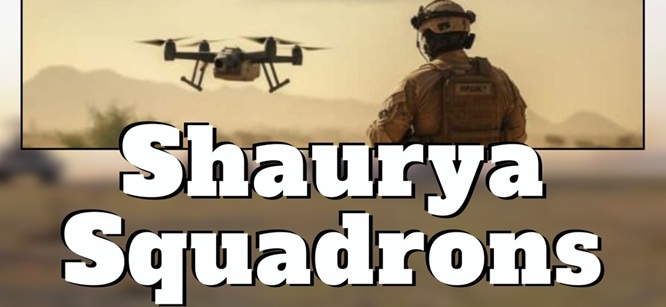
Modern warfare is increasingly technology-driven, with unmanned systems such as drones playing a decisive role in intelligence gathering, surveillance, reconnaissance (ISR), and combat operations.
Recent global conflicts have demonstrated the transformative impact of drones in :
India has been steadily modernising its defence forces to integrate advanced technologies. The induction of Shaurya Squadrons reflects this shift toward network-centric and technology-enabled warfare.
Shaurya Squadrons provide tank commanders with live battlefield data, improving situational awareness and decision-making.
FPV drones and loitering munitions enable targeted strikes on :
Commanders can act instantly without waiting for higher command approvals, enhancing operational flexibility.
The key objective is to reduce the time between detection and destruction of targets from minutes to seconds.
Enhances effectiveness of tank regiments by combining mobility with real-time intelligence and strike capabilities.
The sensor-to-shooter cycle refers to the time gap between :
Shaurya Squadrons aim to drastically reduce this gap, making battlefield response faster and more efficient.
Marks a shift towards technology-driven warfare and unmanned systems.
Faster targeting and engagement improves operational outcomes.
Use of drones minimises exposure of personnel to enemy fire.
Provides edge in high-intensity and hybrid warfare scenarios.
Integrates intelligence, surveillance, and strike functions into a unified system.
FAQs1. What are Shaurya Squadrons ? They are dedicated drone units within Indian Army armoured regiments for surveillance and precision strikes. 2. What is their main objective ? To reduce the sensor-to-shooter cycle and enable faster battlefield response. 3. What types of drones do they use ? Surveillance drones, attack drones, FPV drones, swarm drones, and loitering munitions. 4. How are they different from Ashni Platoons ? Shaurya Squadrons are integrated into armoured units, while Ashni Platoons operate within infantry units. 5. Why are they important for modern warfare ? They enhance real-time intelligence, precision targeting, and reduce risks to soldiers, making operations more efficient. |



Our support team will be happy to assist you!

 Contact Us
  New Batch : 9555124124/ 7428085757
  Tech Support : 9555124124/ 7428085757