Prelims: (Polity & Governance + CA)
Mains: (GS 2 – Constitution, Governance, Accountability; GS 4 – Ethics in Public Administration) |
Why in News ?
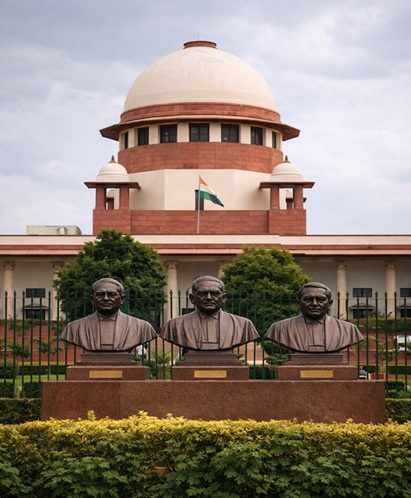
The Supreme Court of India delivered a split verdict on the constitutional validity of Section 17A of the Prevention of Corruption Act, 1988, a provision introduced through the 2018 Amendment. Section 17A mandates prior approval/sanction before initiating any inquiry or investigation against public servants for decisions taken in the discharge of official duties.
The challenge was filed by the Centre for Public Interest Litigation (CPIL), which argued that the provision shields corruption and undermines accountability. Owing to divergent judicial opinions, the matter has now been referred to the Chief Justice of India (CJI) for constitution of a larger Bench.
Background: Balancing Anti-Corruption and Administrative Autonomy
The Prevention of Corruption Act is India’s principal anti-graft legislation, aimed at:
- Detecting corruption
- Punishing misuse of public office
- Ensuring probity in governance
However, concerns over:
- Frivolous complaints
- Harassment of honest officials
- Policy paralysis
led to the insertion of Section 17A in 2018. The provision reflects an attempt to strike a balance between effective governance and vigorous anti-corruption enforcement, a balance that now lies at the heart of constitutional scrutiny.
What is Section 17A of the Prevention of Corruption Act ?
Section 17A requires prior approval of the competent authority before conducting any inquiry or investigation against a public servant for actions taken in official capacity.
Government’s stated objectives:
- Protect honest officers from malicious prosecution
- Prevent vexatious and politically motivated complaints
- Avoid administrative and policy paralysis
The provision applies primarily to decision-making public servants, often at higher levels of bureaucracy.
Divergent Judicial Opinions in the Supreme Court
Justice B.V. Nagarathna: Section 17A is Unconstitutional
Justice Nagarathna struck down Section 17A as illegal, arbitrary, and violative of constitutional principles.
Key reasoning:
- Violation of Article 14 (Equality Before Law): The protection effectively extends only to higher officials involved in policy decisions, while lower-level officials face immediate investigation. This classification lacks a rational nexus with the objective of preventing corruption.
- Arbitrariness and Rule of Law Concerns: By barring even a preliminary enquiry without approval, the provision prevents discovery of truth and places executive discretion above criminal investigation.
- Contrary to the Object of the PC Act: Anti-corruption law exists to expose and punish corruption, not delay or obstruct investigations. Section 17A, according to this view, “protects the corrupt rather than the honest.”
- Policy Paralysis Argument Rejected: Honest officials do not require statutory insulation. Instead, such protection may embolden mala fide decision-making.
Justice K.V. Viswanathan: Section 17A is Constitutionally Valid (With Safeguards)
Justice Viswanathan upheld the provision, emphasising institutional balance.
Key reasoning:
- Misuse ≠ Unconstitutionality: The possibility of misuse cannot justify striking down a law. Doing so would be akin to “throwing the baby out with the bathwater.”
- Preventing Policy Paralysis: Fear of instant FIRs and coercive investigations can induce a “play-it-safe syndrome,” discouraging bold administrative decisions.
- Need for a Balanced Approach: Governance requires protection from mala fide prosecution, alongside accountability.
- Danger of Unfiltered Investigations: Without prior screening, even frivolous complaints could lead to FIRs and arrests, which would be regressive.
Suggested Safeguards:
- Sanction decisions based on recommendations of independent bodies such as:
- Lokpal (Centre)
- Lokayukta (States)
- Independent fact-finding before granting approval
Key Constitutional and Governance Issues Involved
- Article 14 – Equality Before Law: Does selective protection to higher officials amount to hostile discrimination?
- Rule of Law: Does prior approval subordinate criminal investigation to executive discretion?
- Separation of Powers: How far can the executive control initiation of criminal investigations?
- Accountability vs Administrative Autonomy: The tension between fearless governance and effective anti-corruption enforcement.
Challenges Highlighted and Way Ahead
Shielding Corruption
- Delays or denial of approval may stall investigations indefinitely
- Need for statutory timelines for sanction decisions
Executive Interference
- Sanctioning authority may be influenced by political or bureaucratic interests
- Formal role for Lokpal/Lokayukta in sanctioning process
Unequal Protection
- Lower officials face immediate scrutiny while higher officials enjoy insulation
- Authoritative constitutional ruling needed to resolve inconsistency
Erosion of Public Trust
- Perception that anti-corruption law favours the powerful
- Parliament may need to revisit Section 17A to align it with constitutional values
FAQs
1. What is Section 17A of the Prevention of Corruption Act ?
It requires prior approval before initiating inquiry or investigation against public servants for official decisions.
2. Why is Section 17A controversial ?
Critics argue it shields corruption and delays investigation, while supporters say it protects honest officials from harassment.
3. What did the Supreme Court decide ?
The Court delivered a split verdict and referred the matter to the CJI for a larger Bench.
4. Which constitutional provisions are involved ?
Article 14 (Equality before Law), Rule of Law, and principles of separation of powers.
5. What could be the way forward ?
Independent screening by Lokpal/Lokayukta, time-bound sanctions, and legislative review to balance accountability and governance.
|






 Contact Us
  New Batch : 9555124124/ 7428085757
  Tech Support : 9555124124/ 7428085757