Why in the news ?
- Recently, following a framework agreement between the US and Iran on June 15, 2026, the Strait of Hormuz was reopened to global maritime traffic and the US embargo on Iranian shipping was lifted. Previously, Iran had used the Strait to exert strategic pressure after the US and Israel initiated military action against Iran.
- During the war, Iran charged transit tolls on every ship, which have now been abolished, but it continued to charge navigation fees and environmental protection charges. This has raised questions under international law about whether Iran has the legal right to do so.
Why is the Strait of Hormuz important ?
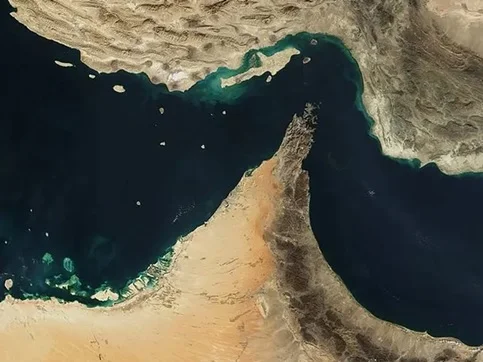
- The Strait of Hormuz is one of the world's most important maritime trade routes. It connects the Persian Gulf with the Gulf of Oman and the Arabian Sea.
- A large portion of the world's seaborne crude oil and natural gas is transported through this strait. The energy security of energy-importing countries such as India, China, Japan, and South Korea depends heavily on this route.
- Therefore, any tension in this region directly impacts the global energy market and maritime trade.
What does international law say ?
- Articles 37 to 44 of the United Nations Convention on the Law of the Sea (UNCLOS), 1982, contain provisions regarding straits used for international navigation.
- According to these provisions, ships and aircraft of all countries have the right to transit passage, i.e., continuous and unhindered passage.
- UNCLOS clearly states that this right cannot be interfered with or suspended in any way.
- Its purpose is to ensure that no coastal country can use its geographical position to influence international trade.
Significance of the Corfu Channel Case
- The International Court of Justice (ICJ) ruled in the Corfu Channel Case (1949) that foreign ships have the right to pass freely through a strait used for international navigation in peacetime, provided they do not pose a threat to the security of the coastal state.
- This decision later became the basis for the principle of 'Freedom of Navigation' enshrined in UNCLOS.
Are Iran's navigation fees legal ?
- In accordance with the spirit of UNCLOS, it is not considered appropriate to use a natural international strait as a means of generating revenue.
- If a country charges ships a fee simply for passing through its territorial waters, it may be considered an obstruction of the right of transit passage.
- Therefore, many international experts consider the navigation fees imposed by Iran to be controversial.
What legal arguments does Iran make in its favor ?
- Iran's first argument is that the Strait of Hormuz is not entirely located in the High Seas, but rather falls within the territorial sea of Iran and Oman. Therefore, not only does complete freedom of navigation apply here, but certain rights of coastal states also apply.
- Second, Iran cites the provisions of UNCLOS regarding "Innocent Passage." According to Article 19, if a ship's activities pose a threat to the peace, security, or public order of a coastal state, the coastal state can take necessary measures. Iran argues that it can invoke this provision in the event of regional tensions.
- Third, Iran argues that ships are also charged fees through other major waterways in the world, such as the Suez Canal and the Panama Canal. However, international experts do not fully accept this argument because they are both artificial canals, while the Strait of Hormuz is a natural strait and is subject to different UNCLOS rules.
- Fourth, Iran also invokes the Persistent Objector Doctrine. Iran has signed UNCLOS but has not ratified it. It argues that the principle of transit passage is not part of customary international law for it, and therefore, it is not bound by it.
- Fifth, Iran also cites its 1993 Law on Marine Areas of the Islamic Republic of Iran in the Persian Gulf and Oman Sea. This law allows for the control of foreign warships and certain categories of vessels and the implementation of environmental protection measures. Iran attempts to justify the environmental protection fee on this basis.
What are the broader implications of this dispute?
- The dispute over the Strait of Hormuz demonstrates how intertwined economic and military power have become in modern times.
- If shipping traffic through the Strait is disrupted, it could lead to increased crude oil prices, increased marine insurance costs, disruption of global supply chains, and a negative impact on the world economy.
Its Importance for India
- India imports a large portion of its energy needs from West Asia, and most of its oil comes through the Strait of Hormuz.
- Therefore, any tension in the region could adversely impact India's energy security, import costs, inflation, and current account deficit.
- This is why India consistently supports stability, maritime security, and adherence to international law in the region.
Conclusion
The Strait of Hormuz is crucial for global energy security and international maritime trade. While UNCLOS ensures freedom of international navigation, legal aspects such as territorial waters, national security, domestic law, and the Persistent Objector Doctrine complicate the issue. A lasting resolution to this dispute is possible not solely through legal interpretations, but through diplomatic dialogue, regional cooperation, and respect for international rules.






 Contact Us
  New Batch : 9555124124/ 7428085757
  Tech Support : 9555124124/ 7428085757