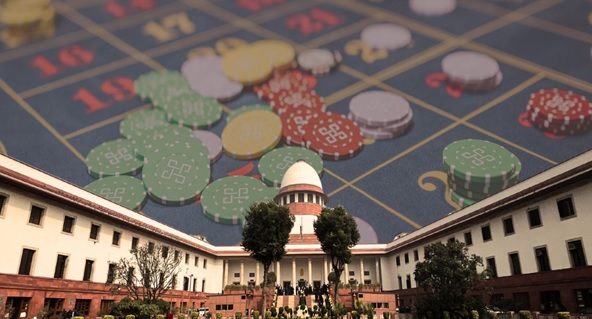
The online real-money gaming industry in India has long faced legal uncertainties, tax disputes, and regulatory challenges. Two significant judgments delivered by the Supreme Court on May 27, 2026, have significantly clarified the legal status of this sector.
On the one hand, the Court upheld the 28 percent GST imposed on online gaming companies, while on the other, it also provided constitutional support to the restrictions imposed by states on online betting and gambling. However, the impact of these judgments is not limited to the gaming industry, but also affects broader questions related to the federal structure, taxation, and regulation of the digital economy.
Background to the Dispute
Two separate but interrelated issues were before the Supreme Court.
The first question was whether state governments could enact laws banning online betting and gambling. Some states attempted to regulate and impose penalties on games played on online platforms. When High Courts struck down these laws, the state governments appealed to the Supreme Court.
The second question concerned the liability of Goods and Services Tax (GST) on online gaming platforms. The dispute centered on whether the tax should be levied only on the platform's income or on the entire amount wagered by players.
GST Dispute and the Court's View
The online gaming industry argued that it acts only as an intermediary platform and its actual income is a small portion of the money wagered by players. Therefore, taxation should be limited to that portion.
However, the Court did not accept this view. The Court held that when money is wagered on an uncertain outcome, the activity's nature deviates from traditional skill-based competitions.
According to the Court, such platforms not only organize competitions but also provide a mechanism in which participants take risks with the potential for economic gain. Therefore, these activities can be classified as special for taxation purposes.
An important aspect was that the Court rejected the traditional distinction between skill and chance as decisive in the context of GST. The Court believed that when real money is at stake, the economic nature of the activity becomes more important for taxation.
The Court also clarified that the 2023 amendments did not introduce any new taxes, but rather clarified and harmonized the existing legal position. On this basis, tax demands for the prior period were also considered valid.
Upholding the Regulatory Power of States
In another decision, the Supreme Court acknowledged the power of states to regulate or prohibit activities such as online betting and gambling.
The Court held that betting and gambling do not fall within the category of ordinary business activities. Therefore, they do not automatically receive the same protections afforded to trade and business under the Constitution.
The Court also underlined that the mere presence of an element of skill in a game does not change its nature if money is at stake. In such cases, the activity may fall within the scope of betting, and states have the right to regulate it.
Noting the expansion of digital technology, the Court also indicated that smartphones and online payment systems have made betting more accessible than ever before. Therefore, states can intervene on grounds of public interest, social security, and public order.
Laws and Industry Challenges of 2025
The significance of these decisions is heightened as they come at a time when the real money online gaming industry is already under intense regulatory pressure.
Central laws enacted in recent years have imposed extensive restrictions on real money based gaming activities. However, e-sports, educational games and some digital games played only for entertainment purposes have been kept in a separate category.
Many industry representatives argue that these restrictions and heavy tax liabilities have seriously affected the economic viability of the business. Many companies have been forced to change their operating models, enter other digital sectors or turn to foreign markets.
Economic and legal implications
The most direct impact of these decisions will be on tax collection and the financial condition of the industry. If tax demands from prior periods are sustained, many companies may face severe financial pressure. Also, the possibility may increase that some companies may resort to processes like restructuring, merger or bankruptcy.
From a legal perspective, these decisions give rise to another important debate – what should be the role of the states and the Center in regulation of online gaming. While the Supreme Court has considered betting and gambling as a subject falling under the State List, the question that may become more important in future is on what basis the Central Government gets the constitutional power to make comprehensive regulatory laws in such an area.
The way forward
The recent decisions of the Supreme Court could prove to be a turning point for India's online gaming industry. These decisions, on the one hand, have legitimized the government's approach to taxation, while on the other hand, they have also strengthened the regulatory powers of the states.
While this may increase challenges for the industry, the Court's message is clear that when a digital activity involves real money, betting and questions of public interest, both the State and the Center can have wide powers to regulate.
However, it will be important to see in the coming years how the industry reorganizes itself to suit the changing legal framework and how governments strike a balance between regulation and innovation.





 Contact Us
  New Batch : 9555124124/ 7428085757
  Tech Support : 9555124124/ 7428085757