|
Prelims : Environment + Ecology + CA
Mains : GS Paper 3 – Environmental Pollution, Conservation, Coastal Ecosystems
|
Why in News ?
- The Ministry of Environment, Forest and Climate Change has released draft rules to manage tar balls, aiming to protect India’s coastline and marine ecosystems from oil pollution.
- The move highlights growing concerns over oil spill residues washing ashore and affecting biodiversity as well as human health.
Background and Context
- India’s extensive coastline is increasingly exposed to marine pollution caused by oil spills and shipping activities.
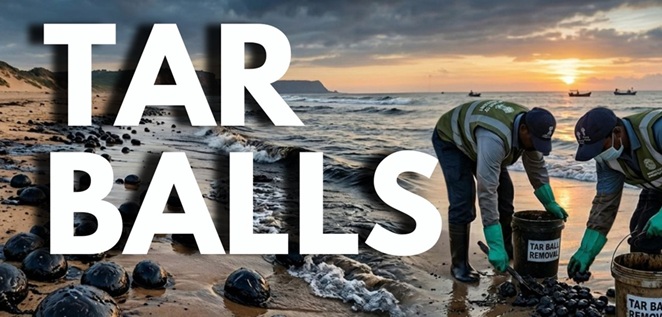
- Tar balls are a visible manifestation of such pollution, often appearing on beaches, especially along the western coast from Gujarat to Goa during seasonal months.
- Despite their recurring presence, the absence of a clear regulatory framework has limited effective management and mitigation efforts.
What are Tar Balls ?
- Tar balls are small, dark, sticky lumps of weathered oil that form in marine environments due to oil spills or natural seepage.
- They are typically semi-solid or solid in nature, and can vary in size from small globules to lumps as large as a basketball.
- These substances often wash ashore, creating both environmental hazards and public nuisance.
How are Tar Balls Formed ?
- Tar balls originate from crude oil released into the sea, either through accidental oil spills or natural seepage.
- Over time, the oil undergoes weathering processes, including :
- Physical changes due to waves and currents
- Chemical transformations
- Biological degradation
- These processes convert the oil into dense, sticky masses that are transported by ocean currents and deposited along coastlines.
Composition of Tar Balls
- Tar balls contain toxic contaminants, including :
- Heavy metals
- Trace elements
- Persistent organic pollutants
- These harmful substances make them hazardous to both marine ecosystems and human health.
Impacts of Tar Balls
1. Threat to Marine Biodiversity
- Tar balls can be ingested by marine organisms such as fish, seabirds, and sea turtles, often mistaken for food.
- This can lead to toxicity, internal injuries, or death, thereby disrupting marine ecosystems.
2. Coastal Pollution
- Accumulation of tar balls on beaches leads to degradation of coastal environments, affecting tourism and local livelihoods.
3. Human Health Risks
- Direct contact with tar balls can cause skin irritation and exposure to toxic chemicals, posing health risks to coastal communities.
4. Seasonal Occurrence in India
- India’s western coastline, particularly from Gujarat to Goa, is highly affected during April to September, due to ocean currents and monsoon-related changes.
Significance of Draft Rules
- The proposed rules aim to establish a structured mechanism for identification, monitoring, and removal of tar balls from coastal areas.
- They are expected to strengthen India’s coastal pollution management framework, addressing a long-standing regulatory gap.
- The initiative also aligns with broader goals of marine conservation and sustainable coastal management.
Challenges
- Detection and monitoring of tar balls in vast marine areas remain technically challenging.
- Coordination among multiple agencies at the central and state levels can complicate implementation.
- Addressing the root causes, such as oil spills and maritime pollution, requires international cooperation.
Way Forward
- Strengthen early warning and monitoring systems for marine pollution
- Enhance inter-agency coordination for rapid response and cleanup
- Promote strict regulation of shipping and offshore activities
- Increase awareness among coastal communities regarding risks and reporting mechanisms
Practice Questions
Prelims :
Q. Tar balls found on coastlines are primarily formed due to :
(a) Volcanic activity
(b) Weathering of crude oil in marine environments
(c) Coral reef degradation
(d) Plastic waste accumulation
Mains :
“Discuss the environmental and ecological impacts of tar balls on coastal ecosystems. Evaluate the need for regulatory measures to address this issue in India.”
FAQs
Q1. What are tar balls ?
They are lumps of weathered oil formed in marine environments.
Q2. How do they reach the coast ?
Through ocean currents and wave action.
Q3. Why are they harmful ?
They contain toxic substances that affect marine life and human health.
Q4. Which regions in India are most affected ?
The western coast, especially Gujarat to Goa.
Q5. Why are draft rules important ?
They provide a framework for managing and reducing coastal pollution caused by tar balls.
|





 Contact Us
  New Batch : 9555124124/ 7428085757
  Tech Support : 9555124124/ 7428085757