Prelims: Tarang Shakti; Veer Guardian; Indian Air Force; F-35; Rafale; AEW&C.
Mains: GS Paper II International relations and defence cooperation; GS Paper III Defence technology and security preparedness. |
Why in News?
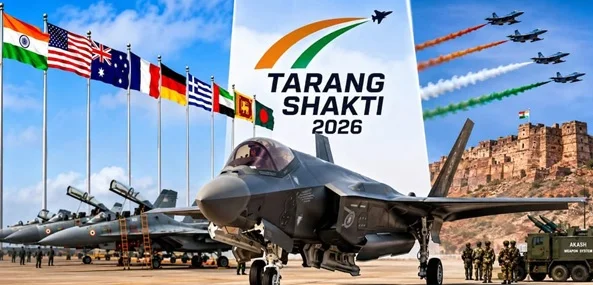
- Indian Air Force (IAF) is scheduled to host the second edition of Exercise Tarang Shakti at Air Force Station Jodhpur, Rajasthan, from September 26 to October 12, 2026.
- More than 40 countries are expected to participate, with planned foreign deployments including American F-35s, French Rafales and UAE F-16s.
Background
- Tarang Shakti is an IAF-hosted multinational air exercise whose inaugural edition took place in 2024. It provides a platform for air forces with different aircraft, training systems and operational practices to learn from one another.
- During the Distinguished Visitors’ Day of the inaugural edition’s second phase in Jodhpur, Defence Minister Rajnath Singh emphasised cooperation, coordination and trust among participating countries. He highlighted the value of exchanges between personnel with different air-combat experiences and military traditions.
Key Points
|
Aspect
|
Reported details
|
|
Edition
|
Second
|
|
Host
|
Indian Air Force
|
|
Venue
|
Air Force Station Jodhpur, Rajasthan
|
|
Dates
|
September 26–October 12, 2026
|
|
International participation
|
More than 40 countries expected
|
|
Main purpose
|
Joint tactical manoeuvres and operational cooperation
|
Aircraft and Support Platforms
|
Country
|
Expected platforms
|
|
United States
|
Two to three F-35 fifth-generation combat aircraft
|
|
France
|
Rafale fighter aircraft
|
|
United Arab Emirates
|
F-16 fighter aircraft
|
|
India
|
Rafale and Sukhoi-30 fighters, alongside support aircraft
|
|
Other participating countries
|
Support assets, including transport aircraft, as reported
|
The IAF is also expected to deploy airborne early warning and control (AEW&C) aircraft, transport aircraft and air-to-air refuelling tankers. Their inclusion would allow training to extend beyond fighter manoeuvres to surveillance, coordination, logistics and sustained air operations.
Why Support Aircraft Matter
- AEW&C aircraft: Provide airborne surveillance and help coordinate friendly aircraft.
- Refuelling tankers: Supply fuel in flight, extending aircraft endurance and operational reach.
- Transport aircraft: Move personnel, equipment and supplies required to support deployments.
Significance of the Exercise
- Improving Interoperability: Multinational training helps air forces practise communication, mission planning and coordination. Operating different aircraft together requires compatible procedures, even when participants use different equipment.
- Exposure to Diverse Operational Practices: Interaction with foreign crews offers opportunities to compare training methods and mission approaches. The planned presence of F-35s would add a fifth-generation aircraft dimension, although participation does not imply access to classified technology or unrestricted sharing of capabilities.
- Strengthening Defence Diplomacy: Exercises create professional relationships and build familiarity between armed forces. Hosting a large multinational event also gives India a platform to engage several defence partners through a common training activity.
Relevance for India
- Operational preparedness: Complex multinational activity can help the IAF assess coordination between fighters, surveillance platforms and support aircraft.
- Diverse partnerships: Engagement with several countries supports India's broad defence relationships and strategic autonomy.
- Hosting experience: Managing visiting aircraft and personnel develops experience in logistics, airspace coordination and ground support.
- Training feedback: Lessons identified during the exercise can inform future training and operational procedures.
These are potential benefits of multinational exercises; their achievement depends on the activities conducted and subsequent implementation of lessons.
Challenges
- Different procedures: Variations in terminology, communications and operational practices can complicate coordination.
- Technology restrictions: Participants may limit the sharing of sensitive aircraft data and mission information.
- Logistical demands: Multiple aircraft types require different maintenance arrangements, equipment and ground support.
- Flight safety: A large concentration of aircraft requires careful airspace management and clear operating procedures.
Way Forward
- The IAF should use structured post-exercise reviews to identify practical improvements in mission coordination and support operations. Common communication procedures, carefully defined information-sharing arrangements and strong safety practices can improve the quality of multinational training.
- Sustained professional exchanges between editions can help convert short-term interaction into lasting operational understanding and stronger defence relationships.
Prelims MCQs
1. Exercise Tarang Shakti is primarily associated with which of the following?
(a) Multinational naval anti-piracy operations
(b) Multinational air-force training
(c) Bilateral army mountain warfare training
(d) Joint coast guard patrols
Mains Practice Question
“Multinational air exercises serve both operational and diplomatic objectives.” Discuss with reference to Exercise Tarang Shakti.
|
FAQs
1. What is Exercise Tarang Shakti?
Tarang Shakti is a multinational air exercise hosted by the Indian Air Force to promote joint training, operational understanding and defence cooperation.
2. Where and when is Tarang Shakti 2026 scheduled?
According to the supplied report, it is scheduled at Air Force Station Jodhpur in Rajasthan from September 26 to October 12, 2026.
3. Which foreign fighter aircraft are expected to participate?
The report identifies US F-35s, French Rafales and UAE F-16s among the planned foreign deployments.
4. How does Tarang Shakti differ from Veer Guardian?
Tarang Shakti is a multinational air exercise, while Veer Guardian is a bilateral air exercise between India and Japan.
5. Why is Tarang Shakti important for India?
It offers opportunities to improve operational coordination, learn from foreign air forces and strengthen defence relationships with participating countries.
|






 Contact Us
  New Batch : 9555124124/ 7428085757
  Tech Support : 9555124124/ 7428085757