Why in news?
India celebrates Teachers’ Day every year on 5 September to honour teachers and recognise their contribution to education, society and nation-building. The day commemorates the birth anniversary of Dr. Sarvepalli Radhakrishnan, one of India’s most distinguished philosophers, educationists and statesmen, who later became the first Vice-President and second President of India.
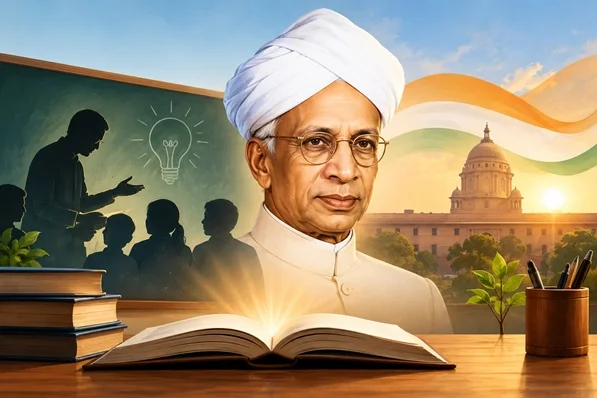
History of Teachers’ Day in India
- After Dr. Radhakrishnan became the President of India in 1962, some of his students and friends reportedly wanted to celebrate his birthday on 5 September. Instead of treating the occasion merely as a personal birthday celebration, Radhakrishnan suggested that it would be more meaningful to observe the day in honour of teachers. Consequently, 5 September came to be celebrated as Teachers’ Day in India from 1962 onwards.
- The occasion therefore honours not only Dr. Radhakrishnan but the contribution of the entire teaching community to Indian society.
Why is Teachers’ Day Celebrated?
- Teachers’ Day recognises that teachers play several roles simultaneously. They are not merely providers of academic information. Teachers can serve as educators, mentors, guides, value builders and nation builders.
- Teachers influence the intellectual development of students while helping them develop discipline, confidence, creativity, ethical values and social responsibility.
Dr. Radhakrishnan’s Life at a Glance
|
1888
|
Born on 5 September
|
|
Academic Career
|
Professor and philosopher
|
|
1931–1936
|
Vice-Chancellor, Andhra University
|
|
1939–1948
|
Vice-Chancellor, Banaras Hindu University
|
|
1948–49
|
Chairman, University Education Commission
|
|
1949–1952
|
Ambassador to the Soviet Union
|
|
1952–1962
|
First Vice-President of India
|
|
1954
|
Awarded Bharat Ratna
|
|
1962–1967
|
Second President of India
|
|
1962 onwards
|
5 September observed as Teachers’ Day in India
|
|
1975
|
Passed away on 17 April
|
Who Was Dr. Sarvepalli Radhakrishnan?
- Dr. Sarvepalli Radhakrishnan (1888–1975) was an eminent Indian philosopher, academic, teacher and statesman. He became internationally recognised for his scholarship on Indian philosophy, comparative religion and ethics. His academic writings helped introduce and interpret Indian philosophical traditions to a wider global audience.
- His journey was remarkable as teacher, professor, philosopher, Vice-Chancellor, diplomat, Vice-President and President of India. His life therefore represents a unique combination of education, scholarship and public service.
Early Life of Dr. Sarvepalli Radhakrishnan
- Dr. Sarvepalli Radhakrishnan was born on 5 September 1888 in southern India. He pursued higher education at Madras Christian College, where philosophy became a major area of his academic interest.
- At a time when Western academic interpretations often misunderstood or underestimated Indian philosophical traditions, Radhakrishnan emerged as an important scholar who explained Indian thought through rigorous academic study.
Academic and Teaching Career
- Dr. Radhakrishnan began his professional life as a teacher and academic. He taught philosophy at major institutions and eventually became associated with universities such as the University of Mysore and the University of Calcutta.
- He was appointed to the prestigious Spalding Professorship of Eastern Religions and Ethics at the University of Oxford. Through his academic work, he sought to create an intellectual bridge between Indian and Western philosophical traditions.
Dr. Radhakrishnan as a Philosopher
- His scholarship dealt extensively with Indian philosophy, Hindu philosophical traditions, Comparative religion, Ethics, Spirituality and Relationship between Eastern and Western thought.
- Some of his well-known works include:
- Indian Philosophy
- The Hindu View of Life
- An Idealist View of Life
- Eastern Religions and Western Thought
- The Principal Upanishads
- The Bhagavadgita
Role in Indian Education
- Dr. Radhakrishnan’s contribution to education extended beyond classrooms and universities. After Independence, he chaired the University Education Commission (1948-49), popularly associated with his name as the Radhakrishnan Commission.
- The Commission examined the state of university education in independent India and made recommendations concerning higher education, teaching standards, university administration and the broader purpose of education.
- Its work became an important milestone in the evolution of India’s post-independence higher-education system.
Achievements:
- First Vice-President of India: Dr. Sarvepalli Radhakrishnan became the first Vice-President of India in 1952. He served in the position for ten years, from 1952 to 1962. As Vice-President, he was also associated with the functioning of the Rajya Sabha as its ex-officio Chairman, giving him an important role in India's parliamentary system.
- Second President of India: In 1962, Dr. Radhakrishnan became the second President of India, succeeding Dr. Rajendra Prasad. He served from 13 May 1962 to 13 May 1967. His presidency coincided with an important and challenging period in Indian history, including major security and political developments.
- Bharat Ratna and Other Recognition: Dr. Sarvepalli Radhakrishnan was awarded the Bharat Ratna in 1954, India’s highest civilian honour. The honour recognised his exceptional contribution to intellectual life, education and public service.
Teachers’ Day and National Teachers’ Awards
- Teachers’ Day is also associated with the recognition of outstanding educators through the National Teachers’ Awards. The Ministry of Education states that these awards recognise teachers whose commitment has enriched students’ lives and improved the quality of school education.
- The selection framework evaluates teachers particularly on their educational impact, innovative practices, learning outcomes, experiential learning, extracurricular contributions, mentoring and community engagement.
Teachers’ Day in India vs World Teachers’ Day
|
Teachers’ Day in India
|
World Teachers’ Day
|
|
5 September
|
5 October
|
|
Linked to Dr. S. Radhakrishnan’s birth anniversary
|
International observance
|
|
Primarily celebrated in India
|
Observed globally
|
|
India has observed it since 1962
|
UNESCO-led international observance
|
FAQs
Why is Teachers’ Day celebrated on 5 September?
It marks the birth anniversary of Dr. Sarvepalli Radhakrishnan, an eminent teacher, philosopher and former President of India.
When was Teachers’ Day first celebrated in India?
India began observing 5 September as Teachers’ Day in 1962.
When was Dr. Sarvepalli Radhakrishnan born?
He was born on 5 September 1888.
Which major civilian award did Dr. Radhakrishnan receive?
He was awarded the Bharat Ratna in 1954.
Which universities did Dr. Radhakrishnan serve as Vice-Chancellor?
He served as Vice-Chancellor of Andhra University and Banaras Hindu University (BHU).
|






 Contact Us
  New Batch : 9555124124/ 7428085757
  Tech Support : 9555124124/ 7428085757