Prelims: TRAI, Unsolicited Commercial Communications (UCC), Application-to-Person (A2P) Calls, Artificial Intelligence, DND.
Mains: GS Paper II—Regulatory bodies and consumer protection; GS Paper III—Technology, telecommunications and digital security. |
Why in News?
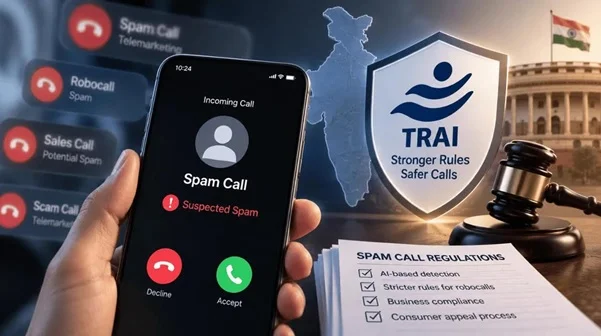
- According to the supplied report, the Telecom Regulatory Authority of India (TRAI) strengthened its framework against Unsolicited Commercial Communications on 18 September 2026.
- The reported changes introduce AI-based identification of suspected spam, greater information sharing among telecom operators, disclosure requirements for automated calls, and a mechanism to challenge the incorrect classification of legitimate calls.
Background
- Unwanted commercial calls and messages interrupt consumers, undermine trust in telecom services and can create opportunities for deceptive communication.
- India regulates commercial communication through the Telecom Commercial Communications Customer Preference Regulations and related amendments. This framework seeks to balance legitimate business communication with consumers’ consent and communication preferences.
- However, automated calling systems allow senders to reach large numbers of people quickly. Addressing such activity requires coordinated detection and enforcement across telecom networks.
What Are Unsolicited Commercial Communications?
Unsolicited Commercial Communications (UCC) broadly refer to unwanted commercial calls or messages received contrary to the applicable consent and customer-preference requirements.
What Are Application-to-Person Calls?
Application-to-Person calls are calls initiated by an application, software system or automated platform without direct human dialling.
The supplied report includes the following within this category:
|
Calling method
|
Meaning
|
|
Autodialling
|
Software automatically dials telephone numbers.
|
|
Robocalls
|
Automated systems place calls and deliver messages.
|
|
Pre-recorded voice calls
|
Recipients hear a previously recorded message.
|
|
Artificial voice calls
|
Calls use a machine-generated voice.
|
Automated calls can serve legitimate purposes, including reminders and service notifications. Their regulatory treatment depends on compliance with the applicable requirements.
Scale of the Spam Challenge
The supplied report provides the following figures:
|
Indicator
|
Reported figure
|
|
Incoming calls during Q1 FY2026–27
|
About 721.79 billion
|
|
Calls flagged as suspected spam by AI systems
|
22.99 billion
|
|
UCC complaints during 2025
|
3.1 million, or 31 lakh
|
|
Complaints through the TRAI DND app during 2025
|
1.7 million, or 17 lakh
|
|
Notices issued to unregistered telemarketers during 2025
|
More than 7.31 lakh
|
These figures measure different things. Flagged calls, complaints and enforcement notices are not interchangeable, and suspected-spam flags do not establish that every call violated the rules.
Significance
- Proactive detection: AI tools can help identify suspicious activity before every affected recipient files a complaint.
- Greater accountability: Declaring automated systems and associated numbers can improve the traceability of commercial callers.
- Coordinated enforcement: Information sharing can help operators recognise activity spread across networks.
- Consumer protection: Better screening can reduce unwanted interruptions and strengthen confidence in telecom services.
- Procedural fairness: An appeal mechanism can help correct errors affecting legitimate communication.
Relevance for India
- India’s digital economy relies heavily on mobile communication for banking, commerce, customer support and public-service delivery.
- Persistent spam can make consumers distrust unfamiliar numbers, potentially causing them to ignore genuine calls. Effective regulation must therefore reduce unwanted communication while preserving access to lawful and useful services.
- The issue also illustrates a broader governance challenge: how to use AI for enforcement while ensuring transparency, accountability and opportunities for human review.
Major Challenges
- Incorrect Spam Identification: Legitimate businesses may make large volumes of calls. If automated systems rely too heavily on call volume, genuine communication could be wrongly flagged.
- Evasion by Repeat Offenders: Senders may change numbers, use different networks or modify calling patterns to avoid detection.
- Privacy and Data Security: Sharing information across operators requires safeguards governing access, permitted use, retention and security.
- Compliance Burden: Smaller businesses may face difficulties understanding disclosure requirements and resolving incorrect classifications.
- Effective Appeals: A grievance mechanism will be useful only if affected parties can access it easily and receive timely, reasoned decisions.
Way Forward
- Establish clear criteria for identifying suspicious activity and initiating enforcement.
- Regularly assess AI systems for detection accuracy and incorrect classifications.
- Provide timely human review before or after consequential restrictions, as appropriate.
- Standardise information sharing among operators with privacy safeguards.
- Simplify compliance guidance for businesses using automated calls.
- Improve public awareness of communication preferences and complaint channels.
- Measure success through reductions in unwanted communication and repeat violations, alongside the accuracy of enforcement.
Prelims MCQs
Q. Application-to-Person (A2P) calls are best described as:
(a) Calls made exclusively between government departments
(b) Calls initiated by applications or automated systems without direct human dialling
(c) Calls made only through satellite networks
(d) Calls that always involve fraudulent activity
Mains Practice Question
“AI-based spam detection can strengthen consumer protection, but its effectiveness depends on accountability and procedural safeguards.” Discuss in the context of telecom regulation in India.
|
FAQs
1. What is the purpose of anti-spam regulation?
It seeks to protect consumers from unwanted commercial communication while allowing legitimate communication under the applicable rules.
2. Are all automated calls spam?
No. Automated calls may serve legitimate purposes. Their compliance depends on applicable consent, disclosure and other regulatory requirements.
3. Why should telecom operators share information about suspicious numbers?
Information sharing can help detect activity spread across networks and support coordinated enforcement.
4. Why is an appeal mechanism necessary?
It allows incorrect spam classifications to be reviewed and helps protect legitimate communication from unjustified restrictions.
|






 Contact Us
  New Batch : 9555124124/ 7428085757
  Tech Support : 9555124124/ 7428085757