Why in News?
Japan was hit by Typhoon Dujuan on September 21–22, 2026, bringing torrential rain, strong winds, flooding and landslides to Tokyo and nearby regions.
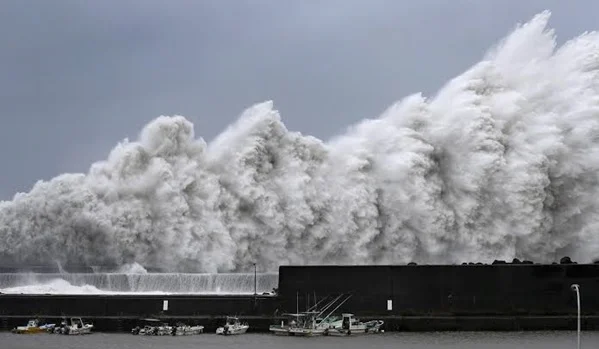
What is Typhoon Dujuan?
- Typhoon Dujuan is a powerful tropical cyclone that affected eastern Japan.
- On September 21, the typhoon recorded winds of around 144 kmph as it moved about 130 km south of Katsuura City near Tokyo.
- By the morning of September 22, it had moved away from Japan’s coast towards the northeast and its wind speed had weakened slightly, according to the Japan Meteorological Agency (JMA).
Japan Meteorological Agency (JMA)
- The Japan Meteorological Agency (JMA) is Japan’s national meteorological agency.
- It monitors and provides warnings about weather, typhoons, earthquakes, tsunamis, and other natural hazards.
Impact of Typhoon Dujuan in Japan
The typhoon caused widespread disruption across Tokyo and neighbouring prefectures.
- More than 1.6 million people were advised to evacuate.
- Two people died after landslides in Chiba and Kanagawa prefectures.
- Landslide warnings were issued for Tokyo, Chiba, Kanagawa and Shizuoka.
- More than 9,000 households near Tokyo lost power.
- Several railway services were suspended.
- Flooding was reported in different parts of the region.
- Authorities warned people against unnecessary travel.
The evacuation advisories were not mandatory.
Heavy Rainfall and Landslide Risk
- The Japan Meteorological Agency had warned that rainfall and strong winds could intensify with the arrival of the typhoon.
- According to the JMA, total rainfall through September 22 could exceed the average monthly rainfall for September, raising the risk of extremely heavy rain, flooding and landslides.
Impact on Major Events
- The typhoon also disrupted several major events.
- The Tokyo Game Show, one of the world's largest video-game trade fairs, was forced to close early on its final day.
- A major outdoor music festival and a baseball match scheduled in Chiba were also cancelled.
Flooding in Tokyo and Nearby Areas
- Flooding was reported in several locations around Tokyo.
- Images showed flooded roads near Kamakura Station, a popular tourist area. Parts of Ichikawa City, east of Tokyo, were also inundated.
- Local authorities warned residents that travelling by car could be dangerous because of flooding.
What is Typhoon?
- A typhoon is a powerful tropical cyclone that forms over the northwestern Pacific Ocean.
- It is the same type of weather system that is called:
- Hurricane in the Atlantic and northeastern Pacific
- Cyclone in the Indian Ocean and South Pacific
- Typhoon in the northwestern Pacific
- Typhoons can bring very strong winds, heavy rainfall, flooding and landslides.
Causes of Typhoons
Typhoons mainly form due to the following conditions:
- Warm Ocean Water: Sea surface temperatures of around 26.5°C or higher provide energy to the storm.
- High Moisture: Warm, moist air rises and supports the development of thunderstorms.
- Low Atmospheric Pressure: Rising warm air creates a low-pressure area near the ocean surface.
- Coriolis Effect: Earth’s rotation causes the system to rotate and develop into a cyclone.
- Low Vertical Wind Shear: Weak changes in wind speed and direction with height allow the storm to strengthen.
- Pre-existing Disturbance: Typhoons generally develop from an existing tropical weather disturbance over the ocean.
Impact of Typhoons in Japan?
- Japan frequently experiences powerful typhoons during late summer and early autumn.
- These storms can cause:
- Heavy rainfall
- Flash floods
- Landslides
- Strong winds
- Power disruptions
- Transport interruptions
- Damage to infrastructure and property
- Japan's dense population and extensive urban infrastructure make effective early-warning systems and disaster preparedness particularly important.
Prelims Practice Question
Q1. Consider the following statements about Typhoons:
- Typhoons are tropical cyclones that generally form over the northwestern Pacific Ocean.
- Warm ocean water provides energy for their development.
- The Coriolis effect helps in the rotational movement of the system.
Which of the statements given above is/are correct?
A. Only 1
B. Only 2 and 3
C. 1, 2 and 3
D. Only 1 and 3
Mains Practice Question
Q. How do tropical cyclones such as Typhoon Dujuan affect urban areas? Discuss the importance of early-warning systems and disaster preparedness in reducing their impact.
|
FAQs
1. What is a Typhoon?
A typhoon is a powerful tropical cyclone that forms over the northwestern Pacific Ocean.
2. What causes Typhoons?
Typhoons develop mainly due to warm ocean water, high atmospheric moisture, low pressure, the Coriolis effect and low vertical wind shear.
3. What is the difference between a Typhoon and a Cyclone?
They are essentially the same type of weather system. The name varies by region. Typhoon is used mainly for the northwestern Pacific, while cyclone is commonly used in the Indian Ocean and South Pacific.
4. Which agency monitors Typhoons in Japan?
The Japan Meteorological Agency (JMA) monitors typhoons and issues weather and disaster warnings.
|






 Contact Us
  New Batch : 9555124124/ 7428085757
  Tech Support : 9555124124/ 7428085757