Prelims: (Polity & Governance + CA)
Mains: (GS 2 – Social Justice, Education, Governance) |
Why in News ?
The University Grants Commission (UGC) has notified new regulations to curb discrimination, including caste-based bias, in higher education institutions. The move follows Supreme Court intervention after petitions by the mothers of Rohith Vemula (2016) and Payal Tadvi (2019), who died by suicide amid allegations of caste-based discrimination.
While these rules update the earlier 2012 equity regulations, they have also triggered pushback, with critics arguing that some provisions may lead to harassment of general category students.
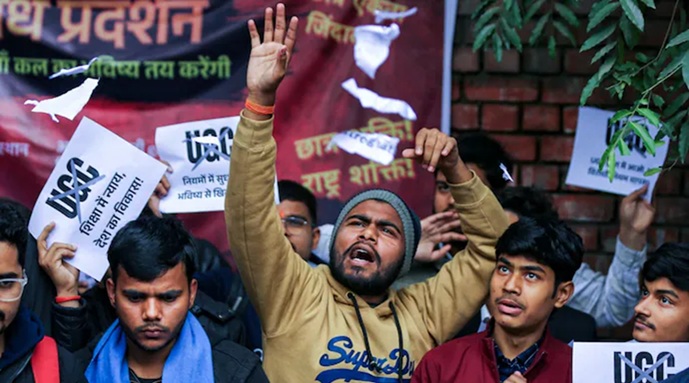
UGC Notifies Promotion of Equity Regulations, 2026
The UGC has notified the University Grants Commission (Promotion of Equity in Higher Education Institutions) Regulations, 2026.
The regulations aim to eradicate discrimination in higher education on grounds such as religion, race, gender, place of birth, caste, or disability, with a special focus on:
- Scheduled Castes (SCs)
- Scheduled Tribes (STs)
- Other Backward Classes (OBCs)
- Economically Weaker Sections (EWS)
- Persons with Disabilities (PwDs)
These rules replace the 2012 Promotion of Equity Regulations and apply to all higher education institutions. They establish a formal structure and time-bound procedure for filing and redressing discrimination-related complaints on campuses.
How Will the New UGC Regulations Be Implemented ?
To operationalise the regulations, the UGC has mandated a three-tier institutional mechanism in every higher education institution:
1. Equal Opportunity Centre (EOC)
- Every institution must establish an EOC to oversee policies for disadvantaged groups.
- It will coordinate with the district administration and police and facilitate legal aid where required.
- The EOC will consist of five faculty members, with no category-wise reservation mandated.
- If a college does not have five faculty members, the university-level EOC of the affiliating university will perform these functions.
2. Equity Committee
- A 10-member committee, chaired by the head of the institution, will support the EOC.
- Five members must belong to reserved categories—OBCs, SCs, STs, PwDs, and women.
- The committee must:
- Meet within 24 hours of receiving a complaint
- Submit its report within 15 days
- The head of the institution must initiate action within seven days of receiving the report.
3. Equity Squads and Helpline
- Institutions must constitute Equity Squads to remain vigilant and prevent discrimination on campus.
- Squads are required to be mobile and regularly visit vulnerable or sensitive locations.
- A 24-hour Equity Helpline must be established.
- Institutions must also appoint Equity Ambassadors to promote awareness and act as “torch bearers” of equity and inclusion.
How Do the 2026 UGC Regulations Differ from the 2012 Rules ?
Nature of the Regulations
- 2012: Largely advisory, stating that punishment should be proportionate to the discrimination or harassment, without clearly defined enforcement mechanisms.
- 2026: Mandatory and enforceable, with clearly specified structures, procedures, and penalties for non-compliance.
Enforcement and Penalties
- 2012: No provision for action against institutions failing to comply.
- 2026: Empowers the UGC to monitor implementation through a national-level monitoring committee and take punitive action, including:
- Debarring institutions from UGC schemes
- Restricting them from offering degree or online programmes
- Removing eligibility for central grants
Institutional Mechanisms
- 2012: Provided for Equal Opportunity Cells and an Anti-Discrimination Officer, but without detailed composition or procedures.
- 2026: Introduces a multi-tier system—EOCs, Equity Committees, and Equity Squads—with clearly defined roles, composition, and accountability.
Complaint Handling and Procedures
- 2012: Lacked clarity on complaint registration, timelines, and disposal.
- 2026: Lays down elaborate, time-bound procedures for filing, examining, and resolving complaints at every stage.
Coverage of Social Groups
- 2012: Focused mainly on SCs and STs, with no explicit mention of OBCs.
- 2026: Explicitly covers OBCs, SCs, STs, PwDs, women, and other disadvantaged groups, reflecting a more inclusive and comprehensive approach.
Controversy Over the New UGC Regulations
The new rules have attracted criticism from some student groups and commentators, who argue that:
- The regulations could lead to harassment of general category students.
- The absence of penalties for false complaints may result in misuse of the framework.
- Institutions could face punitive action even in cases of disputed or unproven allegations.
- The rules may entrench caste identities on campuses rather than reduce them, and could be politically motivated, especially with regard to OBC categorisation.
Supporters, however, argue that the regulations are necessary to ensure institutional accountability, protect vulnerable students, and prevent tragedies like those of Rohith Vemula and Payal Tadvi.
Significance for Higher Education Governance
The 2026 regulations mark a shift from advisory equity norms to a rights-based, enforceable framework in higher education. They aim to:
- Institutionalise equity and inclusion
- Ensure time-bound redressal of discrimination complaints
- Strengthen accountability of institutions
- Align campus governance with constitutional values of equality, dignity, and social justice
FAQs
1. What are the UGC Promotion of Equity Regulations, 2026 ?
They are new, enforceable rules notified by the UGC to prevent discrimination in higher education institutions and ensure equity, inclusion, and accountability.
2. Why were these regulations introduced ?
They followed Supreme Court intervention after cases of alleged caste-based discrimination, including the deaths of Rohith Vemula and Payal Tadvi, highlighting gaps in the earlier framework.
3. What new institutional mechanisms do the 2026 regulations introduce ?
They mandate Equal Opportunity Centres, Equity Committees, Equity Squads, a 24-hour helpline, and Equity Ambassadors in all institutions.
4. How are the 2026 regulations different from the 2012 rules ?
Unlike the largely advisory 2012 rules, the 2026 regulations are mandatory, time-bound, and enforceable, with penalties for institutional non-compliance and broader social group coverage.
5. What are the main criticisms of the new regulations ?
Critics argue that the absence of penalties for false complaints may lead to misuse, harassment of general category students, and increased caste-based divisions on campuses.
|





 Contact Us
  New Batch : 9555124124/ 7428085757
  Tech Support : 9555124124/ 7428085757