Prelims: PERM, Green Card, H-1B Visa, US Department of Labor, Employment-Based Immigration, EB-2 and EB-3 Categories
Mains: GS Paper II – India–US Relations, Indian Diaspora and International Migration; GS Paper III – Globalisation, Employment and the IT Services Sector
Keywords: US Green Card suspension, Cognizant, Infosys, TCS, Wipro, HCL, Capgemini, Microsoft, Adobe, PERM labour certification, H-1B visa, skilled migration, Indian IT professionals and US immigration policy. |
Why in News?
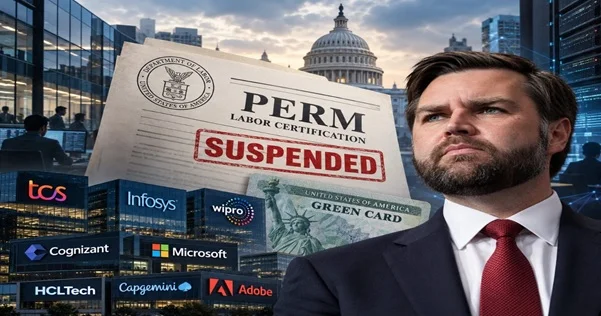
- The US Department of Labor has announced the suspension of several major technology and IT services companies, including Cognizant, Infosys, Tata Consultancy Services (TCS), Wipro, HCL and Capgemini, from the Permanent Labour Certification Programme (PERM).
- The Trump administration has cited alleged fraud, concerns over foreign labour recruitment and the displacement of American workers. Microsoft and Adobe have also reportedly faced suspension from the programme.
What is the Green Card System
- A Green Card allows a foreign national to live and work permanently in the United States, subject to applicable immigration laws. Many skilled professionals obtain permanent residency through employment-based immigration.
- In several employment-based categories, employers must first complete the PERM labour certification process before proceeding with an immigrant petition.
- Indian professionals represent a significant share of skilled foreign workers in the US. However, annual limits on employment-based immigrant visas and country-specific restrictions contribute to lengthy waiting periods for Indian applicants.
What is PERM?
- PERM stands for Program Electronic Review Management. It is the US Department of Labor's system for processing labour certification applications in many employer-sponsored Green Card cases.
- Its primary objective is to ensure that employing a foreign worker permanently does not adversely affect the wages and working conditions of similarly employed American workers.
- The process generally involves obtaining a prevailing wage determination, conducting prescribed recruitment to assess the availability of qualified US workers and submitting a labour certification application. If approved, the employer can proceed to the relevant immigrant petition stage, subject to applicable requirements.
PERM is not itself a Green Card or a work visa. It is an important preliminary stage in many employment-based permanent residency applications.
Why Has the US Suspended Major IT Companies?
- Protection of American Workers: The Trump administration argues that employers should prioritise qualified American workers and prevent immigration programmes from being misused at the expense of domestic employment.
- Concerns About Wage Competition: Authorities have raised concerns about potential wage undercutting and fraudulent filings under employment-based immigration programmes.
- Stricter Immigration Enforcement: The suspensions reflect the administration's broader emphasis on immigration enforcement and domestic employment protection. Large IT services companies face particular scrutiny because their business models often involve international recruitment and the deployment of skilled workers across borders.
PERM Vs H-1B Visa
PERM and the H-1B visa serve different purposes.
- PERM: A labour certification process used in many employer-sponsored employment-based Green Card cases.
- H-1B visa: A temporary, non-immigrant classification allowing eligible US employers to hire foreign professionals in speciality occupations.
An H-1B visa does not automatically grant permanent residency. Similarly, suspension from PERM filings does not automatically cancel an employee's existing H-1B status.
Significance of the Development
- For the US: The action highlights the government's emphasis on enforcing immigration rules and protecting domestic employment. Its actual impact on wages and job creation will depend on implementation and employer responses.
- For India: The development could affect Indian professionals and IT companies operating in the US, an important market for India's technology services industry.
- For skilled migration: It demonstrates how immigration regulations can influence international talent mobility and the global competition for skilled workers.
- For India–US relations: Restrictions may create friction over skilled mobility and services trade. However, the broader impact will depend on the duration of the suspensions and subsequent policy developments.
Challenges Ahead
- Regulatory uncertainty: Employers and employees may not know when affected filings can resume.
- Long waiting periods: Existing Green Card backlogs may compound the impact on Indian applicants.
- Employee retention: Immigration uncertainty may encourage professionals to explore opportunities elsewhere.
- Compliance requirements: Companies may need stronger recruitment documentation and immigration oversight.
- Business costs: Delays in retaining and deploying skilled workers may increase operational and administrative expenses.
Relevance for India
- The development highlights India's need to protect the interests of its skilled workforce while strengthening domestic employment opportunities.
- Indian IT companies can diversify their international markets, expand operations across regions and invest in advanced technologies such as artificial intelligence, cybersecurity and cloud computing.
- The government can also engage with US counterparts through established diplomatic and economic channels to address concerns affecting Indian professionals.
Way Forward
- The US government should ensure that enforcement action is transparent, evidence-based and consistent with applicable law. Clear communication about the scope and duration of suspensions would help employers and workers make informed decisions.
- Indian IT companies should strengthen immigration compliance, review affected cases and provide employees with reliable legal guidance. Professionals should consult qualified US immigration counsel before making decisions about employment, travel or visa extensions.
- India should continue promoting skilled mobility while investing in high-value domestic technology jobs and diversifying international economic opportunities.
Conclusion
- The suspension of major IT companies from the PERM programme highlights the growing importance of immigration compliance and domestic employment priorities in US policy.
- For Indian professionals, the immediate concern is the potential delay in employer-sponsored Green Card applications. The consequences for existing cases and H-1B extensions will depend on the specific restrictions and individual circumstances.
Prelims Practice Question
Consider the following statements about the PERM programme:
- It is a labour certification process used in many employer-sponsored Green Card cases.
- An H-1B visa automatically grants permanent residency.
- Labour certification requirements help protect the wages and working conditions of US workers in covered cases.
Which of the statements given above are correct?
(a) 1 and 2 only
(b) 1 and 3 only
(c) 2 and 3 only
(d) 1, 2 and 3
Mains Practice Question
Examine the implications of stricter US employment-based immigration rules for Indian IT professionals and India's technology industry.
|
FAQs
Q1. What is PERM?
PERM is a US labour certification process used in many employer-sponsored employment-based Green Card cases.
Q2. Which companies have reportedly been suspended?
The reported action names Cognizant, Infosys, TCS, Wipro, HCL and Capgemini. Microsoft and Adobe have also reportedly faced suspension.
Q3. Does the suspension mean Indian employees must leave the US?
No. It does not automatically cancel existing visas or require all affected employees to leave the country.
Q4. Why are Indian workers concerned?
Many rely on employer-sponsored Green Cards and already face substantial waiting periods in employment-based immigration categories.
Q5. Can affected workers extend their H-1B status?
Some workers may qualify for extensions under specific legal provisions. Eligibility depends on their individual circumstances and immigration case status.
|






 Contact Us
  New Batch : 9555124124/ 7428085757
  Tech Support : 9555124124/ 7428085757