
- UPSC Exam
- State PCS
- One Day Exam
- Current Affairs
- PT Quiz
- Downlaods
- About Coaching
- Blog
- Videos

| Prelims: (Economics + CA) Mains: (GS 3 – Infrastructure, Road Safety, Technology in Governance, Sustainable Mobility) |
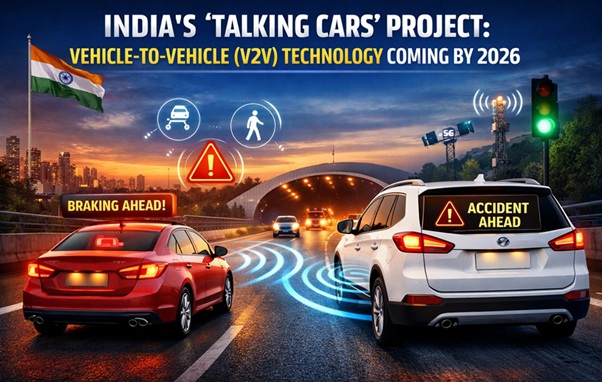
India records the highest number of road accident fatalities globally, far exceeding China and the United States. In this context, the Government of India, through the Ministry of Road Transport and Highways (MoRTH), is planning to introduce Vehicle-to-Vehicle (V2V) communication technology as part of its broader road safety and Intelligent Transport Systems (ITS) initiative.
The move aligns with India’s commitment to reduce road deaths and improve traffic management through technology-driven solutions.
India faces a persistent and severe road safety crisis:
This grim backdrop has intensified the search for technology-based interventions, of which V2V is a key component.
V2V is a wireless communication system that allows vehicles to exchange real-time data such as:
It is a subset of Vehicle-to-Everything (V2X) technology and forms a core part of the Intelligent Transport Systems (ITS) framework.
The system is inspired by aviation safety technologies, where aircraft continuously broadcast their position and speed to nearby aircraft and ground stations to prevent collisions.
India has initiated several steps to operationalise V2V technology:
On-board Unit (OBU):
Functional Benefits:
V2V systems can alert drivers about:
Illustrative Example:
If a vehicle brakes suddenly on a highway, surrounding vehicles receive an early warning, allowing them to slow down in advance and thereby preventing pile-ups and chain collisions.
The rollout of V2V in India is planned in a phased manner:
This phased approach aims to ensure affordability, technical readiness, and industry compliance.
Several countries have already made significant progress in V2V adoption:
Countries such as the UAE, Saudi Arabia, Brazil, and Mexico, like India, are currently in early pilot stages.
Examples of V2V-enabled vehicles:
raises concerns under data protection and privacy frameworks.
which could pose large-scale public safety and national security threats.
To ensure successful and safe adoption of V2V technology, India must focus on:
FAQs1. What is Vehicle-to-Vehicle (V2V) communication ? It is a wireless system that allows vehicles to exchange real-time information such as speed, location, and braking patterns to prevent accidents. 2. Why is India introducing V2V technology ? To reduce road accidents and fatalities by improving real-time communication between vehicles and strengthening road safety through technology. 3. How does V2V differ from traditional traffic management systems ? Unlike traditional systems that rely on static signals and enforcement, V2V enables dynamic, real-time, vehicle-level communication and alerts. 4. What are the main risks associated with V2V systems ? Key risks include cybersecurity threats, data privacy concerns, technological failures, and regulatory gaps. 5. How will V2V be implemented in India ? Through a phased rollout—mandatory installation in new vehicles, followed by retrofitting in older vehicles, supported by free spectrum allocation and regulatory standards. |



Our support team will be happy to assist you!

 Contact Us
  New Batch : 9555124124/ 7428085757
  Tech Support : 9555124124/ 7428085757