
- UPSC Exam
- State PCS
- One Day Exam
- Current Affairs
- PT Quiz
- Downlaods
- About Coaching
- Blog
- Videos

In recent years, the field of Artificial Intelligence (AI) has witnessed remarkable progress with the development of Large Language Models (LLMs) such as GPT-5, Claude, Gemini, and others. These models are capable of understanding, analyzing, and generating human-like language. To understand how these models function effectively, the concept of the Context Window is extremely important, as it determines the model’s effective “memory limit.”
In AI, a Context Window refers to the maximum amount of text that an AI model can consider at one time while generating a response. In other words, it is the limit within which the model can “remember” and analyze the input to produce an appropriate output.
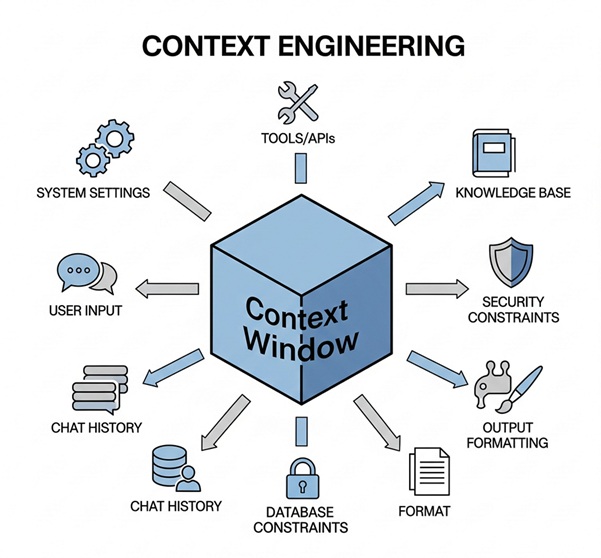
Thus, the context window determines how many tokens of information a model can consider simultaneously while generating a response.
The context window of a Large Language Model (LLM) can be compared to its working memory.
A larger context window significantly enhances the capabilities of an AI model:
In essence, the context window determines the maximum size of documents or code samples a model can process at once.
When a prompt, conversation, document, or codebase exceeds the model’s context window limit:
In such cases, loss of early context can negatively affect the quality and accuracy of the response.
Generally, increasing the size of an LLM’s context window leads to:
As the context window grows, AI models appear more “intelligent” and capable of deeper understanding.
Despite its advantages, a larger context window also presents challenges:-
Therefore, expanding the context window requires a careful balance between technical feasibility and economic efficiency.



Our support team will be happy to assist you!


 Contact Us
  New Batch : 9555124124/ 7428085757
  Tech Support : 9555124124/ 7428085757