- The recent death of a 29-year-old man in Karnataka has once again brought Kyasanur Forest Disease (KFD) into the spotlight.
- This disease often remains unnoticed until it turns severe or fatal.
- It is commonly known as “Monkey Fever” because outbreaks are frequently associated with sudden deaths of monkeys in forested areas.
What is Kyasanur Forest Disease (KFD) ?
Kyasanur Forest Disease is a tick-borne viral hemorrhagic disease found mainly in forest regions of southern India.
- It was first identified in 1957 in the Kyasanur forest area of Karnataka.
- The disease is named after this location.
- KFD is caused by the KFD virus, which belongs to the Flaviviridae family and the Flavivirus genus.
- The virus is part of the Tick-Borne Encephalitis (TBE) complex.
Why is it called “Monkey Fever” ?
- During KFD outbreaks, sudden deaths of monkeys are commonly reported in forest areas.
- Sick or dead monkeys often act as an early warning sign of virus circulation in that region.
- Because of this strong association, local communities refer to KFD as Monkey Disease / Monkey Fever.
Transmission
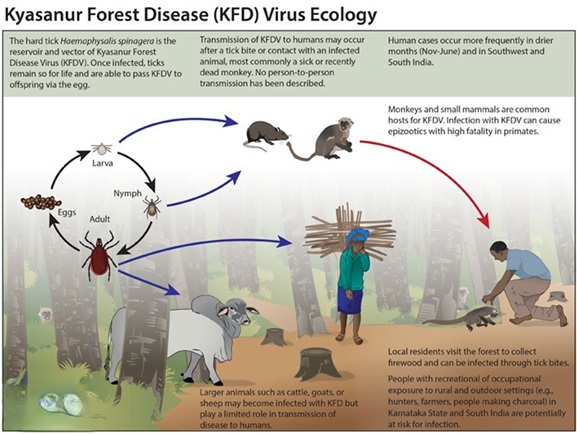
KFD does not spread from person to person, but circulates through a natural transmission cycle.
Main Vector:
- Hard ticks (Haemaphysalis spinigera) — the primary carrier of the virus.
How does infection occur ?
- Through the bite of an infected tick
- By direct contact with infected animals, especially sick or recently dead monkeys
- People working in forests, grasslands, or areas with dense leaf litter are at higher risk
Important: KFD is not transmitted between humans.
Symptoms of Kyasanur Forest Disease
Symptoms usually appear within 3–8 days after infection and may start suddenly.
Early symptoms:
- High fever
- Extreme weakness
- Headache and muscle pain
- Nausea, vomiting, and diarrhea
Severe cases may show:
- Hemorrhagic symptoms (bleeding from nose or gums)
- Neurological complications (tremors, confusion, loss of consciousness)
- In some patients, a second phase (relapse) of illness
If not treated in time, KFD can be fatal.
Treatment
- There is no specific cure for Kyasanur Forest Disease.
- Treatment is entirely based on supportive care, which includes:
- Maintaining fluid and electrolyte balance
- Oxygen support
- Blood pressure management
- Treatment of secondary infections
- ICU care in severe cases
Vaccination
The good news is that:
- A vaccine for KFD is available in India.
- It is recommended in endemic areas such as parts of Karnataka, Goa, Maharashtra, Kerala, and Tamil Nadu.
- The vaccination schedule generally includes two primary doses followed by booster doses.
Prevention Measures
- Wear full-length protective clothing while entering forest areas
- Use tick-repellent sprays or creams
- Avoid touching sick or dead monkeys
- Ensure regular vaccination for people living in or visiting endemic areas
- Report unusual monkey deaths immediately to local authorities







 Contact Us
  New Batch : 9555124124/ 7428085757
  Tech Support : 9555124124/ 7428085757