Prelims : Science & Technology + Internal Security + CA
Mains : GS Paper 3 – Internal Security; Science & Technology; Role of Technology in Security |
Why in News ?
The Prajna System, an indigenously developed AI-enabled satellite imaging platform, has recently been handed over to the Ministry of Home Affairs, marking a significant step in strengthening India’s internal security architecture.
- The system represents a major advancement in the integration of artificial intelligence with satellite-based surveillance, enabling real-time monitoring of sensitive regions
- It reflects India’s growing capability in developing indigenous high-tech security solutions, reducing dependence on foreign technologies
- The deployment comes at a time when internal security challenges such as terrorism, border infiltration, and organised threats require faster, data-driven and intelligence-led responses
- It is expected to enhance the ability of security agencies to anticipate threats rather than merely react to them
Thus, the Prajna System signifies a shift toward technology-driven, predictive, and proactive internal security management.
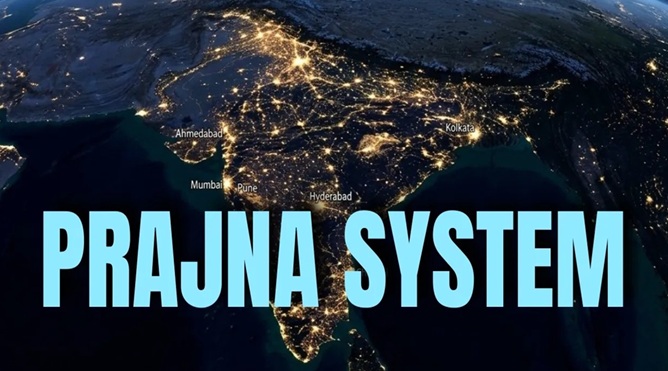
What is the Prajna System ?
The Prajna System is an AI-enabled satellite imaging and analytics platform designed to support security agencies with real-time, actionable intelligence.
- It combines :
- Satellite imagery
- Artificial intelligence algorithms
- Advanced data analytics
- It has been developed indigenously by the Defence Research and Development Organisation (DRDO) through its specialised lab, the Centre for Artificial Intelligence and Robotics (CAIR)
- The system is designed to :
- Monitor sensitive and high-risk regions
- Detect suspicious patterns and activities
- Assist in decision-making during security operations
In essence, Prajna acts as an intelligent surveillance system that transforms raw satellite data into meaningful insights for operational use.
Key Features of the Prajna System
1. Integration of Satellite Imagery with Artificial Intelligence
- The system processes high-resolution satellite images using AI algorithms to :
- Identify objects, movements, and changes on the ground
- Detect unusual or suspicious activities
- Unlike traditional surveillance, which relies heavily on human interpretation, Prajna :
- Automates analysis
- Reduces human error
- Enhances speed and accuracy
This integration allows for continuous, intelligent monitoring of vast and inaccessible areas.
2. Real-Time Data Processing and Decision Support
- One of the most critical features is its ability to :
- Analyse incoming data in real time
- Provide immediate insights to security agencies
- This enables :
- Faster operational decisions
- Quick deployment of forces
- Timely response to emerging threats
Thus, it shifts security operations from delayed response to instantaneous action.
3. Advanced Pattern Recognition and Anomaly Detection
- The system uses AI to :
- Recognise recurring patterns in activities
- Identify deviations or anomalies that may indicate potential threats
- For example :
- Unusual movement patterns in border areas
- Sudden infrastructure changes in sensitive zones
This capability is crucial for early warning systems and threat anticipation.
4. Processing of Large Volumes of Data
- Satellite systems generate enormous amounts of data, which :
- Are difficult to analyse manually
- Prajna can :
- Process and filter massive datasets efficiently
- Extract relevant information quickly
This ensures that critical intelligence is not lost in data overload.
5. Enhanced Situational Awareness
- By combining multiple data inputs, the system provides :
- A comprehensive picture of ground realities
- Security agencies can :
- Visualise developments in real time
- Understand the broader operational context
This improves coordination and strategic planning during operations.
6. Indigenous Development and Strategic Autonomy
- Being developed within India :
- Ensures data security
- Reduces reliance on foreign surveillance technologies
- It contributes to :
- Technological self-reliance
- Strengthening national security infrastructure
Applications of the Prajna System
1. Counter-Terrorism Operations
- Helps identify :
- Movement of suspected militants
- Potential hideouts or infiltration routes
- Enables :
- Pre-emptive strikes
- Disruption of terror activities before execution
2. Border and Coastal Security
- Monitors :
- Border areas for infiltration
- Coastal zones for illegal activities
- Enhances :
- Vigilance in remote and difficult terrains
3. Internal Security and Law Enforcement
- Assists in :
- Tracking organised crime networks
- Monitoring sensitive regions prone to unrest
- Supports :
- Police and paramilitary forces in planning operations
4. Disaster Management and Emergency Response
- Provides :
- Real-time imagery during natural disasters
- Helps in :
- Assessing damage
- Planning rescue and relief operations
5. Infrastructure and Strategic Asset Monitoring
- Tracks :
- Critical infrastructure such as dams, highways, and defence installations
- Ensures :
- Protection against sabotage or threats
Significance of the Prajna System
1. Shift Toward Predictive Security
- Traditional systems focus on responding to incidents
- Prajna enables :
- Anticipation of threats
- Preventive action
This marks a transition to predictive and intelligence-led security governance.
2. Force Multiplier for Security Agencies
- Enhances efficiency of :
- Armed forces
- Police
- Intelligence agencies
- Allows better utilisation of :
- Limited manpower
- Resources
3. Strengthening National Security
- Improves :
- Surveillance capability
- Response time
- Coordination among agencies
4. Promoting Indigenous Technology Development
- Demonstrates India’s capability in :
- AI
- Satellite technology
- Defence innovation
5. Enhancing Decision-Making Accuracy
- Data-driven insights reduce :
- Leads to :
- More precise and effective operations
Challenges and Concerns
1. Privacy and Civil Liberties
- Increased surveillance may :
- Raise concerns about misuse
- Impact individual privacy
2. Data Security Risks
- Sensitive data must be :
- Protected from cyber threats
- Secured against breaches
3. Dependence on Technology
- Over-reliance may :
- Reduce human intelligence inputs
- Create vulnerabilities if systems fail
4. High Cost and Maintenance
- Advanced systems require :
- Significant investment
- Continuous upgrades
5. Need for Skilled Personnel
- Effective use requires :
- Trained analysts
- Technical expertise
Way Forward
1. Strengthening Legal and Ethical Frameworks
- Ensure :
- Proper regulation of surveillance
- Protection of privacy rights
2. Enhancing Cybersecurity Measures
- Safeguard systems against :
- Cyber attacks
- Data breaches
3. Capacity Building
4. Integration with Other Security Systems
- Combine Prajna with :
- Ground intelligence
- Other surveillance technologies
5. Continuous Technological Upgradation
to keep pace with evolving threats
Practice Questions
Prelims
Q. The Prajna System is associated with :
(a) Space exploration
(b) AI-enabled satellite surveillance for security
(c) Agricultural monitoring
(d) Weather forecasting
Mains
“Artificial Intelligence is transforming internal security frameworks in India.” Discuss with reference to systems like Prajna.
FAQs
Q1. What is the Prajna System?
An AI-enabled satellite imaging system for security.
Q2. Who developed it?
DRDO’s Centre for Artificial Intelligence and Robotics.
Q3. What is its main purpose?
Real-time monitoring and decision support.
Q4. Why is it important?
Enhances predictive and proactive security.
Q5. What is the key challenge?
Balancing surveillance with privacy.
|






 Contact Us
  New Batch : 9555124124/ 7428085757
  Tech Support : 9555124124/ 7428085757