|
Prelims : Science & Technology + CA
Mains : GS Paper 3 – Security; Defence Technology; Indigenisation of Defence
|
Why in News ?
The R-37M missile has attracted significant global attention in recent years due to its growing relevance in contemporary aerial warfare and discussions around its possible induction into various air forces.
- It represents a new generation of ultra-long-range air-to-air missiles, capable of striking targets at distances far beyond traditional engagement ranges
- Its operational deployment in modern conflict scenarios has highlighted the increasing importance of beyond-visual-range (BVR) combat, where engagements occur without direct visual contact
- For countries like India, the missile has strategic significance as it could enhance air dominance capabilities and strengthen deterrence posture
Overall, the R-37M reflects a broader shift in military strategy where distance, speed, and information superiority are becoming more decisive than close-range combat manoeuvres.
What is the R-37M Missile ?
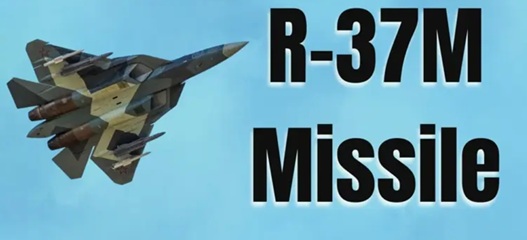
The R-37M is a long-range air-to-air missile developed by Russia, designed primarily to engage and destroy aerial targets at very long distances.
- It belongs to the category of Beyond Visual Range (BVR) missiles, which allow aircraft to attack targets that are not visible to the pilot
- It is an advanced evolution of earlier long-range interceptor missiles, developed to meet the demands of modern network-centric warfare
- Its primary operational role is not limited to dogfights but extends to strategic aerial denial by targeting critical airborne assets
In simple terms, the R-37M enables an aircraft to detect, track, and destroy enemy targets long before entering into close combat, thereby fundamentally altering traditional air combat dynamics.
Key Features of the R-37M Missile
1. Ultra-Long Range Engagement Capability
- The missile is capable of engaging targets at distances of approximately 300–400 kilometres, placing it among the longest-range air-to-air missiles in the world
This extended range has several strategic implications :
- Enemy aircraft can be targeted well before they approach contested airspace, effectively keeping threats at a safe distance
- It creates a psychological and operational “no-entry zone”, forcing adversaries to operate cautiously or from farther distances
- It enables targeting of high-value assets located deep within enemy formations, without the need for direct confrontation
Thus, range becomes a decisive advantage in shaping aerial battles even before they begin.
2. Hypersonic Speed and High Kinetic Energy
- The missile can achieve speeds of up to Mach 6, making it extremely fast and difficult to intercept
The high speed contributes to :
- Reduced reaction time for the target, making evasive manoeuvres less effective
- Increased kinetic energy upon impact, enhancing its destructive capability
- Greater survivability of the missile against interception systems
In essence, speed ensures that once launched, the missile becomes a high-probability kill weapon, especially against large targets.
3. Advanced Multi-Stage Guidance System
The R-37M employs a sophisticated guidance mechanism to ensure accuracy over long distances :
- Inertial Navigation System (INS) guides the missile during the initial phase
- Mid-course updates are provided by the launching aircraft or external systems to adjust trajectory
- Active radar homing in the terminal phase allows the missile to independently track and engage the target
This layered guidance system ensures :
- High precision even at extreme ranges
- Ability to track fast-moving and manoeuvring targets
- Reduced dependence on continuous pilot intervention
It reflects the integration of sensor technology, data links, and automation in modern missile systems.
4. High-Explosive Warhead with Large Lethal Radius
- The missile is equipped with a large high-explosive fragmentation warhead, designed to maximise damage
This allows it to :
- Destroy large airborne platforms even without direct impact
- Create a wide lethal radius, increasing the probability of target neutralisation
Such destructive capability is particularly effective against strategic assets that are critical to air operations.
5. Designed for High-Value Target Engagement
Unlike conventional air-to-air missiles designed for dogfighting, the R-37M is optimised for :
- Airborne Warning and Control Systems (AWACS)
- Aerial refuelling tankers
- Surveillance and reconnaissance aircraft
These targets are :
- Less manoeuvrable
- Highly valuable for command, control, and coordination
By neutralising such assets, the missile can cripple an enemy’s entire air combat ecosystem, even without engaging fighter jets directly.
6. Integration with Advanced Fighter Platforms
- The missile is compatible with high-performance interceptor and fighter aircraft, enabling long-range interception missions
This integration allows :
- Use in network-centric warfare environments, where data from multiple platforms is shared
- Coordination between aircraft, radars, and command systems for effective targeting
Strategic Significance of the R-37M
1. Transformation of Air Combat Doctrine
- Traditional air combat relied heavily on close-range dogfights and pilot skill
- The R-37M shifts the focus toward :
- Long-range detection
- First-strike capability
- Information dominance
This marks a transition from manoeuvre-centric warfare to technology-driven warfare.
2. Stand-Off Strike Capability
- Aircraft can launch the missile from distances where they are :
- Outside enemy radar coverage
- Beyond enemy missile engagement zones
This enhances :
- Pilot safety
- Aircraft survivability
- Operational flexibility
3. Creation of Anti-Access/Area Denial (A2/AD) Zones
- The missile enables the creation of restricted airspaces where enemy aircraft cannot safely operate
This is critical for :
- Protecting strategic assets
- Controlling contested airspace
4. Force Multiplier Effect
- Even limited deployment of such missiles can :
- Disrupt enemy air operations
- Force adversaries to change tactics
This multiplies the effectiveness of existing air power.
Relevance for India
1. Strengthening Air Superiority
- Enhances India’s ability to dominate airspace in potential conflict scenarios
- Extends engagement range of existing fighter aircraft
2. Countering Regional Developments
- Neighbouring countries are upgrading their aerial capabilities
- Long-range missiles provide a technological and strategic edge
3. Enhancing Deterrence
- Ability to target critical enemy assets acts as a strong deterrent
- Reduces likelihood of adversarial escalation
4. Complementing Indigenous Systems
- Can work alongside indigenous missile systems
- Provides capability bridging while domestic technologies evolve
Limitations of the R-37M
1. Large Size and Limited Payload Capacity
- Its size and weight restrict :
- Number of missiles carried
- Compatibility with certain aircraft
2. Reduced Effectiveness Against Agile Targets
- Less suited for highly manoeuvrable fighter jets
- More effective against slower, larger targets
3. Dependence on Advanced Support Systems
- Requires :
- High-quality radar systems
- Real-time data sharing
Without these, effectiveness may be reduced.
4. High Cost and Operational Complexity
- Expensive to produce and deploy
- Requires advanced training and integration
Way Forward
1. Indigenous Development of Long-Range Missiles
- Invest in domestic R&D to develop similar capabilities
- Reduce dependence on foreign suppliers
2. Integration with Network-Centric Warfare
- Enhance data-sharing capabilities between platforms
- Improve real-time targeting systems
3. Development of Countermeasures
- Invest in technologies to :
- Detect long-range missiles
- Jam guidance systems
- Enhance evasive capabilities
4. Balanced Air Combat Strategy
- Combine :
- Long-range missiles
- Medium and short-range systems
to ensure comprehensive defence capability
Practice Questions
Prelims
Q. The R-37M missile is classified as :
(a) Surface-to-air missile
(b) Ballistic missile
(c) Long-range air-to-air missile
(d) Cruise missile
Mains
“Technological advancements such as ultra-long-range air-to-air missiles are redefining the nature of aerial warfare.” Discuss with reference to the R-37M missile.
FAQs
Q1. What type of missile is R-37M ?
It is a long-range air-to-air missile.
Q2. What makes it unique ?
Its extremely long range and high speed.
Q3. What is its main purpose ?
To destroy high-value aerial targets at long distances.
Q4. Why is it important strategically ?
It enhances stand-off strike capability and deterrence.
Q5. What is its limitation ?
Less effective against highly manoeuvrable fighter jets.
|






 Contact Us
  New Batch : 9555124124/ 7428085757
  Tech Support : 9555124124/ 7428085757