Prelims : Economy + CA
Mains : GS Paper 3 – Inclusive Growth; Infrastructure; Industrial Development |
Why in News ?
The Vishwa Sutra Initiative has recently gained attention as part of India’s efforts to :
- Strengthen its position as a global leader in textiles and apparel manufacturing
- Promote traditional textile heritage alongside modern industrial capabilities
- Enhance exports, branding, and value addition in the textile sector
The initiative reflects a strategic push to integrate India’s rich cultural legacy in textiles with global market competitiveness, thereby positioning the country as a comprehensive textile hub.
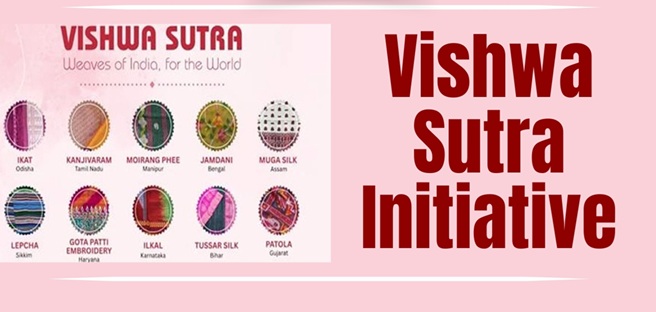
What is the Vishwa Sutra Initiative ?
The Vishwa Sutra Initiative is a government-led effort aimed at promoting India’s textile sector globally by combining :
- Traditional craftsmanship and heritage textiles
- Modern manufacturing technologies
- Global branding and export strategies
The term “Vishwa Sutra” symbolically represents :
Thus, the initiative envisions India as a global thread connecting tradition, innovation, and commerce in the textile industry.
Objectives of the Vishwa Sutra Initiative
1. Promoting India as a Global Textile Hub
- The initiative aims to position India as a one-stop destination for textiles, covering the entire value chain :
- Fibre production
- Yarn and fabric manufacturing
- Garments and fashion
This integrated approach enhances India’s competitiveness in global markets.
2. Boosting Textile Exports
- Focus on increasing India’s share in the global textile trade
- Encourages :
- Value-added products
- Branding of Indian textiles
This reduces reliance on low-value exports and improves foreign exchange earnings.
3. Reviving Traditional and Handloom Sectors
- Emphasis on :
- Handlooms
- Handicrafts
- Indigenous textile traditions
This helps preserve cultural heritage while providing livelihood opportunities to artisans.
4. Encouraging Innovation and Technology Adoption
- Promotes :
- Use of advanced manufacturing technologies
- Digital platforms for marketing and sales
This ensures that the sector remains globally competitive and future-ready.
5. Generating Employment
- The textile sector is labour-intensive and has the potential to :
- Create large-scale employment
- Empower women and rural populations
Key Features of the Initiative
1. Integrated Value Chain Development
- Focus on strengthening all stages of textile production :
- Raw material
- Processing
- Manufacturing
- Marketing
This reduces inefficiencies and enhances productivity.
2. Branding and Global Positioning
- Efforts to create a distinct global identity for Indian textiles
- Promotion through :
- International exhibitions
- Trade fairs
- Branding campaigns
3. Support for MSMEs and Artisans
- Special emphasis on :
- Small and medium enterprises
- Traditional artisans
Provides them with :
- Market access
- Financial support
- Skill development
4. Focus on Sustainability
- Encourages :
- Eco-friendly production practices
- Use of sustainable materials
This aligns with global demand for green and ethical fashion.
5. Digital and E-Commerce Integration
- Promotion of digital platforms to :
- Expand market reach
- Connect producers directly with consumers
Significance of the Vishwa Sutra Initiative
1. Strengthening India’s Global Competitiveness
- India is already one of the largest producers of textiles
- The initiative helps in moving up the value chain from :
- Raw materials to branded products
2. Boosting Export Earnings
- Higher value-added exports lead to :
- Increased foreign exchange earnings
- Improved trade balance
3. Preserving Cultural Heritage
- Revives traditional crafts and techniques
- Ensures sustainability of artisan communities
4. Promoting Inclusive Growth
- Generates employment in rural and semi-urban areas
- Enhances income for marginalised communities
5. Supporting Women Empowerment
- A large proportion of textile workers are women
- The initiative strengthens their economic participation
Challenges
1. Global Competition
- Strong competition from countries like :
2. Infrastructure Gaps
- Issues related to: Logistics & Supply chain efficiency
3. Fragmented Industry Structure
- Presence of numerous small players leads to :
- Lack of scale & Reduced efficiency
4. Technological Gaps
- Need for modernisation and adoption of advanced technologies
5. Environmental Concerns
- Textile industry is resource-intensive
- Requires sustainable practices
Way Forward
1. Strengthening Infrastructure
- Improve logistics and supply chain networks
- Develop textile parks and clusters
2. Enhancing Skill Development
- Train workforce in modern textile technologies
- Upgrade artisan skills
3. Promoting Innovation
- Invest in R&D
- Encourage design and product development
4. Expanding Global Market Access
- Enter new markets
- Strengthen trade agreements
5. Ensuring Sustainability
- Promote eco-friendly practices
- Align with global environmental standards
Practice Questions
Prelims
Q. The Vishwa Sutra Initiative is related to :
(a) Agriculture
(b) Textile sector
(c) Space technology
(d) Digital governance
Mains
“India’s textile sector holds immense potential for economic growth and employment generation.” Discuss in the context of initiatives like Vishwa Sutra.
FAQs
Q1. What is the Vishwa Sutra Initiative ?
It is an initiative to promote India’s textile sector globally.
Q2. What is its main objective ?
To position India as a global textile hub.
Q3. Which sector does it target ?
Textiles and apparel.
Q4. Why is it important ?
It boosts exports, employment, and cultural preservation.
Q5. What is the major challenge ?
Global competition and need for modernisation.
|






 Contact Us
  New Batch : 9555124124/ 7428085757
  Tech Support : 9555124124/ 7428085757