Prelims: (Science & Technology + CA)
Mains: (GS 3 – Space Technology, Indigenisation, Institutional Capacity) |
Why in News ?
The Indian Space Research Organisation (ISRO) suffered a setback at the start of the year when the PSLV-C62 mission, carrying 16 satellites, failed to achieve its intended orbit. This marks the second consecutive failure of the Polar Satellite Launch Vehicle (PSLV)—ISRO’s most reliable launch vehicle for over three decades—following the PSLV-C61 failure in May 2025.
In both missions, the rocket performed normally during the first two stages but developed problems during the third stage, which is critical for achieving orbital velocity. While the cause of the latest failure is yet to be officially confirmed, it is suspected to involve a drop in combustion chamber pressure, similar to the earlier incident.
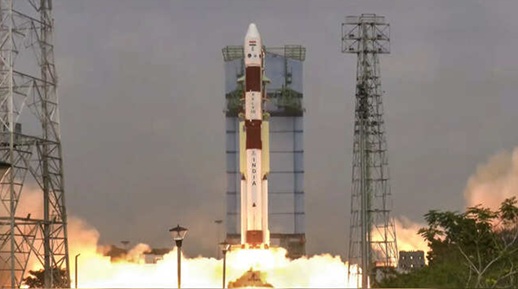
Background: PSLV and India’s Space Reliability Record
Since its first successful launch in 1994, the PSLV has been the backbone of India’s space programme, known for:
- High reliability
- Cost-effective launches
- Commercial deployment of foreign satellites
The PSLV has played a key role in:
- Earth observation missions
- Navigation satellites
- Interplanetary missions such as Chandrayaan-1 and Mars Orbiter Mission
Repeated failures involving this trusted platform therefore raise concerns not just about technology, but also about institutional processes and quality control.
What is the Polar Satellite Launch Vehicle (PSLV) ?
The PSLV is a four-stage launch vehicle, with each stage using a different propulsion system to sequentially accelerate the rocket before separating once its role is complete.
Its design balances:
- High thrust for lift-off
- Efficient acceleration
- Precise orbital insertion
This staged architecture allows the vehicle to gradually build speed and altitude while shedding excess mass.
PSLV: How India’s Workhorse Rocket Reaches Orbit
1. First Stage: Lift-off and Atmospheric Ascent
- Uses solid propellant
- Handles lift-off and steep vertical climb
- Reaches about 50–60 km altitude
- Consumes fuel rapidly in under two minutes before separation
2. Second Stage: Vertical-to-Horizontal Transition
- Powered by the Vikas liquid engine
- Builds horizontal velocity while continuing ascent
- Takes the rocket to 220–250 km altitude
- Accelerates it to around 14,000 km/h
- Significantly reduces vehicle mass before separation
3. Third Stage: Rapid Acceleration Phase
- Uses solid fuel propulsion
- Rocket travels almost entirely horizontally on a sub-orbital path
- Accelerates rapidly to 26,000–28,000 km/h
- This velocity is essential to prevent the vehicle from falling back to Earth
4. Fourth Stage: Precise Orbital Insertion
- Liquid propulsion stage
- Fine-tunes velocity and altitude
- Places satellites into Low Earth Orbit (250–2,000 km)
- After payload deployment, all stages have completed their role
The Critical Role of PSLV’s Third Stage
The third stage is one of the most technically sensitive phases of a PSLV launch.
- Solid fuel burns to produce high-pressure gas
- Gas exits through a nozzle to generate thrust
- Combustion chamber pressure directly determines acceleration
- Any pressure drop:
- Reduces thrust
- Prevents the rocket from reaching orbital velocity
- Causes the mission to fail, as gravity pulls the vehicle back
In the PSLV-C61 mission, failure was attributed to a manufacturing defect leading to pressure leakage, though the detailed Failure Analysis Committee (FAC) report was not made public.
Fallout of Repeated PSLV Failures for ISRO
Operational Impact
- Three failures in the last six missions indicate an unusually high failure rate
- Raises concerns over quality assurance and manufacturing consistency
Commercial Consequences
- PSLV is a major revenue generator through:
- Commercial launches
- Foreign satellite deployment
- Reliability concerns could affect:
- International confidence
- India’s share in the global launch market
Reputational Risk
- Back-to-back failures of a “trusted” launcher attract greater scrutiny
- Comparisons with private global launch providers intensify pressure on ISRO
The Bigger Picture: Transparency and Institutional Trust
Beyond the technical causes, the issue highlights institutional challenges.
- The PSLV-C61 FAC report was not released publicly
- Launching PSLV-C62 just eight months later without disclosing corrective measures has:
- Raised questions on transparency
- Intensified scrutiny over risk management
- Sparked debate on return-to-flight protocols
While space agencies worldwide face failures, openness and accountability are critical for sustaining public and international confidence.
Challenges and Way Ahead
Technical Challenges
- Identifying and rectifying recurring third-stage defects
- Strengthening quality control in solid motor manufacturing
Institutional Challenges
- Balancing launch cadence with safety
- Enhancing transparency in failure analysis
Way Forward
- Public release of investigation findings
- Independent audits of manufacturing processes
- Strengthening redundancy and testing protocols
- Leveraging ISRO’s strong legacy of learning from failures
FAQs
1. What caused the recent PSLV failures ?
Both failures are suspected to be linked to a drop in combustion chamber pressure during the third stage.
2. Why is the third stage so critical ?
It provides rapid acceleration to orbital velocity; insufficient speed causes the rocket to fall back to Earth.
3. How serious are two consecutive PSLV failures ?
They are significant because PSLV has historically been ISRO’s most reliable launcher.
4. Will this affect ISRO’s commercial launches ?
Yes, repeated failures may impact international confidence and commercial revenue in the short term.
5. Can ISRO recover from this setback ?
ISRO has a strong track record of learning from failures and is expected to restore reliability through corrective measures.
|






 Contact Us
  New Batch : 9555124124/ 7428085757
  Tech Support : 9555124124/ 7428085757