Why in the News?
- Recently, the Central Pollution Control Board (CPCB) clarified the rationale behind setting the maximum limit of the Air Quality Index (AQI) at 500 under the National Air Quality Index (NAQI).
Why Is There a Controversy?
- After Diwali, a significant difference was observed between the readings of government and private air quality monitoring platforms in Delhi.
- Private air quality apps reported Delhi's AQI levels between 1,500 and 1,800, whereas the official CPCB readings remained below 400.
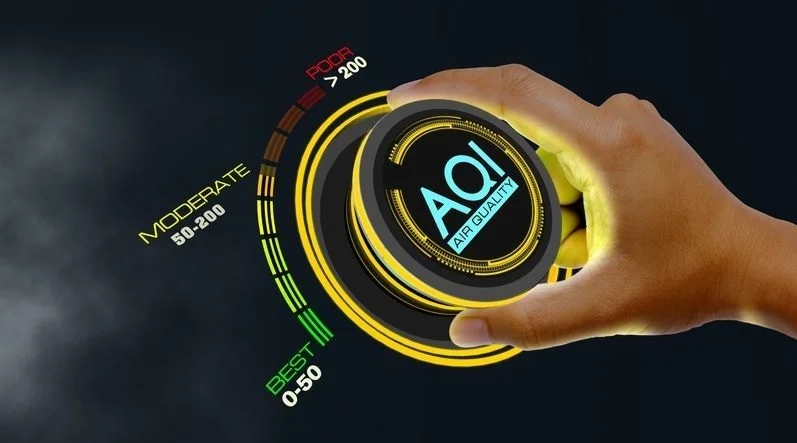
Air Quality Index (AQI)
- Launched in 2014 under the Swachh Bharat Mission.
- It is an index used to report air quality on a daily basis.
- It indicates how clean or polluted the air is and the associated health risks.
- It measures eight major air pollutants:
- PM2.5
- PM10
- Ammonia (NH₃)
- Lead (Pb)
- Nitrogen Oxides (NOx)
- Sulphur Dioxide (SO₂)
- Ozone (O₃)
- Carbon Monoxide (CO)
Difference Between Government and Private AQI Monitoring
- Official AQI is calculated using a 24-hour rolling average. Its objective is to assess people's exposure to air pollution over an extended period.
- Private apps often display real-time or hourly peak pollution levels.
- CPCB monitoring equipment is designed to measure particulate matter (PM) concentrations up to a maximum of 1,000 micrograms per cubic metre.
- During Diwali, when pollution levels exceeded this limit due to firecrackers, the system classified readings recorded during those hours as 'Out of Range' and excluded them from the 24-hour average calculation.
- Private air quality monitoring apps generally use low-cost sensors.
- Many platforms display hourly fluctuations, which may show significantly higher AQI levels during sudden spikes in pollution.
- India uses its own NAQI standards and calculates AQI based on eight pollutants, including PM2.5, PM10, NO₂ and SO₂.
- Several private platforms use US or other international standards (breakpoints), resulting in different AQI values for the same air quality conditions.
Why Is the Maximum AQI Limit Set at 500?
The CPCB has provided the following arguments for limiting AQI to 500:
- The National Air Quality Index (NAQI), developed in 2015, adopted the upper limit of 500 broadly in line with the standards of the US Environmental Protection Agency (US EPA) and China.
- This is not a technical malfunction but an inherent feature of the index's original design.
- The NAQI has six categories, with the highest category, 'Severe', covering AQI values from 401 to 500.
- This category represents the highest level of health risk.
- According to the CPCB, pollution levels above 500 also pose similarly severe health risks. Therefore, extending the numerical scale beyond 500 would not result in any change in the health warning category.
Causes of Air Pollution in Delhi
- Stubble burning in Haryana, Punjab and western Uttar Pradesh.
- Vehicular emissions.
- Dust generated by building construction and other construction activities.
- Road dust.
- Industrial pollution.
- Emissions from coal-based power plants.
- Stable atmospheric conditions during winter: Pollutants become trapped in the atmosphere and are unable to disperse outside Delhi.
Measures to Control Air Pollution
- Encourage farmers to adopt alternatives to stubble burning by providing financial assistance.
- Establish plants for converting stubble into organic manure.
- Set up biogas plants to utilise stubble as a raw material, thereby providing additional income to farmers.
- Increase the availability and improve the quality of public transport.
- Reduce the number of petrol- and diesel-powered vehicles.
- Promote battery-operated and electric vehicles.
- Encourage coal-based industries to shift towards cleaner fuels such as natural gas and hydrogen.
- Impose pollution charges or cess on polluting activities.
Government Initiatives to Control Air Pollution
1. National Clean Air Programme (NCAP)
- Launched: 2019
- Objective: To improve air quality across the country.
- Nodal Ministry: Ministry of Environment, Forest and Climate Change (MoEFCC).
2. Graded Response Action Plan (GRAP)
- Launched: 2017.
- Implementation: Commission for Air Quality Management (CAQM).
- It is an emergency response mechanism to control air pollution.
- It is implemented in Delhi-NCR when air quality deteriorates.
- It aims to prevent further deterioration of air quality once pollution reaches specified thresholds.
- GRAP is divided into four stages:
- Stage I: AQI between 201 and 300 (Poor).
- Stage II: AQI between 301 and 400 (Very Poor).
- Stage III: AQI between 401 and 450 (Severe).
- Stage IV: AQI above 450 (Severe+).
Central Pollution Control Board (CPCB)
- The Central Pollution Control Board (CPCB) is a statutory organisation functioning under the Ministry of Environment, Forest and Climate Change, Government of India.
- It was established on 22 September 1974 under the Water (Prevention and Control of Pollution) Act, 1974.
- It functions as the country's apex technical body for monitoring, preventing and controlling air and water pollution.
Major Statutory Powers
- Under the Water Act, 1974: The Board has powers to prevent and control water pollution and maintain or restore the wholesomeness of water bodies, including rivers, lakes and wells.
- Under the Air Act, 1981: The Board is empowered to improve air quality and control air pollution across the country.
- Under the Environment (Protection) Act, 1986: It provides technical services and advice to the Ministry of Environment.
Structure
- Headquarters: Parivesh Bhawan, New Delhi.
- It works in coordination with State Pollution Control Boards (SPCBs) and Pollution Control Committees (PCCs) of Union Territories.
- It has established regional laboratories and Continuous Ambient Air Quality Monitoring Stations (CAAQMS) across the country to monitor environmental standards.
Major Functions
- Prescribes national standards for industrial emissions, wastewater, ambient air quality and water quality.
- Collects technical and statistical data related to pollution and publishes the National Air Quality Index (NAQI).
- Provides recommendations to the Central Government for implementing pollution control policies and programmes.
- Organises training programmes for personnel engaged in pollution control.
- Conducts public awareness campaigns to promote environmental protection.
Mains Examination Question
"Air Quality Index (AQI) is an important tool for understanding the impacts of urban air pollution. Critically examine the methodology of AQI measurement in India, its limitations and its role in public health policy."
Preliminary Examination Question
Q. When was the Central Pollution Control Board (CPCB) established?
(a) 1972
(b) 1974
(c) 1981
(d) 1986
|
Frequently Asked Questions (FAQs)
1. What is AQI?
Answer: The Air Quality Index (AQI) is a numerical scale that indicates the quality of air and its potential health impacts based on the concentration of various pollutants present in the atmosphere.
2. What is the difference between PM2.5 and PM10?
Answer:
- PM2.5: Particulate matter having a diameter of 2.5 micrometres or less.
- PM10: Particulate matter having a diameter of 10 micrometres or less.
3. What is Temperature Inversion?
Answer: Under normal atmospheric conditions, temperature decreases with increasing altitude. However, during temperature inversion, temperature increases with altitude.
This restricts vertical air mixing and causes pollutants to accumulate near the Earth's surface.
4. What is GRAP?
Answer: The Graded Response Action Plan (GRAP) is an emergency response mechanism under which pollution control measures are implemented in Delhi-NCR according to the severity of air pollution. It was implemented in 2017.
5. Under which major Acts does the CPCB function?
Answer:
- Water (Prevention and Control of Pollution) Act, 1974.
- Air (Prevention and Control of Pollution) Act, 1981.
- Environment (Protection) Act, 1986.
|