Prelims: COP31, Climate Change Performance Index (CCPI), Nationally Determined Contributions (NDCs), Renewable Energy, Paris Agreement.
Mains: GS Paper III – Environmental Conservation, Climate Change, Energy Transition and Sustainable Development.
Keywords: CCPI 2027, COP31, Climate Action, Net Zero Emissions, Carbon Sink, Energy Security, Renewable Energy, Fossil Fuels. |
Why in News?
India has slipped five positions to 28th place in the Climate Change Performance Index (CCPI) 2027, released on the sidelines of the COP31 climate summit in Antalya, Türkiye. Despite significant progress in renewable energy, India retained its overall ‘medium’ performance rating due to continued coal dependence and inadequate energy infrastructure.

About the Climate Change Performance Index (CCPI)
- The CCPI is an independent monitoring tool that evaluates countries' performance in combating climate change.
- It has been published annually since 2005.
- Published by: Germanwatch and NewClimate Institute.
- Coverage: 64 countries and the European Union, accounting for over 90% of global greenhouse gas emissions.
- Objective: To promote transparency, accountability and international cooperation in climate action.
- It assesses countries' progress towards achieving the objectives of the Paris Agreement.
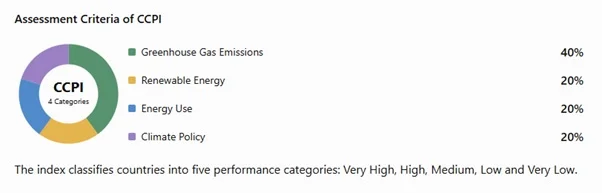
Key Findings of CCPI 2027
- India's Ranking: India ranked 28th with a score of 60.85, declining five positions from the previous edition.
- Global Leader: Denmark secured fourth position with 84.05 points, becoming the highest-ranked country for the sixth consecutive year.
- Vacant Positions: The first three positions remain vacant as no country achieved an overall ‘very high’ rating.
- G20 Performance: Ten G20 countries received ‘very low’ ratings, while the United Kingdom was the only G20 country with a ‘high’ rating.
- European Union: The EU secured 19th position with a ‘medium’ rating.
- Lowest-Ranked G20 Countries: Saudi Arabia (65th), Russia (66th) and the United States (67th).
Global Rankings in CCPI 2027
|
Rank
|
Country/Entity
|
|
1st–3rd
|
Vacant
|
|
4th
|
Denmark
|
|
5th
|
Lithuania
|
|
6th
|
Luxembourg
|
|
7th
|
United Kingdom
|
|
19th
|
European Union
|
|
28th
|
India
|
|
65th
|
Saudi Arabia
|
|
66th
|
Russia
|
|
67th
|
United States
|
|
68th
|
Iran
|
India's Achievements in Climate Action
- Renewable Energy Expansion: India received a ‘high’ rating for its renewable energy trend, particularly solar and wind energy development.
- Non-Fossil Fuel Capacity: India achieved 50% of its installed electricity capacity from non-fossil fuel sources in June 2025, five years ahead of its original target.
- Rooftop Solar: Government initiatives have encouraged decentralised solar electricity generation.
- Electric Mobility: Growing adoption of electric vehicles is supporting the transition towards cleaner transportation.
- Domestic Manufacturing: Production incentives are strengthening domestic solar equipment manufacturing.
India's Climate Commitments
Under its updated Nationally Determined Contributions (NDCs), India aims to achieve the following targets:
|
Climate Target
|
Commitment
|
|
Emissions intensity
|
47% reduction from 2005 levels by 2035
|
|
Non-fossil electricity capacity
|
Approximately 60% by 2035
|
|
Additional carbon sink
|
3.5–4 billion tonnes of CO₂ equivalent through forest and tree cover
|
|
Net Zero Emissions
|
By 2070
|
Note: Non-fossil electricity capacity includes renewable energy and nuclear power. Installed capacity does not necessarily represent actual electricity generation.
Challenges Highlighted by the Report
- Dependence on Coal: Coal continues to play a major role in India's electricity generation, increasing greenhouse gas emissions.
- Inadequate Grid Infrastructure: Electricity transmission and storage infrastructure are struggling to accommodate the rapid expansion of renewable energy.
- Renewable Energy Curtailment: India curtailed around 2.3 TWh of solar electricity between late May and December 2025 to maintain grid stability.
- Fossil Fuel Imports: Dependence on imported crude oil, natural gas and coal creates economic and energy security challenges.
- Rising Energy Demand: Industrialisation, urbanisation and economic development are increasing energy consumption and per-capita emissions.
India's Response to the Report
- The Union Environment Ministry questioned the assessment, highlighting India's rapid progress in clean energy development.
- India emphasised its early achievement of the 2030 non-fossil electricity capacity target.
- The government maintained that coal remains essential for meeting India's growing energy and developmental requirements.
- India's position reflects the need to balance climate mitigation with energy security, economic growth and developmental priorities.
Government Initiatives for Climate Action
|
Initiative
|
Objective
|
|
National Action Plan on Climate Change
|
Address climate change through national missions
|
|
National Green Hydrogen Mission
|
Promote green hydrogen production and utilisation
|
|
PM Surya Ghar: Muft Bijli Yojana
|
Promote residential rooftop solar installations
|
|
PM-KUSUM
|
Encourage solar energy use in agriculture
|
|
Green Energy Corridor
|
Strengthen renewable electricity transmission
|
|
PM E-DRIVE Scheme
|
Accelerate electric mobility
|
|
Carbon Credit Trading Scheme
|
Promote market-based emission reductions
|
Significance of CCPI for India
- Policy Evaluation: Helps assess the effectiveness of India's climate policies.
- International Accountability: Encourages countries to fulfil their climate commitments.
- Energy Transition: Highlights infrastructure gaps in clean energy adoption.
- Climate Investment: Can guide investment towards low-carbon technologies.
- Sustainable Development: Encourages a balance between economic growth and environmental protection.
Way Forward
- Accelerate the development of battery storage and modern electricity grids.
- Prepare a comprehensive roadmap for reducing fossil fuel dependence.
- Promote energy efficiency and cleaner industrial technologies.
- Strengthen investment in green hydrogen and renewable energy.
- Ensure a just energy transition for coal-dependent communities.
- Enhance international cooperation on climate finance and technology transfer.
Conclusion
India's declining CCPI ranking highlights the gap between renewable energy expansion and actual decarbonisation. Achieving long-term climate objectives requires modern energy infrastructure, reduced fossil fuel dependence and a balanced approach towards sustainable development and energy security.
Prelims Practice Questions
Q. With reference to the Climate Change Performance Index (CCPI), consider the following statements:
- It is published by Germanwatch and NewClimate Institute.
- Greenhouse gas emissions receive the highest weightage in the index.
- Denmark secured first position in CCPI 2027.
Which of the statements given above is/are correct?
(a) 1 and 2 only
(b) 2 and 3 only
(c) 1 and 3 only
(d) 1, 2 and 3
Mains Practice Question
Q. Despite significant progress in renewable energy expansion, India's performance in the Climate Change Performance Index has declined. Discuss the major challenges in India's energy transition and suggest measures to achieve its long-term climate commitments.
|
FAQs
Q1. What is India's rank in CCPI 2027?
India secured 28th position with 60.85 points.
Q2. Who publishes the Climate Change Performance Index?
Germanwatch and NewClimate Institute jointly publish this index.
Q3. Which country topped the CCPI 2027 rankings?
Denmark emerged as the highest-ranked country, securing fourth position.
Q4. Why are the first three CCPI positions vacant?
No country achieved the required overall performance standards.
Q5. What is India's net-zero emissions target year?
India aims to achieve net-zero emissions by 2070.
|