
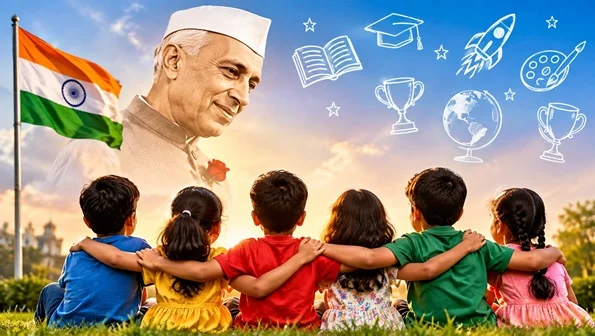
Children's Day 2026 will be celebrated across India on 14 November 2026 (Saturday). The day is popularly known as Bal Diwas.
|
Basis |
Children's Day in India |
World Children's Day |
|
Date |
14 November |
20 November |
|
Associated with |
Jawaharlal Nehru's birth anniversary |
UN initiative |
|
Main objective |
Children's welfare and development |
Promotion of children's rights globally |
|
Historical significance |
Associated with Nehru and Bal Diwas |
UN Declaration and Convention on the Rights of the Child |
|
Article |
Constitutional Provision |
|
Article 14 |
Equality before law and equal protection of laws |
|
Article 15(3) |
Allows the State to make special provisions for women and children |
|
Article 21 |
Protection of life and personal liberty |
|
Article 21A |
Free and compulsory education for children aged 6–14 years |
|
Article 23 |
Prohibition of human trafficking and forced labour |
|
Article 24 |
Prohibits employment of children below 14 years in factories, mines and hazardous employment |
|
Article 39(e) |
Protects the health and strength of workers and children against abuse |
|
Article 39(f) |
Ensures opportunities for healthy development of children with dignity |
|
Article 45 |
Early childhood care and education for children below six years |
|
Article 47 |
Duty of the State to improve nutrition and public health |
|
Act |
Year |
Main Objective |
|
Commissions for Protection of Child Rights Act |
2005 |
Establishment of NCPCR and State Commissions |
|
Right to Education Act |
2009 |
Free and compulsory education for children aged 6-14 |
|
Protection of Children from Sexual Offences (POCSO) Act |
2012 |
Protection against sexual offences |
|
Juvenile Justice Act |
2015 |
Care, protection, rehabilitation and adoption of children |
|
Child and Adolescent Labour (Prohibition and Regulation) Amendment Act |
2016 |
Strengthens restrictions on child labour |
|
Prohibition of Child Marriage Act |
2006 |
Prohibition and prevention of child marriage |
|
Scheme / Initiative |
Ministry / Department |
Objective |
|
Mission Vatsalya |
Ministry of Women and Child Development |
Child protection and welfare services |
|
Mission Saksham Anganwadi and POSHAN 2.0 |
Ministry of Women and Child Development |
Improving nutrition and early childhood care |
|
PM POSHAN Scheme |
Ministry of Education |
Providing nutritional support to schoolchildren |
|
Samagra Shiksha |
Ministry of Education |
Improving school education from pre-school to Class XII |
|
Beti Bachao Beti Padhao |
Ministry of Women and Child Development, with other ministries |
Promoting the survival, protection and education of girls |
|
National Child Labour Project (NCLP) |
Ministry of Labour and Employment |
Rehabilitation of working children; the scheme was subsumed under Samagra Shiksha from 2021-22 |
Prelims MCQsQ. Which Article of the Indian Constitution provides free and compulsory education to children aged 6-14 years? A. Article 19 B. Article 21 C. Article 21A D. Article 45 Mains Practice QuestionQ. Examine the constitutional and legislative framework for the protection of child rights in India. |
When is Children's Day celebrated in India?14 November Who adopted the Convention on the Rights of the Child?The United Nations General Assembly in 1989. What is the legal definition of a child under the National Policy for Children, 2013?Every person below 18 years of age. Which constitutional amendment introduced Article 21A?The 86th Constitutional Amendment Act, 2002. Which organisation is responsible for monitoring child rights protection laws in India?The National Commission for Protection of Child Rights (NCPCR). |