Prelims: (Economy + CA)
Mains: (GS 3 – Industrial Growth, Employment, Economic Development) |
Why in News ?
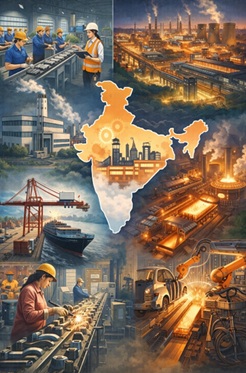
India’s persistent underperformance in manufacturing growth has come under renewed focus amid debates on structural constraints, public sector wage dynamics, productivity gaps, and their implications for industrial competitiveness and job creation.
Background & Context
Manufacturing has historically been the backbone of economic transformation across countries. Economies such as China and South Korea leveraged manufacturing to absorb surplus labour, raise productivity, and integrate into global trade.
India, however, has followed an atypical development trajectory. While services expanded rapidly, manufacturing failed to emerge as a dominant growth engine. Despite starting the 20th century at development levels comparable to several East Asian economies, India did not witness a sustained manufacturing boom. This divergence has raised concerns about structural weaknesses in India’s industrialisation strategy.
Manufacturing and Structural Transformation
- Manufacturing traditionally enables:
- Labour absorption from agriculture
- Productivity enhancement
- Export diversification
- India’s structural transformation has been services-led, with sectors such as software, finance, and business process outsourcing driving growth.
- Manufacturing’s share in GDP has remained broadly stagnant, limiting its role in employment generation and technological upgrading.
- This pattern challenges conventional development models and raises questions about long-term sustainability.
India’s Manufacturing Performance
- Manufacturing’s contribution to GDP has remained nearly constant for decades and has recently declined relative to services.
- Industrial success has been sporadic and regionally concentrated, failing to generate mass employment.
- Compared to China and South Korea, India’s manufacturing sector lacks:
- Scale
- Sophistication
- Integration into global value chains
- Weak manufacturing growth has constrained absorption of low-skilled labour, contributing to informality and underemployment.
Role of Public Sector Wages
- One explanation for manufacturing stagnation lies in public sector wage policies.
- Relatively high government salaries:
- Drew workers away from manufacturing
- Pushed up economy-wide wages
- Manufacturing firms with lower productivity struggled to match these wages, reducing competitiveness.
- Rising public sector incomes also boosted demand for non-tradable goods and services, increasing domestic prices.
- This indirectly hurt manufacturing by making imports relatively cheaper.
Dutch Disease Framework Applied to India
- Traditionally, Dutch disease refers to a resource boom that raises wages and appreciates currency, harming manufacturing exports.
- In India’s case:
- The “boom” came from high-wage non-tradable government services, not natural resources.
- Higher wages raised domestic prices, leading to real exchange rate appreciation without nominal currency changes.
- Result:
- Cheaper imports
- Reduced demand for domestic manufactured goods
- Policy-driven wage increases thus weakened manufacturing incentives, similar to a resource windfall.
Technology and Productivity Constraints
- Economic theory suggests high wages should induce firms to:
- Innovate
- Adopt labour-saving technologies
- Improve productivity
- This process underpinned industrialisation in countries like Britain, Germany, and Japan.
- In India:
- Manufacturing firms largely failed to upgrade technology
- Continued reliance on cheap labour persisted
- Limited capital deepening and weak innovation prevented movement up the value chain, undermining global competitiveness.
Uneven Growth and Rising Inequality
- India’s growth has been marked by:
- Strong services expansion
- Weak wage growth for a large workforce
- Even high-growth sectors like IT and platform-based services show stagnating entry-level wages.
- Many “unicorns” rely on labour reserves rather than breakthrough innovation.
- Manufacturing stagnation has contributed to:
- Rising income inequality
- Weak diffusion of skills and technology
- Growth without mass employment
Implications for Economic Policy
- Weak manufacturing risks premature de-industrialisation, where services dominate before industrial maturity.
- This limits:
- Job creation for semi-skilled workers
- Export diversification
- Inclusive growth
- Policy focus must include:
- Improving manufacturing productivity
- Encouraging technological adoption
- Aligning wage growth with productivity gains
- Investing in skills, infrastructure, and industrial clusters
FAQs
Q1. Why is manufacturing important for development ?
It absorbs surplus labour, raises productivity, and supports exports.
Q2. How has India’s development path differed from East Asia ?
India skipped manufacturing-led growth and moved directly to services.
Q3. What is the Dutch disease analogy in India’s case ?
High public sector wages raised prices and hurt manufacturing competitiveness.
Q4. Why didn’t Indian manufacturing upgrade technologically ?
Reliance on cheap labour and weak incentives for innovation limited productivity growth.
Q5. What is the main policy challenge ahead ?
Preventing premature de-industrialisation and reviving manufacturing-led job creation.
|






 Contact Us
  New Batch : 9555124124/ 7428085757
  Tech Support : 9555124124/ 7428085757