Why in news?
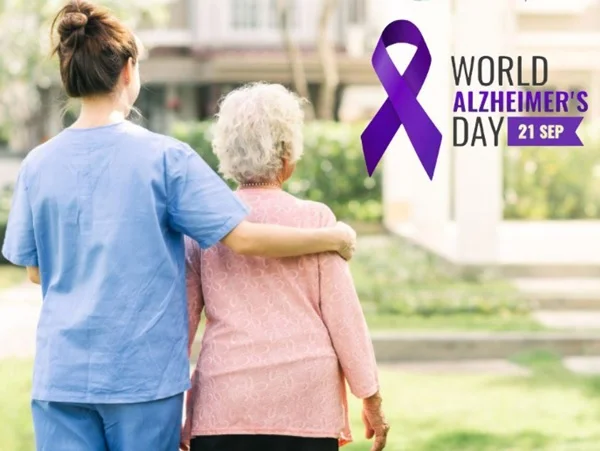
World Alzheimer's Day is observed every year on 21 September to raise awareness about Alzheimer's disease and other forms of dementia.
Key Facts
|
Observed on
|
21 September every year
|
|
First observed
|
1994
|
|
2026 Theme
|
The Earlier You Know, The More You Can Do: A Dementia Diagnosis Matters
|
|
Organising body
|
Alzheimer's Disease International (ADI)
|
|
Main objective
|
Dementia awareness, early diagnosis and caregiver support
|
|
Disease type
|
Progressive neurodegenerative disorder
|
|
Most affected group
|
Older adults particularly those above 65
|
|
Associated proteins
|
Amyloid-beta and Tau
|
|
Relevant SDG
|
SDG 3: Good Health and Well-being
|
What is World Alzheimer's Day?
- World Alzheimer's Day is an international awareness observance dedicated to improving public understanding of Alzheimer's disease and dementia.
- It encourages people to recognise early symptoms, seek medical assessment and support individuals living with dementia.
History
- World Alzheimer's Day was first observed on 21 September 1994, during the tenth anniversary of Alzheimer's Disease International.
- Alzheimer's Disease International was established in 1984 as an international federation of Alzheimer and dementia associations.
- The organisation works to improve awareness, support national Alzheimer associations, promote dementia-friendly policies and encourage international cooperation.
What is Alzheimer's Disease?
- Alzheimer's disease is a progressive neurodegenerative disorder in which nerve cells in the brain gradually become damaged and lose their ability to function normally.
- It primarily affects memory and cognitive functions, including learning, reasoning, communication and decision-making.
- The disease generally begins with mild memory problems and progresses over several years.
- In advanced stages, individuals may require assistance with basic activities such as eating, dressing, bathing and mobility.
Alzheimer's Disease and Dementia
|
Alzheimer's
|
Dementia
|
|
A specific neurological disease
|
A general term for a group of symptoms
|
|
Causes progressive brain-cell damage
|
Can result from several diseases
|
|
Associated with amyloid-beta and tau pathology
|
May have different underlying mechanisms
|
|
Most common cause of dementia
|
Includes Alzheimer's and other forms
|
|
Usually progressive
|
Course depends on the underlying cause
|
What causes Alzheimer's Disease?
- Amyloid-beta plaques: Amyloid-beta protein fragments accumulate outside neurons, forming plaques that are associated with disruption of normal cellular functioning.
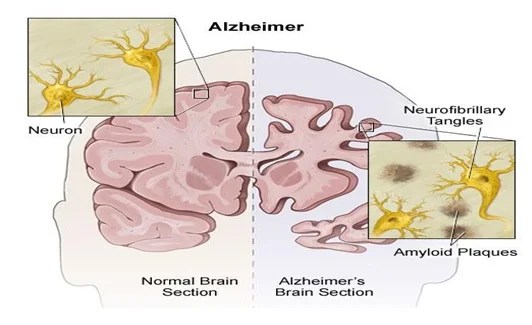
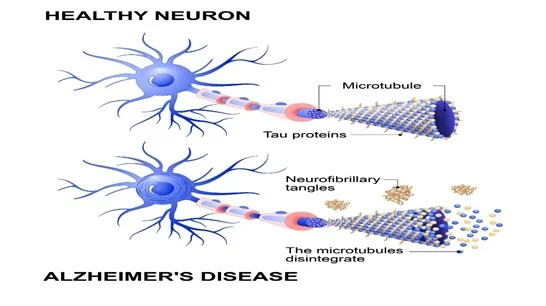
- Tau tangles: Abnormal tau proteins accumulate inside neurons and interfere with their internal transport systems, contributing to neuronal damage.
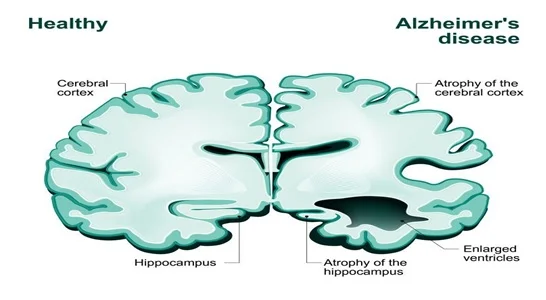
- Brain-cell damage: As neuronal damage progresses, brain regions involved in learning and memory, particularly the hippocampus, become affected.
Major Symptoms
- Memory loss: Frequently forgetting recent conversations, appointments or important events.
- Confusion and disorientation: Difficulty recognising familiar places or understanding time and location.
- Language problems: Trouble finding words, following conversations or expressing thoughts.
- Behavioural changes: Increased anxiety, irritability, withdrawal or changes in personality.
- Difficulty performing daily activities: Problems managing finances, preparing meals or following familiar routines.
- Advanced symptoms: Severe memory impairment, loss of independence and increasing dependence on caregivers.
Major Risk Factors
|
Risk factor
|
Explanation
|
|
Increasing age
|
Strongest known risk factor
|
|
Family history
|
May increase susceptibility
|
|
Cardiovascular conditions
|
Hypertension and diabetes can contribute to dementia risk
|
|
Smoking
|
Associated with vascular and neurological damage
|
|
Physical inactivity
|
Linked with poorer overall brain health
|
|
Social isolation
|
Associated with increased dementia risk
|
|
Hearing loss
|
Untreated hearing loss is a potentially modifiable risk factor
|
Global Burden of Alzheimer's Disease
- According to WHO, approximately 57 million people worldwide were living with dementia in 2021.
- Nearly 10 million new dementia cases occur globally each year.
- Alzheimer's disease accounts for approximately 60-70% of dementia cases.
- More than 60% of people living with dementia reside in low- and middle-income countries.
Alzheimer's Disease in India
- India's growing elderly population makes Alzheimer's disease and other forms of dementia an increasingly important public-health concern.
- Limited awareness and stigma can delay diagnosis, particularly in rural and underserved areas.
- Many patients depend on family members for long-term care because specialised dementia-care facilities are not widely accessible.
- The shortage of trained geriatric specialists, neurologists and caregivers can affect timely diagnosis and treatment.
- Strengthening geriatric healthcare, primary-care screening and community-based support is essential to address the country's dementia burden.
Diagnosis and Treatment
- Alzheimer's disease is diagnosed through medical history, cognitive assessment, neurological examination and appropriate investigations.
- Brain imaging and specialised biomarker tests may be used in selected cases to support diagnosis.
- There is currently no cure for Alzheimer's disease, but treatment can help manage symptoms and, in selected patients, slow disease progression.
- Medicines such as donepezil, rivastigmine, galantamine and memantine may be prescribed according to the patient's condition.
- Disease-modifying anti-amyloid therapies, including lecanemab and donanemab, are available in certain jurisdictions for selected patients with early Alzheimer's disease. They require specialist evaluation and monitoring.
Can Alzheimer's disease be prevented?
- There is no guaranteed method of preventing Alzheimer's disease. However, reducing modifiable dementia risk factors may help lower the risk or delay its onset.
- Regular physical activity and a balanced diet support cardiovascular and brain health.
- Controlling hypertension, diabetes and cholesterol may help reduce vascular contributions to cognitive decline.
- Avoiding tobacco and harmful alcohol consumption can reduce preventable health risks.
- Maintaining social connections, treating depression and addressing hearing or vision impairment may support cognitive health.
- Lifelong learning, mentally stimulating activities and adequate sleep are also beneficial for overall well-being.
Significance
- Public awareness: Encourages people to recognise early symptoms and understand that dementia is not a normal part of ageing.
- Early diagnosis: Promotes timely medical assessment and access to appropriate treatment and care.
- Reducing stigma: Challenges misconceptions and discrimination faced by people living with dementia.
- Caregiver support: Recognises the emotional, physical and financial burden on families and caregivers.
- Healthcare preparedness: Highlights the need for dementia-responsive health systems and specialised geriatric services.
- Research and innovation: Encourages investment in neurological research, diagnostic tools and new treatments.
Challenges in Alzheimer's Care
- Delayed diagnosis due to low awareness and social stigma.
- Limited availability of specialised diagnostic facilities.
- High costs associated with long-term care and certain treatments.
- Shortage of trained healthcare professionals and caregivers.
- Emotional and financial burden on families.
- Unequal access to healthcare between urban and rural populations.
- Absence of a cure and the need for continued research.
Government Initiatives and Public-Health Response in India
|
National Programme for Health Care of the Elderly (NPHCE)
|
Strengthens geriatric healthcare services
|
|
National Mental Health Programme (NMHP)
|
Supports mental-health services and awareness
|
|
Ayushman Bharat
|
Improves access to eligible healthcare services
|
|
National Programme for Prevention and Control of Non-Communicable Diseases (NP-NCD)
|
Addresses conditions such as hypertension and diabetes that are associated with dementia risk
|
|
WHO Global Action Plan on Dementia 2017–2025
|
Provided an international framework for dementia awareness, diagnosis, care and research
|
Prelims MCQ
Q. With reference to Alzheimer's disease, consider the following statements:
- Alzheimer's disease is the most common cause of dementia.
- Amyloid-beta plaques and tau tangles are associated with the disease.
- Alzheimer's disease is an inevitable consequence of normal ageing.
Which of the statements given above are correct?
A. 1 and 2 only
B. 2 and 3 only
C. 1 and 3 only
D. 1, 2 and 3
Mains Practice Question
Q. “Alzheimer's disease is emerging as a significant public-health challenge in ageing societies.” Discuss.
|
FAQs
When is World Alzheimer's Day observed?
It is observed every year on 21 September.
When World Alzheimer’s Day was first observed?
It was first observed in 1994.
Which organisation coordinates World Alzheimer's Day?
Alzheimer's Disease International (ADI).
What is the main objective of World Alzheimer's Day?
To raise dementia awareness, promote early diagnosis and support patients and caregivers.
Who first described Alzheimer's disease?
German psychiatrist Alois Alzheimer described the condition in 1906.
|






 Contact Us
  New Batch : 9555124124/ 7428085757
  Tech Support : 9555124124/ 7428085757