Why in News?
World Rhino Day is celebrated annually on 22 September to raise awareness about the conservation of all five surviving rhinoceros species.
Key Facts
|
World Rhino Day
|
22 September
|
|
First announced
|
2010
|
|
First international observance
|
2011
|
|
Initiating organisation
|
WWF-South Africa
|
|
Conservation message
|
Five Rhino Species Forever
|
|
Living rhino species
|
5
|
|
African rhino species
|
White and Black
|
|
Asian rhino species
|
Greater One-Horned, Javan and Sumatran
|
|
Indian rhino's scientific name
|
Rhinoceros unicornis
|
|
Indian rhino's IUCN status
|
Vulnerable
|
|
India's principal rhino habitat
|
Kaziranga National Park, Assam
|
|
Indian Rhino Vision 2020
|
Launched in 2005
|
|
National Rhino Conservation Strategy
|
2019
|
History of World Rhino Day
- World Rhino Day was first announced by WWF-South Africa in 2010.
- In 2011, it developed into an international observance dedicated to all five surviving rhinoceros species.
- The day promotes cooperation among governments, wildlife organisations, conservationists and local communities.
- Its central objective is to protect rhinoceros populations and preserve their natural habitats.
|
Year
|
Important development
|
|
2010
|
World Rhino Day announced by WWF-South Africa
|
|
2011
|
International observance expanded to all five species
|
|
2005
|
Indian Rhino Vision 2020 launched
|
|
2019
|
India launched its National Conservation Strategy for the Indian One-Horned Rhinoceros
|
What is Rhinoceros?
- The rhinoceros is a large, herbivorous (plant-eating) mammal belonging to the family Rhinocerotidae and order Perissodactyla (odd-toed ungulates).
- Rhinos have thick skin and one or two horns, depending on the species. Their horns are made of keratin, the same protein found in human hair and nails.
- They are primarily solitary animals, although their social behaviour varies by species. Three species are native to Asia, while two are native to Africa.
- They are included in the CITES Appendix I, with certain southern white rhino populations in Appendix II.
Five Species of Rhinoceros
- White Rhinoceros
- Scientific name: Ceratotherium simum
- Distribution: Southern Africa
- IUCN status: Near Threatened
- Largest living rhinoceros species.
- Has two horns and a broad, square-shaped mouth adapted for grazing.
- Black Rhinoceros
- Scientific name: Diceros bicornis
- Distribution: Eastern and Southern Africa
- IUCN status: Critically Endangered
- Has two horns and a pointed upper lip.
- Primarily feeds on leaves, shrubs and woody plants.
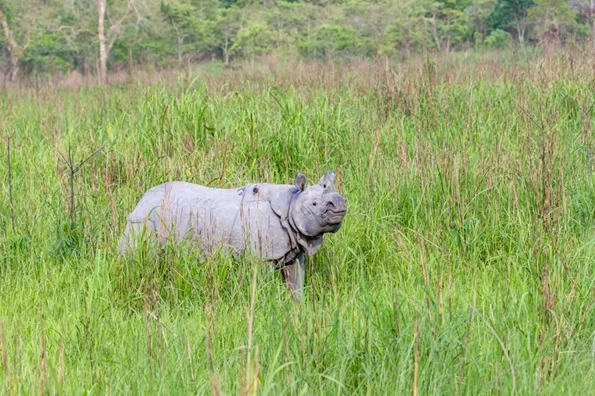
- Greater One-Horned Rhinoceros
- Scientific name: Rhinoceros unicornis
- Distribution: India and Nepal
- IUCN status: Vulnerable
- Has a single horn and thick, armour-like skin folds.
- Primarily inhabits alluvial grasslands and wetlands.
- Javan Rhinoceros
- Scientific name: Rhinoceros sondaicus
- Distribution: Indonesia
- IUCN status: Critically Endangered
- Survives in Ujung Kulon National Park.
- Has one horn, although females generally lack a prominent horn.
- Sumatran Rhinoceros
- Scientific name: Dicerorhinus sumatrensis
- Distribution: Indonesia
- IUCN status: Critically Endangered
- Smallest living rhinoceros species.
- The only surviving Asian rhinoceros species with two horns.
Global Rhino Population
- According to the International Rhino Foundation's State of the Rhino 2026 report, approximately 26,700 rhinos survive worldwide.
- The Greater One-Horned Rhinoceros has experienced population recovery due to conservation programmes in India and Nepal.
- Black rhino populations have also shown long-term recovery, although the species remains Critically Endangered.
- White rhinos have experienced recent population declines.
- Javan and Sumatran rhinos remain among the world's most threatened large mammals.
Rhinoceros Conservation in India
- India is home to the largest population of the Greater One-Horned Rhinoceros.
- The species is primarily found in Assam and West Bengal.
- Rhino conservation in India involves habitat protection, anti-poaching measures, population monitoring and translocation.
- The species is protected under Schedule I of the Wildlife (Protection) Act, 1972.
Major Rhino Habitats in India
|
Protected area
|
State
|
|
Kaziranga National Park
|
Assam
|
|
Pobitora Wildlife Sanctuary
|
Assam
|
|
Orang National Park
|
Assam
|
|
Manas National Park
|
Assam
|
|
Laokhowa–Burachapori landscape
|
Assam
|
|
Jaldapara National Park
|
West Bengal
|
|
Gorumara National Park
|
West Bengal
|
Indian Rhino Vision 2020
- Indian Rhino Vision 2020 was launched in 2005.
- It was a collaborative initiative involving the Assam Forest Department, WWF-India, the International Rhino Foundation and other partners.
- Its objective was to increase Assam's rhino population to 3,000 by 2020.
- The programme aimed to distribute rhinos across seven protected areas in Assam.
- It supported the translocation of rhinos to Manas National Park to establish additional populations.
National Conservation Strategy for the Indian One-Horned Rhinoceros
- The Ministry of Environment, Forest and Climate Change launched the strategy in 2019.
- It provides a long-term framework for conserving the Greater One-Horned Rhinoceros.
- It emphasises population expansion, habitat management and genetic diversity.
- It supports the establishment of additional viable populations through scientifically planned translocations.
- It also highlights habitat connectivity, research and cooperation between conservation authorities.
Importance of Rhinoceros
|
Ecological role
|
Importance
|
|
Grassland management
|
Helps maintain vegetation structure
|
|
Seed dispersal
|
Supports plant regeneration
|
|
Nutrient cycling
|
Dung returns nutrients to the soil
|
|
Habitat modification
|
Wallowing and movement influence habitat features
|
|
Biodiversity conservation
|
Protecting rhino habitats benefits other wildlife
|
Major Threats to Rhinoceros
- Poaching: Illegal hunting for rhino horns remains a major threat.
- Habitat loss: Agricultural expansion, infrastructure and settlements reduce natural habitats.
- Habitat fragmentation: Isolated populations face difficulties in maintaining genetic diversity.
- Climate-related risks: Severe flooding and changing environmental conditions can threaten rhino habitats.
- Human-wildlife conflict: Encounters with people can increase where rhino habitats overlap with human settlements.
International Conservation Framework
|
IUCN
|
Assesses extinction risk through the Red List
|
|
CITES
|
Regulates international trade in rhinos and their parts
|
|
WWF
|
Supports habitat protection and anti-poaching initiatives
|
|
International Rhino Foundation
|
Supports research and conservation programmes
|
|
TRAFFIC
|
Monitors wildlife trade and helps combat illegal trade
|
FAQs
When is World Rhino Day celebrated?
World Rhino Day is celebrated every year on 22 September.
When was World Rhino Day first observed internationally?
It became an international observance in 2011.
How many rhinoceros species exist worldwide?
There are five surviving rhinoceros species.
What is the scientific name of the Indian rhinoceros?
The scientific name is Rhinoceros unicornis.
What is the IUCN status of the Greater One-Horned Rhinoceros?
It is classified as Vulnerable.
|






 Contact Us
  New Batch : 9555124124/ 7428085757
  Tech Support : 9555124124/ 7428085757