Prelims: WWF, Living Planet Report, Living Planet Index, Zoological Society of London (ZSL), Biodiversity Loss, IUCN, Kunming–Montreal Global Biodiversity Framework.
Mains: GS Paper III: Environment Conservation, Biodiversity, Climate Change, Ecosystem Degradation and Sustainable Development. |
Why in news?
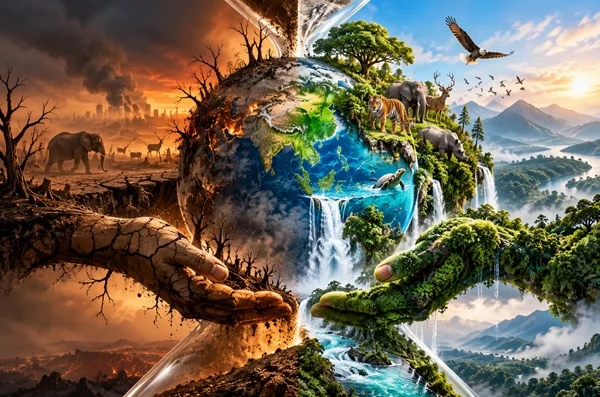
The WWF Living Planet Report 2024 revealed that the average size of monitored wildlife populations declined by 73% between 1970 and 2020.
Key Facts
|
Particular
|
Details
|
|
Report
|
Living Planet Report 2026
|
|
Released by
|
World Wide Fund for Nature (WWF)
|
|
Report title
|
The Science of Hope
|
|
Edition
|
16th
|
|
First published
|
1998
|
|
Frequency
|
Every two years
|
|
Main indicator
|
Living Planet Index (LPI)
|
|
LPI produced by
|
Zoological Society of London (ZSL)
|
|
Assessment period
|
1970–2022
|
|
Global average decline
|
73%
|
|
Vertebrate species monitored
|
5,790
|
|
Population trends analysed
|
35,803
|
What is the Living Planet Report?
- The Living Planet Report is a biennial scientific publication by WWF that assesses global biodiversity trends and the health of ecosystems.
- It uses the Living Planet Index, developed by WWF and ZSL, to monitor changes in the relative abundance of wild vertebrate populations, including mammals, birds, fish, reptiles and amphibians.
- The report also examines the impact of human activities on biodiversity and identifies measures needed to restore ecological balance.
- The 73% decline does not mean that 73% of wildlife species have become extinct. It refers to the average decline in the relative sizes of monitored wildlife populations.
Major Findings of Living Planet Report 2026
- Global Wildlife Population Decline
- Monitored vertebrate wildlife populations declined by an average of 73% between 1970 and 2022.
- The assessment covered 35,803 population trends from 5,790 species.
- The findings indicate widespread pressure on biodiversity and ecosystem health.
- Decline across Different Ecosystems: Freshwater ecosystems experienced the largest decline, reflecting pressures from river fragmentation, pollution, water extraction, habitat destruction and climate change.
|
Ecosystem
|
Average decline
|
|
Freshwater
|
85%
|
|
Terrestrial
|
69%
|
|
Marine
|
59%
|
- Major Drivers of Biodiversity Loss
- Habitat Loss: Deforestation, agricultural expansion and infrastructure development.
- Overexploitation: Unsustainable fishing, hunting and wildlife harvesting.
- Climate Change: Rising temperatures, changing rainfall patterns and extreme weather.
- Pollution: Industrial waste, agricultural chemicals and plastic pollution.
- Importance of Conservation Efforts
- The report highlights that conservation interventions can help wildlife populations recover.
- Protected areas, habitat restoration, species recovery programmes and community participation remain important for reversing biodiversity loss.
- Conservation measures must be supported by broader changes in food production, energy systems and economic activities.
Why is the Living Planet Report 2026 Important for COP17?
- The Living Planet Report 2026 has been released just days before the upcoming COP17 (Yerevan, Armenia from October 19-30, 2026) of the Convention on Biological Diversity (CBD).
- COP17 will provide an important opportunity for countries to assess their progress towards the global biodiversity targets adopted in 2022.
How the Living Planet Report connects to COP17?
- Urgency of Biodiversity Conservation: The reported 73% average decline in monitored wildlife populations demonstrates the scale of biodiversity loss and reinforces the need for stronger conservation measures.
- Supports the Global Biodiversity Framework: The Kunming-Montreal Global Biodiversity Framework was adopted at COP15 in 2022. It includes four long-term goals for 2050 and 23 targets for 2030.
Important targets
|
Target 1
|
Ensure participatory, integrated and biodiversity-inclusive spatial planning to reduce biodiversity loss
|
|
Target 2
|
Restore at least 30% of degraded ecosystems by 2030
|
|
Target 3
|
Effectively conserve at least 30% of terrestrial, inland water, coastal and marine areas by 2030
|
|
Target 4
|
Halt human-induced extinctions of known threatened species and support species recovery
|
|
Target 19
|
Mobilise at least US$200 billion annually for biodiversity by 2030
|
- Helps Identify Implementation Gaps: COP17 will assess whether countries are making sufficient collective progress towards their biodiversity commitments.
- Highlights the Need for Biodiversity Finance: The report emphasises that conservation requires changes in financial systems, including reducing investments that damage ecosystems and increasing funding for restoration.
- Biodiversity Conservation with Climate Action: The report reinforces the need to integrate biodiversity protection with climate mitigation, sustainable agriculture, clean energy and ecosystem restoration.
- Encourages Action Beyond Protected Areas: The report argues that conservation efforts alone cannot reverse global biodiversity decline. Food production, energy generation and financial investment must also become environmentally sustainable.
Why is COP17 particularly important in 2026?
- COP17 takes place four years after the adoption of the Kunming-Montreal Global Biodiversity Framework and four years before its 2030 target deadline.
- It will be an important milestone for:
- Reviewing collective implementation progress.
- Identifying gaps in national biodiversity commitments.
- Strengthening monitoring and reporting.
- Mobilising financial and technical resources.
- Accelerating conservation and restoration measures.
- The WWF report strengthens the scientific case for urgent implementation, although it does not predetermine COP17 negotiations or their outcomes.
India's Role and Relevance
- India is a party to the Convention on Biological Diversity and has several initiatives relevant to the global biodiversity agenda.
- Major conservation initiatives include:
- Project Tiger: Conservation of tigers and their habitats.
- Project Elephant: Protection of elephants, habitats and corridors.
- National Biodiversity Action Plan: India's framework for biodiversity conservation and sustainable use.
- Biological Diversity Act, 2002: Provides a legal framework for conservation, sustainable use and benefit-sharing.
- Protected Area Network: National parks, wildlife sanctuaries, conservation reserves and community reserves.
- National Mission for a Green India: Supports forest and ecosystem restoration.
Significance
- Biodiversity Monitoring: Provides scientific evidence of wildlife population trends.
- Policy Formulation: Helps governments identify conservation priorities.
- Ecosystem Protection: Highlights the importance of forests, freshwater ecosystems and oceans.
- Climate Resilience: Demonstrates the connection between biodiversity and climate adaptation.
- International Cooperation: Supports global discussions on biodiversity conservation and sustainable development.
Challenges
- Habitat destruction : Agriculture, urbanisation and infrastructure fragment natural habitats
- Climate change: Rising temperatures and extreme weather threaten ecosystems
- Overexploitation: Unsustainable fishing, hunting and harvesting reduce wildlife populations
- Funding gaps: Conservation and restoration require greater financial resources
- Monitoring limitations: Biodiversity data remain uneven across species and regions
Prelims MCQ
Q. Consider the following statements regarding the Living Planet Report:
- It is published by WWF.
- The Living Planet Index is produced by the Zoological Society of London.
- The Living Planet Report 2026 recorded an average 73% decline in monitored vertebrate wildlife population sizes.
Which of the statements given above are correct?
(a) 1 and 2 only
(b) 2 and 3 only
(c) 1 and 3 only
(d) 1, 2 and 3
Mains Practice Question
Q. Discuss the major drivers of biodiversity loss and suggest measures for ecosystem restoration.
|
FAQs
Who releases the Living Planet Report?
World Wide Fund for Nature (WWF).
What is the latest edition?
16th
What is the theme of the 2026 report?
The Science of Hope.
What is the global wildlife population decline?
73% on average among monitored vertebrate populations since 1970.
Which ecosystem recorded the highest decline?
Freshwater ecosystems at 85%.
|






 Contact Us
  New Batch : 9555124124/ 7428085757
  Tech Support : 9555124124/ 7428085757