Prelims: Make in India, Make in India 2.0, Manufacturing GVA, IIP, PLI Scheme, FDI, PM GatiShakti, NSWS, Startup India, Semiconductors, Rare-Earth Magnets, Capital Goods, Electronics Manufacturing, Defence Manufacturing, Specialty Steel, BHAVYA, Semicon 2.0, Critical Minerals, Domestic Value Addition, Global Value Chains.
Mains: GS Paper III - Indian Economy
Keywords: Make in India 2026, Make in India 12 Years, India Manufacturing, Manufacturing Growth, Make in India 2.0, Manufacturing GVA, PLI Scheme, Electronics Manufacturing, Defence Manufacturing, Pharmaceutical Manufacturing, Semiconductor Manufacturing, Capital Goods, FDI, PM GatiShakti, Semicon 2.0, BHAVYA, Global Manufacturing Hub. |
Why in News?
- The Make in India initiative completed 12 years on September 25, 2026. Launched in 2014, the initiative aimed to make India a global hub for manufacturing, design and innovation.
- Over the past 12 years, India’s manufacturing capabilities have expanded across electronics, automobiles, pharmaceuticals, steel, railways and defence. The focus has also shifted towards developing domestic capabilities in components, machinery, strategic materials and advanced technologies.
What is Make in India?
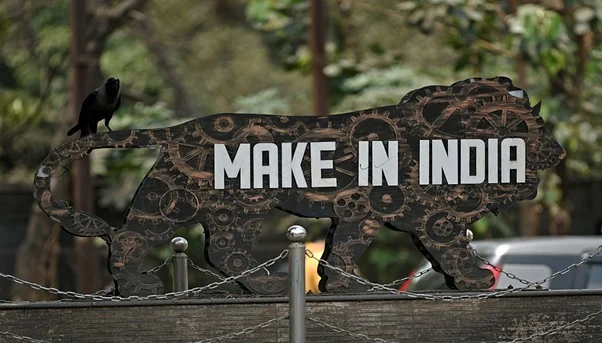
- Make in India was launched on September 25, 2014, to promote manufacturing, attract investment, encourage innovation and develop world-class infrastructure in India.
- The initiative was guided by the principle of “Minimum Government, Maximum Governance” and focused on simplifying government processes and improving the business environment.
- It was later expanded under Make in India 2.0, which currently covers 27 sectors:
- 15 manufacturing sectors
- 12 services sectors
- The broader objective is to increase domestic manufacturing, create employment, strengthen supply chains and improve India’s competitiveness in global markets.
India’s Manufacturing Growth
- India’s manufacturing sector has recorded significant growth in recent years.
- Manufacturing Gross Value Added (GVA) at constant prices recorded a compound annual growth rate (CAGR) of 10.88% between 2022-23 and 2025-26 under the revised national accounts series.
- The manufacturing component of the Index of Industrial Production (IIP) also increased by 7% during April-July 2026 compared with the corresponding period of 2025.
- This growth has been supported by rising production in several key industries.
Electronics and Mobile Manufacturing
- Electronics has emerged as one of the major areas of India's manufacturing expansion.
- Electronics production increased from around ₹1.9 lakh crore in 2014-15 to around ₹13.11 lakh crore in 2025-26, an increase of nearly seven times.
- Mobile phone production increased from around ₹18,000 crore to ₹6.27 lakh crore during the same period, representing an approximately 33-fold increase.
- India is now the world’s second-largest mobile phone manufacturer by volume.
- Overall electronics production grew by 15.8% in 2025-26 compared with the previous year.
Automobile Manufacturing
- India’s automobile industry has also expanded significantly.
- Vehicle production reached 31.03 million units in 2024-25, around 33% higher than in 2014-15.
- Compared with 2020-21, production in 2024-25 increased by:
- 65% in passenger vehicles
- 65% in commercial vehicles
- 71% in three-wheelers
- 30% in two-wheelers
- The growth reflects the expansion of both domestic demand and India's manufacturing capabilities.
Pharmaceutical and Medical Device Manufacturing
- India is the third-largest pharmaceutical producer in the world by volume and 11th-largest by value.
- The pharmaceutical industry's annual turnover reached ₹4,71,898 crore in 2024-25, recording a CAGR of around 9.5% since 2020-21.
- Domestic medical device manufacturing also increased from around ₹28,000 crore in 2019-20 to ₹41,500 crore in 2024-25, an increase of about 48.2%.
- India is also developing capabilities in advanced medicines, biosimilars, antibiotics and innovative drug development.
Growth in Steel Production
- India's steel sector has witnessed a major increase in production.
- Crude steel production increased from 81.7 million tonnes in 2014-15 to 170 million tonnes in 2025-26.
- The expansion of steel production has strengthened India's industrial base and supported sectors such as automobiles, construction, infrastructure and engineering.
Railways and Defence Manufacturing
Railways
- Indian Railways has expanded its domestic manufacturing capacity for coaches, locomotives, wheels and axles.
- Between 2014 and 2024, Indian Railways manufactured 54,809 coaches. Average annual coach production increased from fewer than 3,300 during 2004-14 to 5,481 during 2014-24.
- In 2025-26, it produced:
- 1,674 locomotives
- 6,677 Linke Hofmann Busch (LHB) coaches
- The Rail Wheel Factory also produced 2,10,026 wheels, 1,22,000 axles and 1,20,100 wheelsets in 2025-26.
Defence
- Indigenous defence production has increased substantially.
- Defence production rose from ₹46,429 crore in 2014-15 to a record ₹1.78 lakh crore in 2025-26.
- This represents an increase of around 283% compared with 2014-15.
- The expansion reflects efforts to strengthen domestic defence manufacturing and reduce dependence on imports.
From Final Products to Domestic Components
- A major change in India's manufacturing landscape is the growing focus on producing not only final products but also components, machinery, materials and critical technologies within the country.
- This is important because a strong manufacturing ecosystem requires domestic capabilities across the entire value chain.
Rare-Earth Permanent Magnets
- A pilot plant for Nd-Fe-B (Neodymium-Iron-Boron) rare-earth permanent magnets was established at ARCI, Hyderabad, in March 2026.
- These magnets are important for:
- Electric vehicles
- Renewable energy systems
- Electronics
- Advanced manufacturing
- The facility is expected to support technology validation, process optimisation, industry collaboration and the scaling up of domestic technologies.
Indigenous Space Technology
- ISRO and SCL have developed the VIKRAM3201 and KALPANA3201 microprocessors.
- VIKRAM3201 is the first fully Make-in-India microprocessor qualified for the harsh conditions of launch vehicles and was fabricated at SCL.
- KALPANA3201 was designed using open-source software tools and has also been tested with flight software.
Solar Manufacturing
- India's solar manufacturing capacity has expanded rapidly.
- Solar module manufacturing capacity increased from 2.3 GW in 2014 to 192 GW as of June 2026.
- Solar-cell manufacturing capacity increased from 1.2 GW to around 30 GW during the same period.
Expansion of Capital Goods and Machinery
- Make in India has also strengthened India's capacity to manufacture industrial machinery and capital goods.
- Production across various capital goods and heavy engineering equipment increased from ₹2,87,233 crore in 2019-20 to ₹5,69,900 crore in 2024-25.
- Major increases were recorded in:
- Earthmoving and mining machinery
- Printing machinery
- Machine tools
- Plastic-processing machinery
- Heavy electrical equipment
- Food-processing machinery
- Textile machinery
- Dies, moulds and press tools
- Process plant equipment
- This expansion is important because domestic machinery production can reduce dependence on imported industrial equipment and strengthen manufacturing value chains.
Reforms and Investment under Make in India
Make in India has been supported by reforms aimed at improving the investment environment and simplifying business processes.
Foreign Direct Investment
- India permits 100% Foreign Direct Investment (FDI) through the automatic route in most sectors, subject to sector-specific rules and restrictions.
- Cumulative FDI reached around USD 843 billion between 2014-15 and 2025-26, representing a significant increase over the preceding 12-year period.
National Single Window System
- The National Single Window System (NSWS) provides businesses access to more than:
- 327 Central approvals
- 3,452 State approvals
- Across 34 States and Union Territories
- As of September 21, 2026, the system had onboarded more than 5.69 lakh business entities.
India Industrial Land Bank
- The India Industrial Land Bank is a GIS-enabled platform that provides information on industrial land and infrastructure.
- As of May 2026, it had mapped 4,220 industrial parks covering around 6.98 lakh hectares.
PM GatiShakti
- The PM GatiShakti National Master Plan, launched in October 2021, aims to improve coordinated infrastructure planning and execution.
- As of August 11, 2026, its Network Planning Group had evaluated 396 projects worth around ₹18.66 lakh crore.
Production Linked Incentive Scheme
The Production Linked Incentive (PLI) Scheme is one of the major policy instruments used to strengthen domestic manufacturing.
PLI schemes currently cover 14 sectors, including:
- Electronics
- Pharmaceuticals
- Automobiles
- Solar photovoltaic modules
- Specialty steel
- Textiles
As of June 2026, PLI schemes had:
- Attracted ₹2.40 lakh crore in investment
- Generated more than ₹22.66 lakh crore in production and sales
- Supported exports worth over ₹15.20 lakh crore
- Created more than 14 lakh jobs
Startup India and Manufacturing Innovation
- The Startup India initiative, launched in January 2016, aims to promote innovation, support startups and encourage investment.
- As of September 2026, around 2.54 lakh entities had been recognised as startups under the initiative.
- Startups can contribute to manufacturing through new technologies, product development, research and innovation.
New Initiatives to Strengthen Manufacturing
India has introduced several new measures to deepen manufacturing capabilities in strategic and emerging sectors.
Specialty Steel
The third round of the Production Linked Incentive Scheme for Specialty Steel, launched in November 2025, covers advanced categories such as:
- Super alloys
- CRGO steel
- Stainless steel products
- Titanium alloys
- Coated steels
Rare-Earth Permanent Magnets
- The Scheme to Promote Manufacturing of Sintered Rare Earth Permanent Magnets, notified in December 2025, has an allocation of ₹7,280 crore.
- It aims to establish 6,000 MTPA of integrated manufacturing capacity for sintered NdFeB-type rare-earth permanent magnets.
BHAVYA
- The Bharat Audyogik Vikas Yojana (BHAVYA) was approved in March 2026 with an allocation of ₹33,660 crore.
- It aims to develop 100 investment-ready industrial parks with integrated infrastructure.
Mobile Phone Manufacturing Scheme
- The Mobile Phone Manufacturing Scheme, approved in July 2026, has an allocation of ₹62,500 crore for 2026-27 to 2030-31.
- Its objectives include increasing mobile phone production, improving domestic value addition, strengthening supply chains and enhancing global competitiveness.
Semicon 2.0
- Semicon 2.0, approved in July 2026, has an allocation of ₹1,27,500 crore.
- It aims to strengthen India's semiconductor ecosystem across:
- Semiconductor design
- Manufacturing
- Advanced packaging
- Materials
- Equipment
- Research
- Talent development
BHAVYA Rasayan
- The Bharat Audyogik Vikas Yojana Rasayan (BHAVYA Rasayan) was approved on July 24, 2026, with an allocation of ₹3,030 crore.
- It aims to establish three dedicated chemical parks in India.
Significance of Make in India
- The Make in India initiative has contributed to the expansion of India's manufacturing ecosystem in several areas.
- First, it has strengthened domestic production across sectors such as electronics, automobiles, pharmaceuticals, steel, defence and railways.
- Second, it has encouraged domestic value addition by promoting the production of components, machinery and critical materials within India.
- Third, it has supported investment and infrastructure development through measures such as PLI, PM GatiShakti, the National Single Window System and industrial parks.
- Fourth, it has helped develop strategic capabilities in areas such as semiconductors, rare-earth materials, defence technology, space technology and renewable energy.
- Finally, it aims to improve India's position in global manufacturing and supply chains.
Challenges Ahead
Despite significant progress, India needs to address several issues to further strengthen its manufacturing sector.
- Increasing domestic value addition in manufacturing supply chains
- Improving research and development capabilities
- Developing a highly skilled industrial workforce
- Strengthening logistics and infrastructure
- Improving the competitiveness of small and medium enterprises
- Ensuring reliable access to critical minerals and strategic materials
- Increasing India's participation in global value chains
- Promoting advanced manufacturing and emerging technologies
Way Forward
- India's next phase of manufacturing growth will require a shift from simply increasing production to building competitive, technology-intensive and globally integrated manufacturing ecosystems.
- Greater focus on research and development, skill development, domestic component manufacturing, advanced technologies, logistics, critical minerals and sustainable production can help strengthen India's manufacturing base.
- The integration of initiatives such as Make in India, PLI, PM GatiShakti, Semicon 2.0 and industrial development programmes can further support India's manufacturing ambitions.
Conclusion
After 12 years, Make in India has expanded beyond increasing production to strengthening domestic value addition, technology, skills and industrial capabilities. The next focus should be on innovation, competitiveness and deeper integration with global value chains.
Prelims Practice Question
With reference to the Make in India initiative, consider the following statements:
- It was launched on September 25, 2014.
- Make in India 2.0 covers both manufacturing and services sectors.
- The Production Linked Incentive (PLI) Scheme covers 14 sectors.
Which of the statements given above is/are correct?
A. 1 and 2 only
B. 2 and 3 only
C. 1 and 3 only
D. 1, 2 and 3
Mains Practice Question
Q. “Make in India has evolved from a manufacturing promotion initiative into a broader strategy for strengthening domestic value addition and technological capabilities.” Discuss.
|
FAQs
1. What is Make in India?
Make in India is an initiative launched on September 25, 2014, to promote manufacturing, investment, innovation and infrastructure development in India.
2. What is Make in India 2.0?
Make in India 2.0 is the expanded version of the initiative covering 27 sectors, including 15 manufacturing and 12 services sectors.
3. What is the main objective of Make in India?
Its key objectives include increasing domestic manufacturing, attracting investment, creating employment, encouraging innovation and integrating India with global manufacturing value chains.
4. How has Make in India strengthened electronics manufacturing?
Electronics production increased significantly between 2014-15 and 2025-26, while mobile phone production expanded substantially, making electronics one of India's major manufacturing growth areas.
5. What is the role of the PLI Scheme?
The Production Linked Incentive (PLI) Scheme provides sector-specific incentives linked to production or sales and aims to increase domestic manufacturing, investment and competitiveness.
|






 Contact Us
  New Batch : 9555124124/ 7428085757
  Tech Support : 9555124124/ 7428085757