
New
Hindi Medium: (Delhi) - GS Foundation (P+M) : 10th Aug 2026, 3:00 PM Hindi Medium: (Prayagraj) - GS Foundation (P+M) : 18th Aug 2026, 8:00 AM English Medium: (Delhi) - GS Foundation (P+M) : 6th Aug 2026 English Medium: (Prayagraj) - GS Foundation (P+M) : 15th July 2026, 8:00 AM Hindi Medium: (Delhi) - GS Foundation (P+M) : 10th Aug 2026, 3:00 PM Hindi Medium: (Prayagraj) - GS Foundation (P+M) : 18th Aug 2026, 8:00 AM English Medium: (Delhi) - GS Foundation (P+M) : 6th Aug 2026 English Medium: (Prayagraj) - GS Foundation (P+M) : 15th July 2026, 8:00 AM

25 Years of the Himalayan Chandra Telescope: India Celebrates a Milestone in Astronomy

Prelims: Science & Technology (Astronomy and Space Science), Current Affairs
GS Paper III - Science and Technology (Developments and Applications of Science & Technology and Scientific Research).

Why is it in the news?

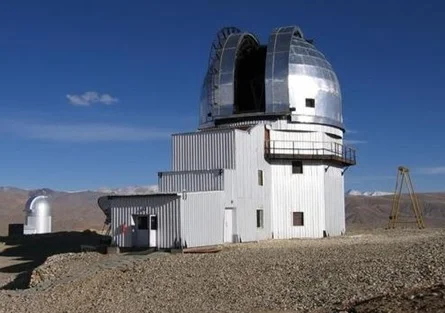
India has celebrated 25 years of successful operations of the 2-metre Himalayan Chandra Telescope (HCT) at Hanle, Ladakh. A three-day conference organized by the Indian Institute of Astrophysics (IIA) highlighted the telescope's achievements, scientific contributions, and future expansion plans.
About the Himalayan Chandra Telescope (HCT)

  • The Himalayan Chandra Telescope (HCT) is a 2-metre optical telescope located at Hanle, Ladakh, at an altitude of 4,517 metres. 
  • It is operated by the Indian Institute of Astrophysics (IIA), an autonomous institute under the Department of Science and Technology (DST). 
  • The telescope was named after Nobel Laureate Subrahmanyan Chandrasekhar. 
  • HCT achieved its First Light on 26 September 2000 and was dedicated to the nation in August 2001. 

Why was Hanle chosen?

Hanle is one of the best astronomical sites in the world because of:

  • Over 250 clear observing nights every year. 
  • Very low atmospheric water vapour, ideal for infrared observations. 
  • Highly transparent skies. 
  • Minimal light pollution. 
  • High altitude and dry climate. 

Unique Feature

  • Since June 2001, the telescope has been operated remotely in real time from the IIA campus in Hosakote, Bengaluru. 
  • It uses a dedicated INSAT-3B satellite link provided by ISRO, making it one of India's earliest remotely operated telescopes. 

Scientific Contributions

Over the past 25 years, HCT has made significant contributions in astronomy, including:

  • Study of gamma-ray bursts. 
  • Research on supernovae and novae. 
  • Discovery and study of exoplanets, including participation in the discovery of TRAPPIST-1b. 
  • Spectroscopy of comets. 
  • Studies of stars, nebulae, galaxies, quasars, and active galactic nuclei (AGN). 
  • Long-term monitoring of young stars and variable stars. 

Current Instruments

The HCT is equipped with:

  • HFOSC – Optical camera and spectrograph. 
  • uTIRSPEC – Near-infrared spectrometer and imager. 
  • HESP – High-resolution Echelle spectrograph. 

Future Plans

  • The Union Budget has announced:
  • 3.7-metre Upgraded Himalayan Chandra Telescope (UHCT). 
  • 13.7-metre National Large Optical-Infrared Telescope (NLOT) at Hanle. 
  • These projects will be led by the Indian Institute of Astrophysics (IIA) and are expected to significantly strengthen India's astronomical research capabilities.

Hanle: India's Astronomy Hub

Today, Hanle hosts several major astronomical facilities, including:

  • Himalayan Chandra Telescope (HCT) 
  • GROWTH-India Telescope 
  • MACE (Major Atmospheric Cherenkov Experiment) Telescope 
  • HAGAR (High Altitude Gamma Ray) Telescope 
  • Hanle Dark Sky Reserve, established to preserve the region's exceptionally dark skies. 

Significance

The Himalayan Chandra Telescope has played a key role in advancing optical and infrared astronomy in India. Its success has established Hanle as a globally recognized astronomical site and laid the foundation for India's next generation of world-class telescopes.

Prelims Question

Q. Consider the following statements about the Himalayan Chandra Telescope (HCT):

  1. It is located at an altitude of about 4,517 metres above sea level.
  2. It is named after Nobel Laureate Subrahmanyan Chandrasekhar.
  3. It is primarily a radio telescope.

Which of the statements given above is/are correct?

  1. 1 and 2 only

  2. 2 and 3 only

  3. 1 and 3 only

  4. 1, 2 and 3

Mains Question

Q. Discuss the significance of high-altitude astronomical observatories in advancing India's space and astronomical research. Illustrate your answer with reference to the Himalayan Chandra Telescope (HCT).

FAQs: Himalayan Chandra Telescope (HCT)

Q1. What is the Himalayan Chandra Telescope (HCT)?

Answer: The Himalayan Chandra Telescope (HCT) is a 2-metre optical telescope located at Hanle, Ladakh, and operated by the Indian Institute of Astrophysics (IIA) for astronomical research.

Q2. Why is Hanle considered an ideal location for astronomical observations?

Answer: Hanle offers over 250 clear nights a year, very low atmospheric water vapour, minimal light pollution, and highly transparent skies, making it one of the world's best sites for optical and infrared astronomy.

Q3. Why is the Himalayan Chandra Telescope in the news?

Answer: The HCT recently completed 25 years of successful operations, and India celebrated the milestone with a conference highlighting its scientific achievements and future expansion plans.

Q4. What is unique about the operation of HCT?

Answer: Since June 2001, HCT has been operated remotely in real time from the IIA campus in Bengaluru through a dedicated INSAT-3B satellite link provided by ISRO.

Have any Query?

Our support team will be happy to assist you!

OR


