Prelims: Indian Polity and Governance – Constitution, Political System, Federalism, Centre-State Relations and Statutory Bodies
Mains: GS Paper II: Functions and responsibilities of the Union and the States; issues and challenges pertaining to the federal structure; Centre-State relations and cooperative federalism. |
Why in the News
Union Home Minister and Minister of Cooperation Amit Shah chaired the 31st meeting of the Southern Zonal Council (SZC) on August 20, 2026, in Mahabalipuram, Tamil Nadu. The meeting brought together representatives of southern states and Union Territories to discuss important Centre-State and inter-State issues and strengthen regional cooperation.
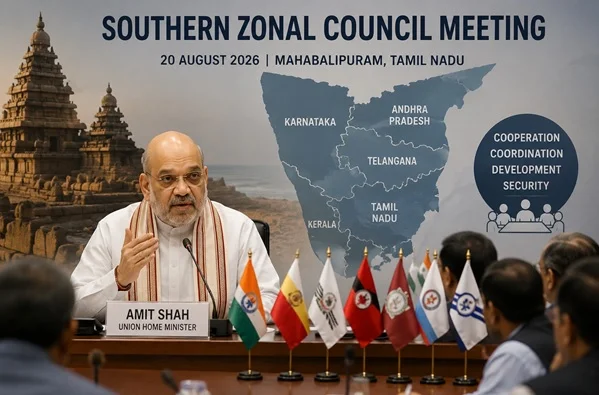
Key facts
|
Aspect
|
Details
|
|
Meeting
|
31st Southern Zonal Council Meeting
|
|
Date
|
20 August 2026
|
|
Venue
|
Mahabalipuram, Tamil Nadu
|
|
Chairperson
|
Union Home Minister Amit Shah
|
|
Organised by
|
Inter-State Council Secretariat, Ministry of Home Affairs
|
|
Host
|
Government of Tamil Nadu
|
|
Nature of Zonal Councils
|
Statutory and advisory bodies
|
|
Legal Basis
|
States Reorganisation Act, 1956
|
What are Zonal Councils?
- Zonal Councils are statutory bodies created to promote cooperation and coordination among states and between the Centre and states.
- The idea of such councils was proposed by Prime Minister Jawaharlal Nehru in 1956 in the context of the reorganisation of states. They were intended to reduce tensions arising from linguistic reorganisation and develop a habit of cooperative working among states.
- They are statutory bodies, established under Part III, Sections 15–22 of the States Reorganisation Act, 1956.
How Many Zonal Councils are there?
The States Reorganisation Act, 1956 provides for five Zonal Councils:
- Northern Zonal Council (Haryana, Himachal Pradesh, Punjab, Rajasthan, Chandigarh, Delhi, Jammu & Kashmir, Ladakh)
- Central Zonal Council (Chhattisgarh, Madhya Pradesh, Uttar Pradesh, Uttarakhand)
- Eastern Zonal Council (Bihar, Jharkhand, Odisha, West Bengal)
- Western Zonal Council (Goa, Gujarat, Maharashtra, Dadra & Nagar Haveli and Daman & Diu)
- The North-Eastern region has a separate institutional mechanism known as the North Eastern Council (NEC). The NEC was established under the North Eastern Council Act, 1971 and became operational in 1972. It is different from the five Zonal Councils established under the States Reorganisation Act.
- Southern Zonal Council (Andhra Pradesh, Karnataka, Kerala, Tamil Nadu, Telangana, Union Territories, Puducherry, Andaman and Nicobar Islands, and Lakshadweep)
Composition of Zonal Councils
- Under the States Reorganisation Act, the broad structure includes Chairman, The Union Home Minister chairs the Zonal Councils, Vice-Chairman, One of the Chief Ministers of the member states acts as Vice-Chairman by rotation.
- The councils include Chief Ministers of member states, two ministers from each member state, Representatives of the concerned Union Territories, senior officials from the Centre and states.
- The Act provides for the Union Minister nominated by the President to chair the Council and for Chief Ministers to serve as Vice-Chairman by rotation.
What Issues Can Zonal Councils Discuss?
Zonal Councils can deliberate on matters of common regional interest, particularly where cooperation between multiple governments is required.
- Inter-State Water Disputes: Southern India has several sensitive river-water issues involving states such as Karnataka, Tamil Nadu, Andhra Pradesh, Telangana and Kerala. Water sharing therefore remains an important area where political dialogue and coordination are necessary.
- Inter-State Disputes: Disagreements concerning boundaries, resources, administration or implementation of agreements can be discussed.
- Infrastructure and Connectivity: States can coordinate on highways, railways, transport, power infrastructure, and regional connectivity
- Internal Security: Coordination becomes important for issues such as drug trafficking, organised crime, cybercrime, cross-border criminal networks, and inter-state policing.
- Social Sector Issues: States and the Centre can coordinate policies relating to education, health, women and child safety, and social welfare.
- State Reorganisation Issues: Pending issues resulting from state reorganisation can also be discussed. This is particularly significant for Andhra Pradesh and Telangana in relation to matters arising from the Andhra Pradesh Reorganisation Act.
Important Issues at the 31st Meeting
- Reports from the meeting indicated discussion of a broad range of regional concerns, including inter-state disputes, security, development priorities, river-water questions and centre-state coordination.
- Some southern-state representatives also raised wider federal questions such as fiscal federalism and political representation/delimitation, while water-related projects and disputes continued to feature prominently in discussions.
Objectives of Zonal Councils
The major objectives can be understood through five broad ideas:
- Cooperation: Encouraging states to work together instead of approaching every disagreement as a political dispute.
- Coordination: Improving coordination between the Union Government and State Governments.
- Conflict Resolution: Providing an institutional forum where inter-State problems can be discussed before they become larger disputes.
- National Integration: Reducing regional tensions and strengthening mutual understanding among different states. The Ministry of Home Affairs describes Zonal Councils as mechanisms for resolving inter-State and Centre-State problems and promoting balanced regional development and harmonious relations.
- Role in Cooperative Federalism: India has a federal political system in which the Union and states have constitutionally defined responsibilities. However, many modern governance problems such as water management, transport, migration, internal security and infrastructure cross state boundaries.
Significance of the Southern Zonal Council
- Platform for Inter-State Dialogue: It brings neighbouring states together to discuss disputes directly instead of relying only on courts or political confrontation.
- Strengthens Centre-State Relations: Regular interaction between Union and State governments improves coordination and communication.
- Helps Resolve Regional Problems: Many problems such as water sharing, transportation, infrastructure and security have an inter-State dimension.
- Encourages Consensus-Based Governance: The councils are primarily advisory, making dialogue and consensus their principal tools.
- Supports Balanced Regional Development: States can coordinate development priorities and infrastructure projects affecting the wider region.
- Strengthens National Integration: Institutional dialogue helps reduce regional tensions and creates greater trust among states.
Limitations of Zonal Councils
- Advisory Nature: Their recommendations are not legally binding on states or the Union Government.
- Political Differences: Political disagreements between governments can prevent consensus.
- Complex Inter-State Disputes: Long-standing issues such as river-water disputes may require judicial, tribunal or other statutory mechanisms in addition to Zonal Council discussions.
- Implementation Gap: Agreement during meetings does not automatically guarantee timely implementation.
- Need for Regular Follow-up: Effective functioning depends on continuous monitoring through Standing Committees and concerned ministries.
Way Forward
- Zonal Councils should be strengthened through regular meetings, time-bound implementation of agreed decisions and stronger follow-up by Standing Committees.
- They should complement constitutional, judicial and statutory mechanisms while serving as an effective platform for cooperative and competitive federalism.
Prelims MCQ
Q. With reference to the Zonal Councils in India, consider the following statements:
- Zonal Councils are statutory bodies established under the States Reorganisation Act, 1956.
- The Union Home Minister is the Chairman of each Zonal Council.
- The North Eastern Council is one of the five Zonal Councils.
Which of the statements given above are correct?
(a) 1 and 2 only
(b) 2 and 3 only
(c) 1 and 3 only
(d) 1, 2 and 3
Mains Practice Question
Q. Despite being advisory bodies, Zonal Councils play an important role in India's federal architecture. Critically examine.
|
FAQs
What are Zonal Councils?
They are statutory regional forums for promoting Centre-State and inter-State cooperation.
Under which law were Zonal Councils established?
They were established under the States Reorganisation Act, 1956.
Who is the Chairman of Zonal Councils?
The Union Home Minister is the Chairman of each Zonal Council.
What is the main purpose of Zonal Councils?
To promote cooperation, resolve inter-State issues and strengthen regional coordination.
Which states are members of the Southern Zonal Council?
Andhra Pradesh, Karnataka, Kerala, Tamil Nadu and Telangana.
|






 Contact Us
  New Batch : 9555124124/ 7428085757
  Tech Support : 9555124124/ 7428085757