Why in News?
- India’s AM Green Ammonia (India) Private Ltd and Japan’s energy company JERA have signed a binding agreement for the long-term supply of green ammonia from India to Japan.
- The agreement aims to support maritime decarbonisation and develop Japan’s low-carbon ammonia supply chain.
- The deal is significant for India’s clean energy exports and the development of its green hydrogen economy.
Key Highlights of the Agreement
- Companies involved: AM Green Ammonia (India) Private Ltd and JERA Co. Inc.
- Supply volume: Approximately 70,000 tonnes of green ammonia annually.
- Duration: Five years, with the possibility of extension for additional supplies.
- Production location: AM Green’s proposed facility at Kakinada, Andhra Pradesh.
- Expected operational timeline: 2028–2029.
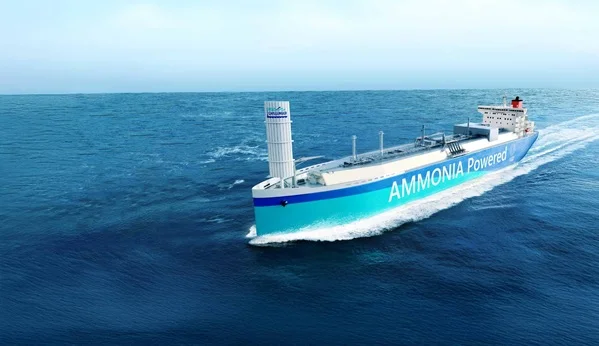
- Primary application: Fuel for ammonia-powered vessels, particularly car carriers transporting automobiles.
- Japanese infrastructure: JERA plans to use receiving, storage and distribution facilities being developed near its Hekinan Thermal Power Station in Aichi Prefecture.
The companies describe the project as one of the early large-scale green ammonia bunkering initiatives globally.
What Is Green Ammonia?
- Green ammonia is ammonia (NH3) produced using hydrogen generated through renewable energy, combined with nitrogen obtained from the air.
- It can be used in fertiliser production, chemical industries, energy storage and potentially as a fuel for maritime transport.
- Compared with hydrogen, ammonia can also be more convenient to store and transport under appropriate conditions.
How Is Green Ammonia Produced?
Green ammonia (NH3) is produced by combining green hydrogen, generated using renewable energy, with nitrogen extracted from the air.
- Renewable Energy: Solar and wind energy provide electricity for the production process.
- Electrolysis of Water: Electricity is used to split water into hydrogen and oxygen. Alkaline electrolysis is one of the technologies used for this process.
- Nitrogen Separation: Nitrogen is separated from the air.
- Ammonia Synthesis: Hydrogen reacts with nitrogen under controlled temperature and pressure in the Haber–Bosch process to produce ammonia.
- Storage and Transportation: The resulting green ammonia is stored and transported for use in fertilisers, chemical industries and potentially as a maritime fuel.
AM Green’s Kakinada project will use alkaline electrolysis technology and pumped-hydro energy storage. These technologies can support the use of renewable electricity and help manage fluctuations in its availability.
Significance of the Agreement for India
- Promoting clean energy exports: India can emerge as a major international supplier of green ammonia and other low-carbon energy products, creating new export opportunities.
- Supporting the National Green Hydrogen Mission: The agreement can contribute to the development of India’s green hydrogen and green ammonia ecosystem, including production, industrial applications and exports.
- Strengthening energy security: Japan gains an additional renewable-based source of ammonia, while India can build long-term commercial partnerships in the clean energy sector.
- Decarbonising maritime transport: Ammonia-powered ships could reduce dependence on conventional marine fossil fuels. However, the actual climate benefits depend on production methods, engine technology and emissions controls.
- Industrial development and employment: Investments in renewable energy, electrolysers, storage facilities, ports and ammonia handling infrastructure can generate economic opportunities.
Link with the National Green Hydrogen Mission
Launched in January 2023, India’s National Green Hydrogen Mission aims to make the country a global hub for the production, use and export of green hydrogen.
Its key objectives include:
- Promoting domestic electrolyser manufacturing.
- Scaling up green hydrogen production.
- Reducing dependence on fossil fuels.
- Supporting decarbonisation in hard-to-abate sectors.
- Developing export opportunities for green hydrogen and its derivatives.
Green ammonia is an important derivative of green hydrogen because it can facilitate the storage, transportation and use of hydrogen-derived energy in fertilisers, chemicals and maritime transport.
Major Challenges
- High production costs: Green ammonia can be more expensive than conventional ammonia produced using fossil fuels.
- Renewable energy requirements: Large quantities of clean electricity are needed for electrolysis and ammonia production.
- Infrastructure constraints: Specialised facilities are required for storage, transportation, distribution and ship bunkering.
- Safety concerns: Ammonia is toxic and corrosive. Leakage can pose serious risks to human health and the environment.
- Emissions from combustion: Ammonia combustion can produce nitrogen oxides and other nitrogen-based pollutants, requiring appropriate engine technology and emissions controls.
- International certification: Export markets require compliance with applicable standards for carbon intensity, lifecycle emissions and sustainability.
Way Forward
- India should expand renewable energy capacity, strengthen domestic electrolyser manufacturing and develop transparent certification standards for green ammonia.
- Cooperation with Japan and other potential importing countries can help secure long-term demand and encourage investment in production and port infrastructure.
- Research into ammonia-powered engines, safe bunkering systems and emissions control is also essential. Projects should be assessed on the basis of their entire lifecycle emissions, water consumption and environmental impacts rather than production capacity alone.
Conclusion
- The AM Green–JERA agreement represents an important step towards expanding India’s clean energy exports and developing lower-carbon fuel options for Japan.
- With appropriate infrastructure, safety standards and lifecycle emissions management, green ammonia could contribute to India’s energy transition and the global decarbonisation of maritime transport.
UPSC Prelims MCQ
|
Question 1. Consider the following statements regarding green ammonia:
- It can be produced using hydrogen generated from renewable energy.
- Its chemical formula is \(NH3\).
- It can potentially be used as an alternative fuel in maritime transport.
Which of the statements given above are correct?
(A) 1 and 2 only
(B) 2 and 3 only
(C) 1 and 3 only
(D) 1, 2 and 3
|