Prelims: India–Japan 2+2 Dialogue, Quad, JIMEX, Dharma Guardian, Acquisition and Cross-Servicing Agreement.
Mains: GS Paper II- India’s bilateral relations and the Indo-Pacific. GS Paper III: Maritime security and defence indigenisation.
Keywords: India–Japan relations, Rajnath Singh Tokyo visit, 2+2 Ministerial Dialogue, Indo-Pacific security, defence technology cooperation, UNICORN. |
Why in News?
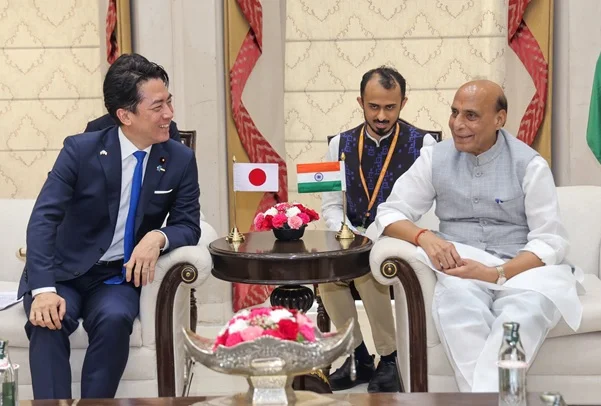
Defence Minister Rajnath Singh arrived in Tokyo on 18 November 2026 for a two-day official visit. The fourth India–Japan Foreign and Defence Ministers’ Dialogue is scheduled for 19 November. Singh will also hold separate bilateral talks with Japanese Defence Minister Shinjiro Koizumi.
|
Particular
|
Details
|
|
Venue and date
|
Tokyo, Japan, 19 November 2026
|
|
Indian delegation
|
External Affairs Minister S. Jaishankar and Defence Minister Rajnath Singh
|
|
Japanese delegation
|
Foreign Minister Toshimitsu Motegi and Defence Minister Shinjiro Koizumi
|
|
Previous round
|
20 August 2024, New Delhi
|
What Is a 2+2 Dialogue?
A 2+2 Dialogue brings together the foreign and defence ministers of two countries. By placing both ministries at the same table, the format helps governments coordinate diplomatic priorities with practical decisions on defence cooperation.
For India and Japan, that can mean linking a shared commitment to secure sea routes with naval exercises, logistics arrangements and defence technology projects.
Background of India–Japan Security Cooperation
- 2008: India and Japan issued a Joint Declaration on Security Cooperation, identifying the safety of sea routes as a shared interest.
- 2014: The relationship was elevated to a Special Strategic and Global Partnership.
- 2020: The two countries signed the Acquisition and Cross-Servicing Agreement (ACSA). It entered into force in 2021 and provides a framework for their forces to supply each other with agreed logistics support, supplies and service.
- 2022 and 2024: The second 2+2 dialogue took place in Tokyo, followed by the third round in New Delhi. At the 2024 meeting, the ministers reviewed progress on the proposed transfer of the Unified Complex Radio Antenna (UNICORN) and related technologies.
- July 2026: At their annual summit, Prime Ministers Narendra Modi and Sanae Takaichi announced documents on economic security and artificial intelligence cooperation, widening the scope of the partnership.
Key Points on the Tokyo Agenda
- Maritime Security in the Indo-Pacific: The ministers will review strategic cooperation and reaffirm their commitment to a free, open, inclusive and rules-based Indo-Pacific. The separate defence ministers’ talks will address maritime security. For both countries, secure sea lanes matter because they carry commercial shipping and energy supplies.
- Defence Equipment and Industrial Cooperation: The defence ministers are expected to discuss closer cooperation on equipment, technology and industrial partnerships. The UNICORN integrated antenna system illustrates how a specific technology project can give substance to defence ties. For India, the industrial value of such projects depends on the technology shared and the role Indian firms can play in manufacturing and long-term maintenance.
- Joint Exercises Across the Three Services: The two defence ministers will discuss increasing the scale and complexity of joint exercises across the three services. India and Japan already conduct JIMEX, a bilateral naval exercise, and Dharma Guardian, a bilateral army exercise. They also participate in the Malabar naval exercise with Australia and the United States. More complex exercises can help the forces communicate and coordinate more effectively.
- A Follow-up to Earlier Defence Talks: The Tokyo bilateral will be Singh and Koizumi’s third meeting in 2026, following talks in New Delhi in August and on the sidelines of the ASEAN Defence Ministers’ Meeting-Plus in Cebu in October. In August, the ministers agreed to establish a working group to coordinate cooperation across areas including operations, equipment, technology and industry. Tokyo offers an opportunity to review how those commitments are being put into practice.
Significance and Relevance for India
|
Area
|
Why it matters for India
|
|
Maritime security
|
Cooperation with Japan helps India work with a major partner on the security of sea routes linking the Indian and Pacific oceans.
|
|
Defence indigenisation
|
Joint projects can help Indian firms build manufacturing and maintenance capabilities when agreements provide for meaningful industrial participation.
|
|
Operational coordination
|
Exercises build familiarity between the forces, while ACSA gives them a framework for reciprocal logistics support.
|
|
Act East and the Quad
|
Stronger ties with Japan support India’s engagement with East Asia and complement its cooperation with Japan, Australia and the US through the Quad.
|
These benefits draw on existing logistics arrangements, regular exercises and the two countries’ cooperation through the Quad.
Challenges
- Turning proposals into projects: Joint development and production require agreement on costs, intellectual property, technology transfer and the responsibilities of industrial partners.
- Managing different security priorities: India’s priorities in the Indian Ocean and Japan’s concerns in East Asia can influence which projects receive resources first.
- Sustaining coordination: More complex exercises and deeper logistics cooperation require compatible procedures, regular planning and follow-up between the two countries’ services.
Way Forward
- Use the bilateral working group to set timelines and responsibilities for a small number of defence technology projects.
- Clarify technology transfer, local manufacturing and maintenance roles early in industrial negotiations.
- Build on existing maritime exercises through search-and-rescue and disaster-response drills and use the logistics agreement to support recurring exchanges.
Conclusion
The fourth India–Japan 2+2 Dialogue gives both countries an opportunity to turn shared Indo-Pacific priorities into practical cooperation. Progress can be measured by how consistently their forces work together and whether defence technology discussions lead to projects with defined timelines and industrial roles.
UPSC Prelims Practice Question
Consider the following statements regarding India–Japan defence cooperation.
- The 2+2 Ministerial Dialogue brings together the foreign and defence ministers of both countries.
- JIMEX is a bilateral naval exercise between India and Japan.
- The Acquisition and Cross-Servicing Agreement establishes a mutual defence obligation.
Which of the statements given above are correct?
(a) 1 and 2 only
(b) 2 and 3 only
(c) 1 and 3 only
(d) 1, 2 and 3
Mains Practice Question
How does the India–Japan 2+2 Dialogue advance India’s interests in the Indo-Pacific? Discuss with reference to maritime security, military logistics and defence industrial cooperation.
|
FAQs
1. What is the India–Japan 2+2 Dialogue?
It brings together both countries’ foreign and defence ministers.
2. When will the fourth India–Japan 2+2 Dialogue take place?
It is scheduled for 19 November 2026 in Tokyo.
3. Who represents India at the Tokyo 2+2 Dialogue?
Defence Minister Rajnath Singh and External Affairs Minister Jaishankar.
4. What is JIMEX?
JIMEX is a bilateral naval exercise between India and Japan.
5. What does the India–Japan logistics agreement cover?
It enables reciprocal military logistics support, supplies and services.
|