Prelims: Nimso Kerung, Karbi community, Chomangkan ceremony, Diphu, Sixth Schedule
Mains: GS Paper I (Indian Art and Culture) and GS Paper II (Tribal Autonomy and Local Governance)
Keywords: Nimso Kerung folk dance, Karbi Anglong, Guinness World Records, Assam tribal culture, Karbi Anglong Autonomous Council |
Why in News?
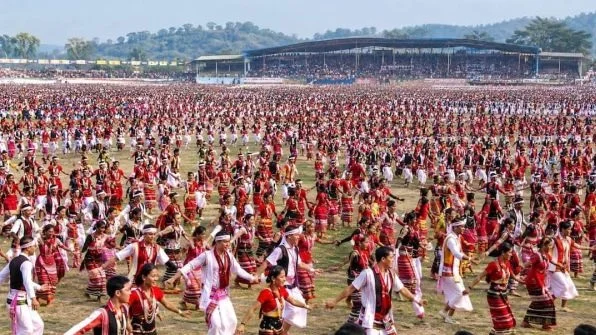
- On 16 November 2026, around 15,000 dancers gathered at KASA Stadium in Diphu, Assam, to perform Nimso Kerung, a traditional folk dance of the Karbi community.
- Guinness World Records adjudicator Swapnil Dangarikar announced the record for the largest folk dance performance.
What Is Nimso Kerung?
- Nimso Kerung is a traditional group dance of the Karbi community of Assam. In Karbi, Nimso means a young woman or maiden, while Kerung refers to picking up or choosing. In the context of the dance, the name refers to choosing a young woman as a dance partner.
- Young men and women traditionally form a circle and move together to the rhythm of drums and accompanying songs. Coordination between the dancers is central to the performance.
Link with the Chomangkan Ceremony
- The dance is traditionally associated with Chomangkan, a Karbi ceremony held to honour deceased family members. Within this larger ceremony, Nimso Kerung provides a social occasion for young people to gather, sing and dance together.
- The two aspects help explain its place in Karbi life. Chomangkan expresses remembrance, while the dance gives younger members of the community a role in a tradition practised across generations.
The Record-Setting Performance at a Glance
|
Feature
|
Details
|
|
Date
|
16 November 2026
|
|
Venue
|
KASA Stadium, Diphu, Assam
|
|
Dance form
|
Nimso Kerung
|
|
Participation
|
Around 15,000 dancers from 17 communities
|
|
Occasion
|
75th Karbi Anglong Day celebrations
|
|
Organiser
|
Karbi Anglong Autonomous Council
|
|
Guinness adjudicator
|
Swapnil Dangarikar
|
The dancers performed the same folk dance in synchrony while wearing the traditional clothing of their respective communities. This gave the public performance a distinct local character and made the region’s cultural diversity visible to audiences.
Significance
- Passing on traditional knowledge: Preparing for a group performance gives young dancers an opportunity to learn the steps, rhythm and timing from instructors and experienced performers. The process can also encourage them to ask about the meanings of the songs and the occasions on which the dance is performed.
- Participation across communities : At Diphu, dancers from 17 communities came together around a tradition rooted in Karbi culture. Rehearsing and performing together gave participants a shared experience, while their clothing reflected the distinct identities of the communities they represented.
- Visibility for Northeast India’s folk arts : International recognition can encourage teachers, researchers and cultural institutions to explore the dance and its history. It can also create opportunities for local performers and musicians to explain the tradition in their own words.
Intangible Cultural Heritage
Nimso Kerung illustrates how cultural knowledge is carried through practice, memory and participation. A video can capture the movements and formations, while accounts from practitioners can explain how the songs are learned, what they mean and how the dance fits into Chomangkan. Preserving a living tradition therefore involves supporting the people who practise and transmit it, alongside documenting the performance itself.
Role of Autonomous District Councils
The Sixth Schedule provides for autonomous councils in specified tribal areas of Assam, Meghalaya, Tripura and Mizoram. The KAAC’s role in organising the event shows how an autonomous institution can provide a public platform for a locally rooted cultural practice. Councils can also support smaller initiatives throughout the year, such as village workshops, recordings in local languages and exchanges between experienced artists and school students.
Challenges
- Loss of context : Audiences may first encounter the dance through a short video of the record attempt. Without an explanation of Chomangkan, they may miss the dance’s connection with remembrance and community life.
- Continuity after major events : A stadium performance can attract attention in the short term. Passing on the tradition requires regular opportunities for young people to learn from dancers, singers and musicians.
- Community control over documentation : Recording ceremonies and songs raises questions about who can publish, adapt or use that material. Families and practitioners should have a say in what is shared and how it is presented.
Way Forward
- Document the dance with practitioners: Record its steps, songs and ceremonial context with community consent. Use Karbi for the original accounts and add translations for wider access.
- Support teaching throughout the year: Local institutions can fund village workshops and school demonstrations led by experienced artists, with fair payment for their time.
- Explain the tradition at public event: A brief introduction to Chomangkan and the meaning of Nimso Kerung can help audiences understand what they are watching.
- Preserve local variations: Document how different groups perform the dance so that the choreography used for one large event leaves room for forms practised locally.
Conclusion
The Diphu performance brought a Karbi folk dance to international attention and gave thousands of young people a chance to take part. Its lasting contribution will depend on whether performers have opportunities to learn the songs, movements and ceremonial meanings of Nimso Kerung from the people who keep the tradition alive.
Prelims Practice Question
With reference to Nimso Kerung, consider the following statements.
- It is a traditional folk dance of the Karbi community.
- It is associated with Chomangkan, a ceremony honouring the deceased.
- The Guinness World Record performance took place in Haflong.
Which of the statements given above are correct?
(a) 1 and 2 only
(b) 2 and 3 only
(c) 1 and 3 only
(d) 1, 2 and 3
Practice Main Question
How can autonomous district councils help preserve tribal performing arts while promoting them through public events? Discuss with reference to Assam’s Nimso Kerung.
|
FAQs
1. Which community performs Nimso Kerung?
The Karbi community of Assam traditionally performs it.
2. Which ceremony is associated with Nimso Kerung?
It is traditionally performed during the Chomangkan ceremony.
3. Where was the Guinness World Record set?
It was set at KASA Stadium in Diphu.
4. How many dancers participated in the record performance?
Around 15,000 dancers participated in the record-setting performance.
5. Who organised the Karbi Anglong Day celebrations?
The Karbi Anglong Autonomous Council organised the celebrations.
|