
- UPSC Exam
- State PCS
- One Day Exam
- Current Affairs
- PT Quiz
- Downlaods
- About Coaching
- Blog
- Videos

| Mains: GS Paper II: Centre-State Relations, Governance, Fundamental Rights, Rule of Law GS Paper III: Internal Security, Insurgency, Border Management, Role of Armed Forces in Internal Security. Keywords: AFSPA 1958, Armed Forces Special Powers Act, disturbed area, Section 3 AFSPA, Section 4 AFSPA, Section 7 AFSPA, Manipur, Nagaland, Arunachal Pradesh, Northeast India, insurgency, internal security, counter-insurgency, human rights, Centre-State relations |
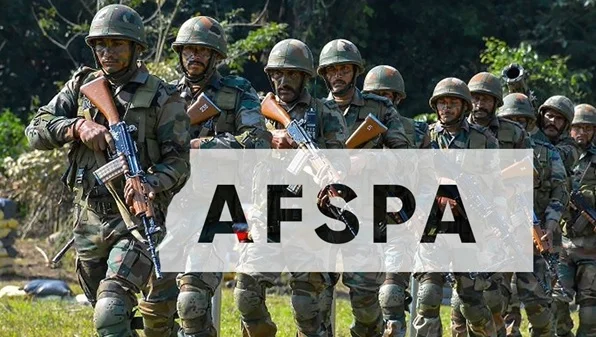
The Ministry of Home Affairs has extended the Armed Forces (Special Powers) Act, 1958 (AFSPA) in specified areas of Manipur, Nagaland and Arunachal Pradesh for another six months from October 1, 2026. The extension follows a review of the law-and-order situation in the three northeastern states.
The Northeast is strategically significant because of its:
In such areas, the armed forces may be deployed in support of civil administration when ordinary policing capabilities are considered insufficient to deal with the security situation.
AFSPA creates a difficult policy balance between operational effectiveness and civilian accountability.
Therefore, the key governance challenge is to ensure that security personnel have adequate operational capability while mechanisms for investigation, oversight and accountability remain effective.
The extraordinary powers available to security personnel have generated concerns regarding alleged excessive use of force, custodial deaths, disappearances and accountability.
These concerns have contributed to demands for stronger safeguards and greater transparency.
Critics have particularly focused on the legal protection available to personnel operating under AFSPA.
The challenge is to ensure that legitimate counter-insurgency operations can continue while credible allegations of abuse are investigated effectively.
Repeated extensions raise an important policy question: whether extraordinary security legislation should remain applicable for extended periods or whether its geographical scope should be progressively reduced as the security situation improves.
Long-term military deployment can affect relations between security forces and local communities. Consequently, counter-insurgency measures need to be accompanied by political dialogue, development, institution-building and confidence-building measures.
MCQQ. Consider the following statements regarding the Armed Forces (Special Powers) Act, 1958:
Which of the statements given above is/are correct? A. 1 and 2 only Mains Question“AFSPA seeks to address extraordinary internal-security challenges, but its prolonged application raises questions of accountability and civilian rights.” Discuss the need to balance national security with democratic accountability. |
1. What is AFSPA?AFSPA is the Armed Forces (Special Powers) Act, 1958, which provides specified powers to armed forces personnel operating in areas officially declared as disturbed. 2. Which section allows declaration of a disturbed area?Section 3 of AFSPA provides for declaration of an area as a disturbed area. 3. Where has AFSPA been extended from October 1, 2026?It has been extended in specified areas of Manipur, Nagaland and Arunachal Pradesh for six months. 4. Is the whole of Manipur under AFSPA?The October 2026 notification covers the entire state except areas under 13 police stations in five districts. 5. Why is AFSPA important for UPSC?AFSPA connects internal security, insurgency, human rights, Centre-State relations, constitutional governance and civil-military relations, making it relevant particularly to GS Paper 3, with linkages to GS Paper 2. |



Our support team will be happy to assist you!


 Contact Us
  New Batch : 9555124124/ 7428085757
  Tech Support : 9555124124/ 7428085757