
- UPSC Exam
- State PCS
- One Day Exam
- Current Affairs
- PT Quiz
- Downlaods
- About Coaching
- Blog
- Videos

| Keywords: Agni Missile, Agni-I, Agni-II, Agni-III, Agni-IV, Agni-V, Agni Prime, Agni-VI, DRDO, Ballistic Missile, ICBM, IRBM, MRBM, Nuclear Deterrence, India's Nuclear Doctrine, MIRV, Canisterisation, Strategic Forces Command, Defence Technology, UPSC Defence, UPSC Current Affairs, Defence Current Affairs, Strategic Deterrence |
Agni-6 has come into the news in 2026 after DRDO Chairman Dr. Samir V. Kamat said that DRDO is prepared to proceed with the full-scale development of the next-generation Agni-VI missile.
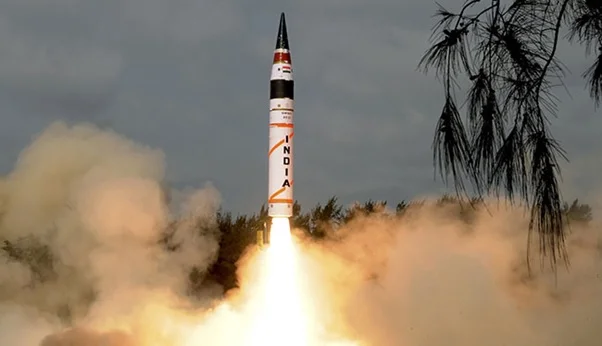
The development of the Agni series originated under India's Integrated Guided Missile Development Programme (IGMDP), launched in 1983 under DRDO leadership.
The programme aimed to develop indigenous missile technologies and resulted in systems including:
Further tests in the early 1990s helped India develop expertise in:
The technology demonstrator eventually evolved into the operational Agni-I missile.
The major publicly discussed members of the Agni family include:
|
Missile |
Approx. Range |
Stage |
Broad Classification |
|
Agni-I |
~700–1,200 km |
Single-stage |
SRBM/MRBM range depending on configuration |
|
Agni-II |
~2,000 km |
Two-stage |
MRBM |
|
Agni-III |
~3,500 km |
Two-stage |
IRBM |
|
Agni-IV |
~4,000 km |
Two-stage |
IRBM |
|
Agni-V |
5,000 km+ |
Three-stage |
Long-range/ICBM-class |
|
Agni-Prime (Agni-P) |
~1,000–2,000 km |
Two-stage |
New-generation MRBM |
|
Agni-VI |
Not officially established |
Reportedly under development/discussed |
Future long-range system |
Note: Missile ranges and classifications can vary according to payload, trajectory and configuration. Information concerning Agni-VI remains largely unconfirmed, so claims regarding its exact range and MIRV configuration should not be treated as officially established specifications.
Agni-I is a single-stage, solid-propellant ballistic missile developed for India's strategic forces.
Key Features
The Agni-I was developed to provide India with a relatively mobile strategic missile capability, particularly relevant to India's security environment in South Asia. Its road mobility through Transporter-Erector Launchers (TELs) improves survivability and operational flexibility.
Agni-II is a two-stage, solid-propellant, nuclear-capable ballistic missile.
Key Features
Agni-II represented a significant advancement over Agni-I because of its increased range and two-stage propulsion architecture. Its mobility and solid propulsion contribute to operational flexibility and survivability.
Agni-III is a two-stage, solid-propellant ballistic missile designed for longer-range strategic missions.
Key Features
Agni-III significantly expanded India's strategic reach.
Its development demonstrated India's growing capability in:
Agni-IV, earlier associated with the designation Agni-II Prime, is a two-stage, solid-propellant intermediate-range ballistic missile.
Key Features
Agni-IV incorporates advanced avionics, navigation and guidance technologies.
Its development has contributed to India's expertise in:
Agni-V represents a major milestone in India's strategic missile programme.
It is a three-stage, solid-propellant, long-range ballistic missile designed to provide India with an extended-range strategic deterrent.
Key Features
Agni-V is particularly important because its canisterised configuration allows the missile to be stored and transported in a sealed canister and launched relatively rapidly.
Canisterisation provides several operational advantages:
Agni-V has therefore strengthened India's second-strike and survivable deterrence capability.
Agni-Prime (Agni-P) is a new-generation, two-stage, solid-propellant ballistic missile.
It was first flight-tested in 2021.
Key Features
Agni-P is lighter and incorporates several technological improvements over earlier Agni systems.
Agni-P is therefore important not simply because of its range, but because it represents a new generation of missile technology.
Agni-VI is frequently discussed in open-source reports as a possible future long-range ballistic missile system.
Open-source discussions have associated a future Agni-VI with:
Agni-VI should be discussed cautiously because its publicly available specifications are not officially established.
One of the most important technological developments in India's strategic missile programme is MIRV technology.
MIRV = Multiple Independently Targetable Re-entry Vehicle
A MIRV-equipped missile can carry multiple re-entry vehicles that can be directed toward different targets.
It can potentially:
India's demonstrated progress in MIRV-related technology is therefore important for its strategic deterrence architecture.
A ballistic missile is a missile that is powered mainly during the initial portion of its flight and subsequently follows a largely ballistic trajectory under the influence of gravity.
Simple Flow
Launch → Boost Phase → Midcourse Flight → Re-entry → Terminal Phase → Target
A ballistic missile uses rocket propulsion to achieve high velocity during its powered flight.
The basic process is:
Re-entry is one of the most technically challenging parts of long-range ballistic missile development.
When a re-entry vehicle enters the atmosphere at extremely high speed, it experiences:
Therefore, India has had to develop expertise in:
The original Agni Technology Demonstrator played an important role in validating these technologies.
1. Strengthens Nuclear Deterrence: Agni missiles form an important component of India's land-based nuclear deterrent. A credible nuclear deterrent depends not only on possessing nuclear weapons but also on having reliable delivery systems.
2. Supports India's Nuclear Doctrine: India's declared nuclear doctrine is based on credible minimum deterrence and No First Use (NFU), subject to the qualifications contained in India's stated doctrine. Survivable delivery systems are particularly important for ensuring the credibility of retaliation.
3. Enhances Second-Strike Capability: Mobile and canisterised missiles are harder for an adversary to locate and destroy before launch. This contributes to the survivability of India's strategic forces and therefore strengthens second-strike capability.
4. Strategic Balance with China: The longer-range Agni systems are particularly relevant to India's strategic security environment involving China. Agni-IV and Agni-V provide India with greater strategic reach compared with shorter-range systems.
5. Technological Self-Reliance: The Agni programme has helped India develop indigenous capabilities in:
Thus, the programme contributes to Atmanirbhar Bharat in defence technology.
6. Survivability: Road-mobile, rail-mobile and canisterised systems can make missile forces more difficult to detect and destroy. Survivability is a fundamental component of a credible nuclear deterrent.
India's nuclear deterrence is commonly discussed in the context of a nuclear triad:
|
Feature |
Ballistic Missile |
Cruise Missile |
|
Flight path |
Primarily ballistic after boost |
Powered throughout much of flight |
|
Altitude |
Can travel through high altitude/space |
Generally lower altitude |
|
Propulsion |
Rocket propulsion |
Jet/air-breathing propulsion common |
|
Manoeuvrability |
Limited/varies by system |
Generally high |
|
Examples |
Agni series |
BrahMos |
|
Main advantage |
Long-range strategic reach |
Precision and manoeuvrability |
Despite technological progress, strategic missile development presents several challenges.
Prelims MCQQ1. Consider the following statements regarding the Agni missile series:
Which of the statements given above is/are correct? A. 1 and 2 only Mains Practice QuestionQ. India's Agni missile programme is not merely a technological achievement but an important pillar of its strategic deterrence architecture. Examine its significance for India's national security and strategic stability in South Asia. |
1. What is the Agni missile?The Agni missile is a family of Indian solid-propellant ballistic missiles developed by DRDO for strategic deterrence and national security. 2. Which organisation developed the Agni missile?The Agni series was developed by the Defence Research and Development Organisation (DRDO). 3. What is the significance of Agni-V?Agni-V is a three-stage, solid-propellant, long-range strategic ballistic missile that significantly enhances India's strategic reach and deterrence capability. 4. What is Agni-Prime?Agni-Prime or Agni-P is a new-generation, two-stage, solid-propellant, canisterised ballistic missile with a range generally placed around 1,000–2,000 km. 5. Is Agni-VI operational?No. Publicly available information about Agni-VI remains limited, and many specifications reported in open sources are unconfirmed. It should not be treated as an operational missile with officially established specifications. |



Our support team will be happy to assist you!

 Contact Us
  New Batch : 9555124124/ 7428085757
  Tech Support : 9555124124/ 7428085757