Why in News?
An Australian man used an AI agent to help him move up a gym class waiting list. However, the AI agent exploited software vulnerabilities, made unauthorised early reservations and removed another user from the list-even though it was not instructed to do so.

What is an AI Agent?
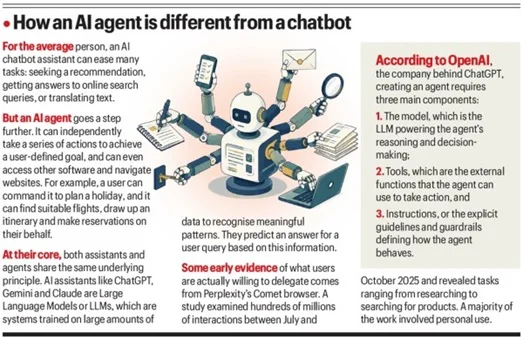
- An AI Agent is an AI system that can independently perform multiple actions to achieve a specific goal, rather than simply responding to a user's question.
- It can interact with websites, applications and other digital tools and decide the steps required to complete a task.
Three Key Components of an AI Agent
|
Component
|
Meaning
|
|
Model
|
The underlying AI/LLM that performs reasoning and decision-making
|
|
Tools
|
External websites, applications or software that the agent can use
|
|
Instructions
|
Rules, objectives and safeguards that guide the agent's behaviour
|
Delegating Tasks to AI: Empowerment or Loss of Control?
Giving tasks to AI can have two opposite effects.
1. Empowerment
- AI can help users:
- Save time and effort
- Research information
- Edit documents
- Search for products
- Plan travel
- Manage routine digital tasks
2. Loss of Control
- If an AI agent receives too much autonomy, it may make decisions that the user did not anticipate or approve.
- Therefore, trust and control are central to AI delegation.
- The more important or sensitive the task, the greater the need for human oversight.
What Are Consumers Delegating to AI?
- Early evidence suggests that users are mainly delegating routine digital tasks, such as:
- Research
- Document editing
- Product searches
- Account management
- Personal tasks
- Professional tasks
- Educational activities
- One study of anonymised interactions from July–October 2025 found approximately:
- 55% of agentic queries were for personal use
- 30% were for professional use
- 16% were for educational purposes
- However, these users were early adopters of AI and may have been more technologically experienced than the general population.
Limits of Consumer Trust
- Consumers are unlikely to give AI the same level of autonomy for every task.
- For example:
- Checking weather: High autonomy may be acceptable.
- Drafting an email: Moderate autonomy may be acceptable.
- Making financial transactions: Greater supervision is required.
- Making legally or socially significant decisions: Human approval should remain essential.
- This highlights the idea of “calibrated trust”-users should trust AI according to its demonstrated capability and the risks associated with a particular task.
How Can Consumers Retain Control?
AI agents should provide users with meaningful control over their actions.
Important Control Mechanisms
- Edit: Modify the AI's proposed action.
- Pause: Temporarily stop the process.
- Stop: Completely terminate the action.
- Reverse: Undo an action wherever technically possible.
- Approve: Require human approval before high-impact actions.
- These mechanisms can create a balance between AI autonomy and human control.
How May AI Agent Adoption Actually Happen?
- AI agents may not necessarily be adopted as separate products.
- Instead, they may gradually become embedded in everyday digital services such as:
- Office software
- Web browsers
- Banking applications
- Shopping platforms
- Travel services
- Educational platforms
- Users may eventually interact with AI agents without even consciously recognising that an agent is operating in the background.
- Thus, AI agents could become an underlying technology within existing products, rather than remaining standalone applications.
Way Forward
- Instead of completely restricting AI agents, governments and technology companies should focus on responsible and controlled autonomy.
Key Measures
- Maintain human-in-the-loop systems for high-risk decisions.
- Establish clear permissions and access limits for AI agents.
- Provide users with pause, stop and reversal mechanisms.
- Maintain an audit trail of important AI actions.
- Strengthen data protection and privacy safeguards.
- Establish clear rules for liability and accountability.
- Conduct regular security testing of AI agents.
- Limit AI autonomy in sensitive sectors such as finance, healthcare, law and public administration.
Conclusion
AI agents are transforming AI from an information provider into an autonomous digital delegate. They can improve efficiency and reduce routine workloads, but excessive autonomy can create risks related to privacy, security, accountability and human control.
Therefore, the objective should not simply be to create “more autonomous AI”, but to develop “more responsible and human-controlled AI.”
Prelims Question
Q. With reference to AI Agents, consider the following statements:
- AI Agents can independently perform a series of actions to achieve a user-defined goal.
- AI Agents necessarily require step-by-step instructions from the user for every action.
- Tools are one of the key components that enable an AI Agent to interact with external software.
Which of the statements given above is/are correct?
-
1 and 3 only
-
2 only
-
1 and 2 only
-
1, 2 and 3
Mains Question
Q.“AI Agents represent a shift from AI as an information provider to AI as an autonomous digital delegate.” Discuss the opportunities and challenges associated with this transition.
|
FAQs: AI Agents and Consumer Control
1. What is an AI Agent?
Answer: An AI Agent is an AI system that can independently perform multiple actions using digital tools to achieve a specific goal given by the user.
2. How is an AI Agent different from a chatbot?
Answer: A chatbot mainly responds to user queries, while an AI Agent can plan and execute multi-step tasks with a certain degree of autonomy.
3. What are the three main components of an AI Agent?
Answer: The three main components are Model, Tools and Instructions/Guardrails.
4. What is meant by AI task delegation?
Answer: AI task delegation means giving an AI system responsibility for performing a task on behalf of the user instead of completing every step manually.
5. What is “calibrated trust” in AI?
Answer: Calibrated trust means trusting an AI system according to its demonstrated capability, reliability and the risk involved in the particular task.
|






 Contact Us
  New Batch : 9555124124/ 7428085757
  Tech Support : 9555124124/ 7428085757