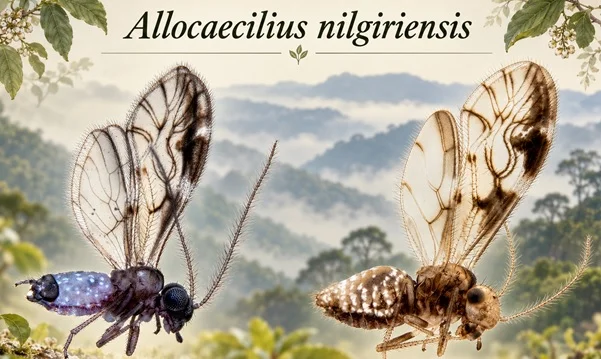
Allocaecilius nilgiriensis: New Barklice Species Discovered in Nilgiri Hills of Western Ghats

Prelims: Species in News, Western Ghats, Zoological Survey of India
Mains: GS Paper III – Environment, Biodiversity and Conservation
Keywords: Allocaecilius nilgiriensis, Barklice, Nilgiri Hills, Western Ghats, Zoological Survey of India, Shola Forests, Biodiversity Hotspot, Insect Taxonomy

Why in News?

  • The discovery represents only the second recorded species of the genus Allocaecilius in India.
  • With this discovery, the total number of known species belonging to this genus worldwide has increased to 13.
  • The findings were published on October 12, 2026, in the scientific journal Zootaxa. 

About Allocaecilius nilgiriensis

Allocaecilius nilgiriensis is a newly identified species of barklouse, a small insect found in moist forest environments.

Feature

Description

Scientific name

Allocaecilius nilgiriensis

Common group

Barklice (singular: Barklouse)

Order

Psocodea

Family

Pseudocaeciliidae

Genus

Allocaecilius

Discovered by

Zoological Survey of India

Location

Nilgiri Hills, Southern Western Ghats

Distribution

Tamil Nadu and Kerala

Habitat

Shola and evergreen rainforests

Known species in genus

13 worldwide

Distinctive Physical Characteristics

  • Forewings: Brown patches in specific wing cells identified as R1, R3 and R5.
  • Male reproductive structure: Thumb-like structures on the hypandrium, a plate on the lower abdomen.
  • Female reproductive structure: A deeply indented subgenital plate.
  • Scientific importance: Examination of both male and female specimens supports accurate identification and classification.

What are Barklice?

Barklice are tiny, generally harmless insects that live on tree bark, leaves and vegetation, particularly in humid environments.

  • They feed on fungi, mould, algae, lichens and decaying organic matter.
  • They contribute to nutrient cycling by consuming organic debris and microorganisms.
  • Despite their name, barklice are not the same as parasitic lice found on humans and animals.
  • Their presence contributes to the functioning of forest microecosystems.

Habitat and Distribution

The newly discovered species inhabits the moist, shaded vegetation of high-altitude shola and evergreen rainforests in the Southern Western Ghats.

About the Nilgiri Hills

Feature

Details

Location

Tamil Nadu, Kerala and Karnataka region

Mountain system

Western Ghats

Highest peak

Doddabetta (2,637 metres)

Major ecosystem

Shola forests and montane grasslands

UNESCO recognition

Western Ghats World Heritage Site includes Nilgiri landscape components

Ecological significance

Rich biodiversity, endemic species and important watersheds

What are Shola Forests?

Shola forests are tropical montane evergreen forests found in sheltered valleys and depressions of high-altitude landscapes in South India.

  • They are commonly surrounded by montane grasslands, forming a distinctive shola-grassland ecosystem.
  • They occur in the higher elevations of the Western Ghats, particularly in the Nilgiri, Anamalai and Palani Hills.
  • They support many endemic plant and animal species.
  • They play an important role in water retention, stream regulation and maintaining ecological balance.

About the Zoological Survey of India (ZSI)

The Zoological Survey of India is a scientific organisation responsible for studying and documenting India's animal diversity.

Feature

Details

Established

1 July 1916

Headquarters

Kolkata, West Bengal

Administrative ministry

Ministry of Environment, Forest and Climate Change

Main responsibility

Faunal surveys, taxonomy, classification and biodiversity documentation

Important collections

National Zoological Collections

The organisation conducts scientific expeditions, identifies previously undocumented animal species and maintains collections for biological research. 

Significance of the Discovery

  1. Biodiversity Documentation: The discovery adds to the scientific understanding of India's insect diversity, particularly in the Western Ghats.
  2. Ecological Importance: Barklice contribute to forest ecosystem functioning by feeding on microorganisms and decaying organic material.
  3. Taxonomic Advancement: Studying both male and female specimens helps resolve identification difficulties and improves classification accuracy.
  4. Conservation Importance: The discovery highlights the need to protect specialised habitats such as shola forests and evergreen rainforests.
  5. Scientific Research: The findings provide reference characteristics for future taxonomic and biogeographical studies in the Oriental region.

Challenges to Conservation

  • Habitat fragmentation: Infrastructure development and land-use changes can disrupt forest ecosystems.
  • Climate change: Changes in temperature and rainfall may affect moisture-dependent organisms.
  • Invasive species: Non-native plants can alter natural shola-grassland landscapes.
  • Limited scientific knowledge: Many small insects remain insufficiently studied, making conservation assessments difficult.

Way Forward

  • Strengthen conservation measures in ecologically sensitive regions of the Western Ghats.
  • Encourage detailed faunal surveys and taxonomic research.
  • Protect shola forests and surrounding montane grasslands from habitat degradation.
  • Develop long-term monitoring programmes to understand the effects of climate change on forest insects.
  • Promote collaboration between research institutions, conservation organisations and local communities.

Prelims Practice Question

Q. With reference to Allocaecilius nilgiriensis, recently discovered in India, consider the following statements:

  1. It is a newly discovered barklouse species recorded from the Nilgiri Hills.
  2. It inhabits moist shola and evergreen forests of the Southern Western Ghats.
  3. It is a parasitic insect that feeds primarily on the blood of mammals.
  4. It was discovered and described by scientists from the Zoological Survey of India.

Which of the statements given above are correct?

(a) 1 and 2 only

(b) 1, 2 and 4 only

(c) 2, 3 and 4 only

(d) 1, 2, 3 and 4

Mains Practice Question

Q. Discuss the ecological significance of newly discovered insect species in biodiversity hotspots. How can taxonomic research contribute to conservation strategies in the Western Ghats?

FAQs

Q1. What is Allocaecilius nilgiriensis?

It is a newly described species of barklouse insect discovered in the Nilgiri Hills of the Southern Western Ghats.

Q2. Which organisation discovered the species?

Scientists from the Zoological Survey of India (ZSI) discovered and scientifically described the species.

Q3. Where is Allocaecilius nilgiriensis found?

It has been recorded from moist shola and evergreen forest habitats in the Southern Western Ghats, covering parts of Tamil Nadu and Kerala.

Q4. What do barklice eat?

Barklice mainly feed on fungi, algae, lichens, mould and decaying organic material present on tree surfaces.

Q5. Why is this discovery important?

It expands knowledge of India's insect biodiversity and helps scientists better understand the taxonomy and distribution of the genus Allocaecilius.