Prelims : (Polity + Governance + CA)
Mains : GS 2 – Governance, Federalism, Centre-State Relations |
Why in News?
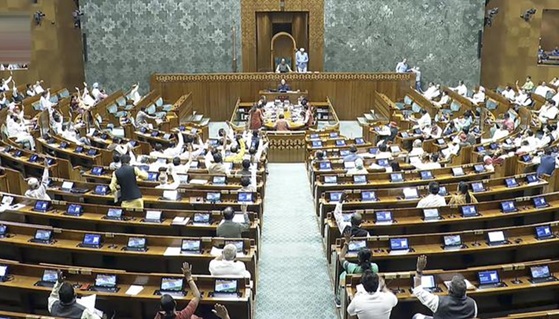
- The Lok Sabha has passed the Andhra Pradesh Reorganisation (Amendment) Bill, 2026, granting statutory status to Amaravati as the sole capital of Andhra Pradesh.
- The move aims to end long-standing uncertainty over the state’s capital, which persisted since bifurcation in 2014.
- The Bill witnessed political opposition, with the YSR Congress Party staging a walkout during the debate.
Background and Context
- The issue of Andhra Pradesh’s capital dates back to the Andhra Pradesh Reorganisation Act (2014), which :
- Bifurcated the state into Telangana and Andhra Pradesh
- Designated Hyderabad as a temporary common capital for 10 years
- After bifurcation :
- Andhra Pradesh required a new permanent capital
- Amaravati was identified as the proposed capital
- However, the issue remained contentious due to :
- The three-capital proposal (2020) :
- Executive: Visakhapatnam
- Legislative: Amaravati
- Judicial: Kurnool
- Legal challenges and political disagreements
- The latest amendment seeks to provide clarity and finality to this prolonged debate.
Key Provisions of the Amendment Bill, 2026
- The Bill amends the 2014 Reorganisation Act to :
- Declare Amaravati as the Sole Capital : Provides legal and statutory recognition to Amaravati
- End Multi-Capital Ambiguity : Overrides earlier decentralisation proposals
- Ensure Administrative Stability : Establishes a single centre of governance
- Respond to State Resolution : Based on a resolution passed by the Andhra Pradesh Legislative Assembly requesting Centre’s approval
About Amaravati: The Proposed Capital
- Amaravati is a greenfield capital city project located on the banks of the Krishna River.
- Key features :
- Developed through an innovative land pooling scheme, with farmers contributing over 33,000 acres of land
- Planned as :
- A sustainable, modern administrative hub
- A city inspired by global capitals with advanced infrastructure
- Core institutions planned :
- Legislative Assembly
- Secretariat
- High Court
Rationale Behind the Bill
1. Need for Administrative Certainty
- A state requires a fixed administrative centre for effective governance.
- Frequent policy shifts created :
- Confusion in administration
- Delays in infrastructure development
2. Investor Confidence and Economic Growth
- The Bill is expected to :
- Restore investor confidence
- Unlock large-scale infrastructure investments (estimated ₹56,000 crore)
- A stable capital is essential for :
- Attracting domestic and foreign investment
- Urban and industrial development
3. Honouring Stakeholder Commitments
- Thousands of farmers contributed land under the land pooling model.
- The decision is seen as :
- Recognising their sacrifice
- Ensuring continuity of the capital project
4. Political and Legal Clarity
- Resolves :
- Policy inconsistencies across successive governments
- Legal disputes over the capital issue
Significance of the Decision
Governance and Administration
- Establishes a clear seat of power, improving :
- Coordination between institutions
- Policy implementation
Federal Structure
- Highlights :
- Role of Parliament in matters linked to state reorganisation
- Interaction between Centre and State in governance decisions
Economic Development
- Expected to :
- Boost infrastructure development
- Generate employment opportunities
- Strengthen regional growth
Urban Planning
- Promotes development of :
- A planned, modern capital city
- Sustainable and smart infrastructure
Concerns and Criticism
1. Regional Imbalance
- Critics argue :
- Concentrating development in one region may neglect others
2. Political Opposition
- Some parties have opposed :
- Central intervention
- Scrapping decentralisation approach
3. Financial Burden
- Development of a greenfield capital requires :
- Massive investment
- Long gestation periods
Core Analysis: Stability vs Decentralisation Debate
Advantages of Single Capital Model
- Administrative efficiency
- Policy clarity
- Investor confidence
Arguments for Decentralisation
- Balanced regional development
- Reduced regional disparities
- Inclusive governance
- The debate reflects a broader question :
- Centralised efficiency vs decentralised equity
Way Forward
Short-Term Measures
- Ensure smooth implementation of the capital project
- Address concerns of different regions
Long-Term Strategy
- Promote balanced regional development alongside Amaravati
- Strengthen infrastructure across all regions
Policy Focus
- Combine:
- Administrative efficiency
- Inclusive development
Practice Questions
Prelims :
Q. Which Act governs the bifurcation of Andhra Pradesh and creation of Telangana ?
(a) States Reorganisation Act, 1956
(b) Andhra Pradesh Reorganisation Act, 2014
(c) Government of India Act, 1935
(d) None of the above
Mains :
“Discuss the significance of declaring Amaravati as the sole capital of Andhra Pradesh in the context of governance and federalism.”
FAQs
1. What does the new Bill state ?
It declares Amaravati as the sole capital of Andhra Pradesh.
2. Why was this needed ?
To resolve long-standing uncertainty over the capital.
3. What was the earlier proposal ?
A three-capital model (executive, legislative, judicial).
4. What is the significance ?
Ensures administrative stability and boosts investment.
5. What is the key concern ?
Risk of regional imbalance in development.
|






 Contact Us
  New Batch : 9555124124/ 7428085757
  Tech Support : 9555124124/ 7428085757