Prelims: State Government Schemes, LPG Subsidy, Direct Benefit Transfer, Social Welfare Schemes, Tamil Nadu
Mains: GS Paper II: Government Policies and Interventions, Welfare Schemes for Vulnerable Sections, Issues Related to Poverty
GS Paper III: Inclusive Growth, Agriculture and Farmers’ Welfare
Keywords: Annapoorani Super Six Scheme, Tamil Nadu, Free LPG Cylinders, LPG Subsidy, Direct Benefit Transfer, DBT, Women Welfare, Household Expenditure, Small Farmers, Social Welfare |
Why in News?
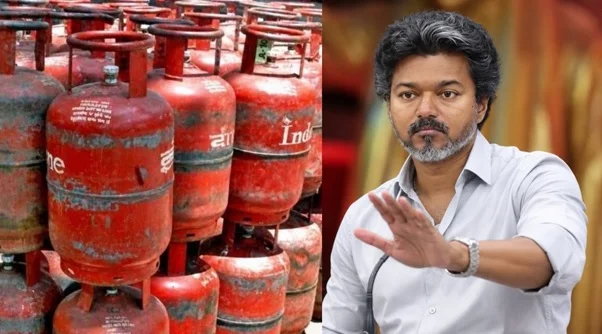
Tamil Nadu Chief Minister C. Vijay Joseph has announced the Annapoorani Super Six Scheme, under which eligible families in the state will receive six free LPG cylinders every year.
Important Point
- The scheme was one of the major welfare promises made during Vijay’s election campaign and is aimed at reducing the financial burden of cooking gas expenditure on households.
- The Tamil Nadu government plans to roll out the scheme after Pongal, by January 2027, with preparatory work already underway.
What is the Annapoorani Super Six Scheme?
The Annapoorani Super Six Scheme is a proposed welfare initiative of the Tamil Nadu government aimed at providing financial support to households for purchasing LPG cylinders.
Under the scheme:
- Eligible families will receive the benefit equivalent to six LPG cylinders every year.
- In the initial phase, the government will provide support for three cooking gas cylinders per family.
- Subsequently, the cost of LPG cylinders will be credited directly into the bank accounts of beneficiaries.
- The scheme is expected to cover around 1.30 crore families across Tamil Nadu.
- The state government proposes to allocate around ₹4,000 crore annually for the scheme.
When Will the Scheme Be Launched?
According to the announcement by the Chief Minister, the Annapoorani LPG Cylinder Scheme is expected to be launched by January 2027, after the Pongal harvest festival. The government has stated that preparatory work for implementation has already begun.
Who Can Avail the Annapoorani Super Six Scheme?
The scheme is intended primarily for economically weaker and vulnerable households.
The proposed beneficiaries include:
- Families with an annual income of around ₹2.5 lakh
- Economically backward families
- Small and medium farmer families
- Families with differently abled members
- Poor and vulnerable households
The detailed eligibility conditions, documentation requirements and application procedure are expected to become clearer once the government issues the formal operational guidelines.
How Will the LPG Benefit Be Provided?
The government plans to use a Direct Benefit Transfer (DBT)-based mechanism.
Expected Process
Eligible Household → LPG Cylinder Purchase → Government Assistance → Amount Credited to Bank Account
- Instead of permanently altering the market price of LPG, the government can reimburse eligible beneficiaries for the cost of the specified number of cylinders.
- This approach can also help in maintaining a digital record of beneficiaries and reducing duplication or leakage in welfare delivery.
Why Has Tamil Nadu Announced the Scheme?
- Reduce Household Expenditure: LPG cylinders form an important part of the monthly expenditure of many families. Providing support for six cylinders annually can reduce this burden.
- Support Economically Weaker Families: The scheme specifically targets poorer households and families with limited annual income.
- Support Farmers: Small and medium farmer families are also proposed to be included among the beneficiaries, extending the scheme beyond purely urban welfare.
- Promote Clean Cooking Fuel: Affordable LPG access can encourage households to continue using cleaner cooking fuel instead of shifting towards traditional biomass fuels such as firewood.
- Women-Centric Welfare Impact: Women often bear a disproportionate burden from the use of traditional cooking fuels. Greater affordability of LPG can therefore have indirect benefits for women’s health, convenience and time use.
Significance of the Scheme
The Annapoorani Super Six Scheme combines social welfare with household energy security.
If implemented effectively, the scheme could:
- Reduce the cost of cooking fuel for vulnerable households
- Improve access to clean cooking energy
- Increase disposable income available for food, education and healthcare
- Provide additional support to small farmer households
- Strengthen the use of DBT-based welfare delivery
With around 1.30 crore families expected to benefit, the scheme could become one of Tamil Nadu’s major household welfare programmes.
Challenges
- Fiscal Burden: An annual allocation of around ₹4,000 crore represents a significant recurring expenditure for the state government.
- Identification of Beneficiaries: The government will need an effective mechanism to identify eligible households and prevent inclusion and exclusion errors.
- DBT and Banking Access: Accurate linking of beneficiary databases, bank accounts and LPG consumer records will be important for smooth implementation.
- Long-Term Sustainability: Since six cylinders are proposed to be supported every year, the scheme creates a recurring fiscal commitment rather than a one-time expenditure.
- Centre-State Coordination: Domestic LPG supply and existing subsidy mechanisms involve central government systems and oil marketing companies. Effective data and administrative coordination could therefore be important.
Annapoorani Scheme and PM Ujjwala Yojana: Key Difference
The two schemes address clean cooking access from different angles.
- Pradhan Mantri Ujjwala Yojana (PMUY) primarily seeks to expand LPG access among eligible poor households by providing LPG connections and associated support.
- The Annapoorani Super Six Scheme, on the other hand, focuses on reducing the recurring cost of LPG consumption by supporting eligible Tamil Nadu families for up to six cylinders annually.
Thus, the broader policy chain can be understood as: LPG Connection → Affordable Refill → Sustained LPG Usage → Clean Cooking Energy
Way Forward
- Tamil Nadu should develop a transparent beneficiary database and clearly define income and socio-economic eligibility criteria before implementation.
- The government should integrate LPG consumer IDs, Aadhaar-linked authentication where legally applicable, and bank accounts to make DBT efficient while ensuring adequate safeguards for privacy and grievance redressal.
- Regular evaluation should also examine whether the scheme is increasing LPG refill frequency and reducing household dependence on traditional cooking fuels.
Prelims MCQ
Q. The Annapoorani Super Six Scheme is associated with which state?
(a) Keralam
(b) Karnataka
(c) Tamil Nadu
(d) Telangana
Mains Practice Question
“Affordable access to clean cooking fuel requires not only LPG connections but also the ability of households to afford regular refills.” Discuss in the context of state-level LPG subsidy schemes in India.
|
FAQs
1. What is the Annapoorani Super Six Scheme?
It is a Tamil Nadu government initiative to provide eligible families with six free LPG cylinders every year.
2. When will the scheme be launched?
The scheme is expected to be launched after Pongal, by January 2027.
3. How many families will benefit from the scheme?
Around 1.30 crore families are expected to benefit.
4. What is the annual allocation for the scheme?
The Tamil Nadu government plans to allocate around ₹4,000 crore annually.
5. Who will be eligible for the scheme?
Low-income, economically weaker, small and medium farmer, differently-abled and poor families are expected to be covered.
|





 Contact Us
  New Batch : 9555124124/ 7428085757
  Tech Support : 9555124124/ 7428085757