Why in the news ?
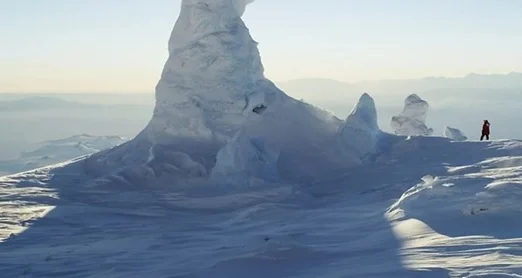
Recently, Mount Erebus, an active volcano in Antarctica, has once again sparked discussion. According to scientists, it is the only known volcano in the world that releases microscopic crystals of pure gold into the atmosphere. It is estimated that this volcano emits microscopic gold particles at a rate of approximately 80 grams per day, with an annual value of over 19 crore rupees.
Key Points
- Mount Erebus is the world's southernmost active volcano.
- It is the only known volcano on Earth that emits microscopic crystals of pure gold.
- Approximately 80 grams of microscopic gold particles are released into the atmosphere every day.
- Gold particles can travel with the wind for approximately 1,000 kilometers.
- Scientists still don't understand how this gold is actually formed and reaches the atmosphere.
What is Mount Erebus ?
- Mount Erebus is an active volcano located on Ross Island in Antarctica.
- It is located near the Ross Sea and approximately 1,350 kilometers from the South Pole.
Its Key Features
- It is the world's southernmost active volcano.
- It contains a permanent lava lake.
- It continuously emits volcanic gases.
How does gold emerge from volcanoes ?
- According to scientists, extremely minute quantities of pure gold crystals are present in the hot volcanic gases emanating from Mount Erebus.
- These particles are in the form of microscopic crystals.
- Their size can be up to 60 micrometers.
- They can travel up to 1000 kilometers with the wind.
- They eventually settle on the ice of Antarctica.
- Studies conducted with an electron microscope revealed that these are not just dust particles, but pure gold particles with a well-organized crystalline structure.
The Scientific Process of Gold Formation
- Scientists believe that volcanic gases contain compounds containing chlorine and sulfur.
- At high temperatures, gold rises with these gases.
- As the gases cool, the gold separates and forms tiny crystals.
- However, this process at Mount Erebus appears different from that at other volcanoes.
Is gold found in other volcanoes ?
- Yes, scientists have found trace amounts of gold in the gases of other active volcanoes, such as :
- Kīlauea (Hawaii)
- Mount Etna (Italy)
- Augustine Volcano (Alaska)
- El Chichón (Mexico)
- But Mount Erebus is the only known volcano to emit crystalline pure gold particles into the atmosphere.
The Mystery Remains
1. Direct Crystallization from Gases
-
According to this theory, chlorine-rich volcanic gases form gold crystals upon cooling. However, due to the extremely low gold content of the gases, this theory remains questionable.
2. Pre-Formed Crystals in the Lava Lake
- According to another theory, microscopic gold crystals first form slowly on the surface of the lava lake and later reach the atmosphere with the gases.
- To date, none of these theories has been conclusively confirmed.
Scientific Importance
- Helps in understanding volcanic geochemistry.
- New information on the process of metal movement within the Earth.
- Useful in studying the chemical composition of volcanic gases.
- Contributes to understanding the natural processes of mineral formation.
Conclusion
Mount Erebus is one of Earth's most unique volcanoes. Its permanent lava lake, continuous gas emissions, and emission of microscopic crystals of pure gold into the atmosphere make it extremely important scientifically. Despite more than three decades of research, the exact process by which this volcano produces and emits gold crystals remains unsolved. This is why Mount Erebus remains a major focus of fascination for researchers in geology and volcanology.







 Contact Us
  New Batch : 9555124124/ 7428085757
  Tech Support : 9555124124/ 7428085757