Prelims : Science & Technology + CA
Mains : GS Paper 3 – Science & Technology, Emerging Technologies, AI |
Why in News ?
Researchers at University of Cambridge have developed a new class of brain-inspired hafnium oxide memristors, which have the potential to drastically reduce the energy consumption of artificial intelligence systems.
This development is particularly significant because energy demand in AI systems is rising exponentially, especially with the growth of large language models, data centres, and high-performance computing, making energy efficiency one of the most pressing challenges in modern technology.
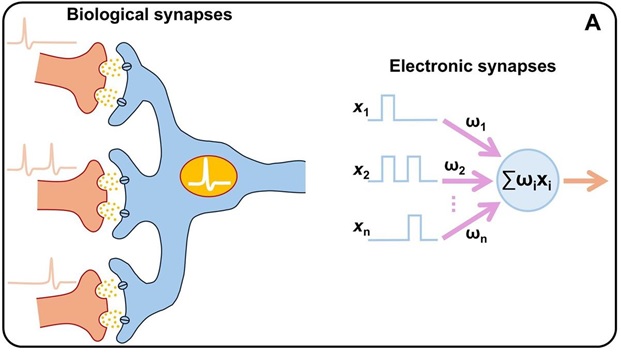
What is a Memristor?
A memristor (memory resistor) is an advanced nanoelectronic device that can simultaneously store data and process information, unlike traditional computing components that separate these two functions.
- In conventional computing systems, data must constantly move between memory units and processors, leading to high energy consumption and slower processing speeds.
- Memristors eliminate this inefficiency by enabling in-memory computing, where storage and computation occur within the same physical unit.
- This architecture is inspired by the human brain, where neurons and synapses perform both storage and processing functions in an integrated manner.
What is Special About Hafnium Oxide Memristors?
The newly developed memristors use hafnium oxide (HfO₂), a material already widely used in semiconductor manufacturing, but with significant structural and functional enhancements.
- Researchers have engineered a multi-layered thin-film structure by introducing additional elements such as strontium and titanium, which enables more precise control over electrical behaviour and improves the device’s responsiveness.
- The device operates using p-n junction-based switching mechanisms, which allow smooth and predictable transitions between different electrical states, unlike earlier designs that relied on random filament formation.
- By eliminating dependence on unstable conductive filaments, the new design achieves greater stability, repeatability, and durability, addressing one of the biggest limitations of previous memristor technologies.
- The material’s compatibility with existing semiconductor processes enhances its potential for integration into current chip manufacturing ecosystems, making it more viable for future commercial applications.
How Does It Work ? (Brain-Inspired Mechanism)
1. Mimicking Biological Synapses
- The memristor behaves similarly to a synapse in the human brain, where the strength of connections between neurons changes based on activity and learning.
- It can replicate mechanisms such as spike-timing dependent plasticity, where the timing and frequency of electrical signals determine how strongly connections are formed or weakened.
- This enables the device to learn from patterns and adapt dynamically, making it highly suitable for artificial intelligence applications.
2. In-Memory Computing Architecture
- Traditional computing systems follow the von Neumann architecture, where memory and processing units are physically separate, resulting in constant data transfer.
- This data movement is energy-intensive and creates a bottleneck known as the “von Neumann bottleneck.”
- Memristors overcome this limitation by :
- Storing data locally
- Processing data within the same unit
- Reducing the need for repeated data transfer
- This results in faster computation, reduced latency, and significantly lower energy consumption, making it ideal for AI workloads.
3. Ultra-Low Energy Operation
- The new memristors operate at extremely low switching currents, which are orders of magnitude lower than conventional semiconductor devices.
- This allows them to perform complex operations with minimal power usage, making them highly efficient for large-scale AI systems that require continuous computation.
Key Features
1. Significant Reduction in Energy Consumption
- One of the most important features of this technology is its ability to reduce energy consumption in AI systems by up to 70%, which can dramatically lower operational costs and environmental impact.
- This is especially relevant for data centres, which are major consumers of electricity globally.
2. High Stability and Reliability
- Unlike earlier memristor designs that suffered from unpredictable behaviour due to filament-based switching, the new design ensures :
- Consistent performance across multiple cycles
- Reduced variability in outputs
- Long-term operational reliability
- This makes the technology more suitable for real-world applications.
3. Multi-Level Data Storage Capability
- The device can support hundreds of distinct conductance states, allowing it to store and process information in an analogue manner rather than binary.
- This is particularly useful for AI systems, which rely on complex weight adjustments in neural networks.
4. Brain-Like Learning and Adaptability
- By mimicking biological learning processes, the memristor can enable AI systems to:
- Learn more efficiently from data
- Adapt to changing inputs
- Perform tasks with greater accuracy and flexibility
- This brings AI closer to human-like cognitive capabilities.
5. Compatibility with Existing Semiconductor Technology
- The use of hafnium oxide ensures that the technology can be integrated with current CMOS fabrication processes, reducing barriers to adoption and facilitating future scalability.
Significance of the Breakthrough
1. Addressing the Energy Challenge in AI
- AI systems, particularly deep learning models, require massive computational power, leading to high energy consumption.
- Memristor-based systems can significantly reduce this burden by enabling energy-efficient computation at scale.
2. Advancing Neuromorphic Computing
- The technology is a major step forward in neuromorphic computing, which seeks to replicate the efficiency and adaptability of the human brain in machines.
- This could fundamentally change how computing systems are designed in the future.
3. Enabling Edge Computing and Decentralised AI
- Low-power operation allows AI capabilities to be deployed on :
- Smartphones and wearable devices
- Internet of Things (IoT) devices
- Remote and resource-constrained environments
- This promotes decentralised and accessible AI systems.
4. Environmental Sustainability
- By reducing energy consumption, this technology can :
- Lower carbon emissions associated with data centres
- Support global sustainability goals
- Reduce the environmental footprint of digital infrastructure
Challenges and Limitations
1. High Manufacturing Temperature
- Current fabrication processes require very high temperatures, which may not be fully compatible with existing large-scale semiconductor production methods.
2. Scalability and Commercialisation Issues
- Although promising, the technology is still at an experimental stage, and scaling it for mass production presents technical and economic challenges.
3. Integration with Existing Computing Systems
- Transitioning from traditional architectures to memristor-based systems will require significant changes in hardware design and software frameworks, which may slow adoption.
Way Forward
1. Improving Manufacturing Techniques
- Research should focus on reducing fabrication complexity and making the process compatible with existing industrial standards.
2. Strengthening Industry-Academia Collaboration
- Partnerships between research institutions and semiconductor companies can accelerate commercialisation and deployment.
3. Developing a Supporting Ecosystem
- Investment in software, algorithms, and system architectures tailored for memristor-based computing is essential for widespread adoption.
Practice Questions
Prelims
Q. Memristors are primarily associated with :
(a) Data storage only
(b) Simultaneous data storage and processing
(c) Optical communication
(d) Quantum encryption
Mains
“Neuromorphic computing using memristors can address the growing energy challenges of artificial intelligence systems.” Discuss.
FAQs
Q1. What is a memristor ?
A device that can store and process data simultaneously.
Q2. Why is it important for AI ?
It improves efficiency and reduces energy consumption.
Q3. What is unique about hafnium oxide memristors ?
They offer high stability and ultra-low power usage.
Q4. What is neuromorphic computing ?
Brain-inspired computing architecture.
Q5. What is the key benefit ?
Significant reduction in AI energy consumption.
|






 Contact Us
  New Batch : 9555124124/ 7428085757
  Tech Support : 9555124124/ 7428085757